
China Has Energy Loan Relationships With 35 African Governments. Aliko Dangote Told You Why.
Ready
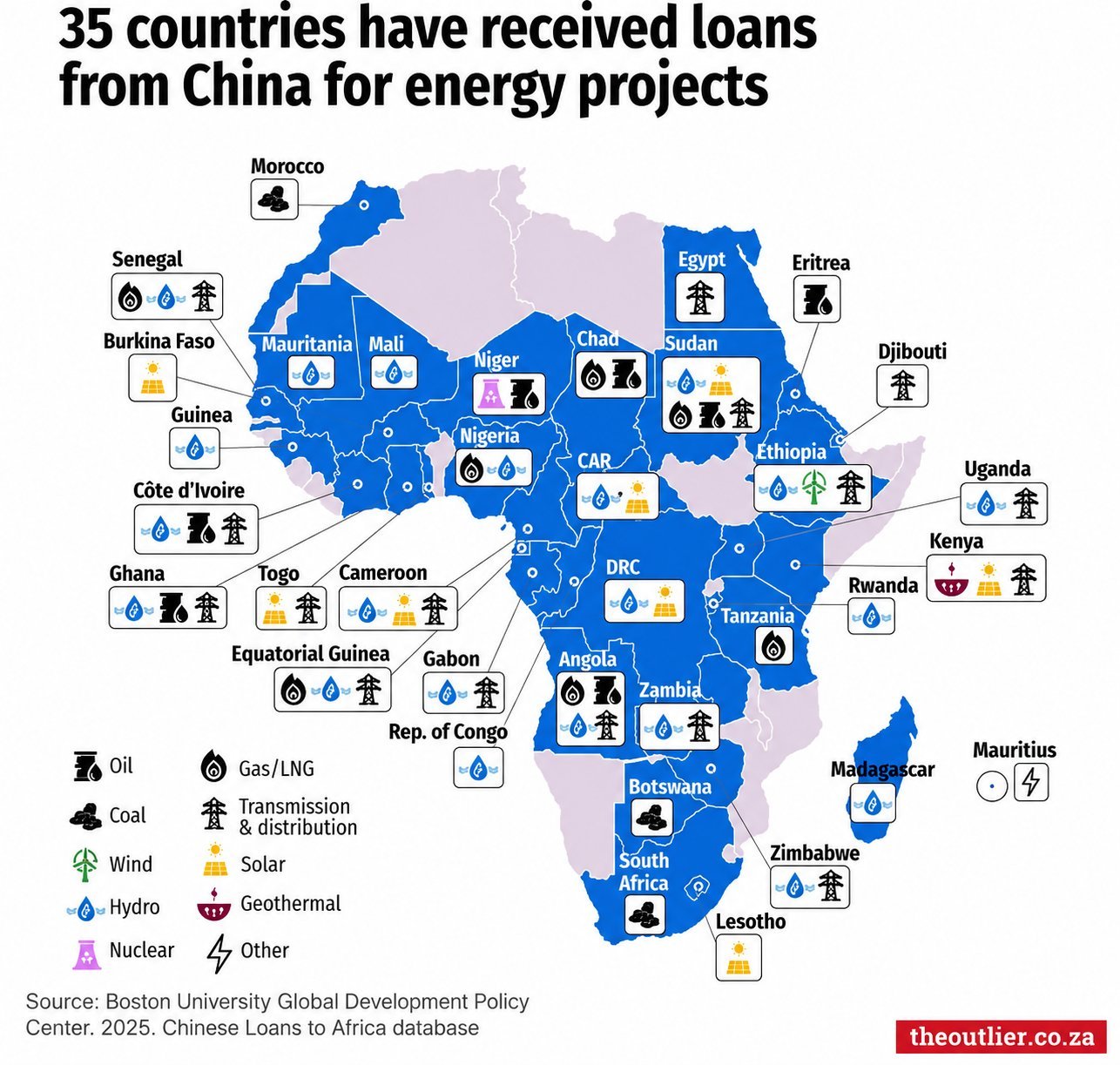
Boston University's Global Development Policy Center's Chinese Loans to Africa database documents 35 African countries that have received Chinese loans for energy projects spanning oil, gas, coal, nuclear, solar, hydro, wind, geothermal, and transmission infrastructure across the full continental geography. The project type distribution follows a deliberate pattern: resource-extracting economies received oil and gas financing, infrastructure-deficit economies received transmission and distribution financing, and every other economy received whatever generation technology the bilateral deal required to get the contract signed. Aliko Dangote's explanation to Norges Bank's Nicolai Tangen of why China dominates African business, because Chinese suppliers backed by Sinosure's USD 1.2 trillion in global deal support offer 20% upfront with five-year financing while European alternatives demand the full cheque before work begins, is the operational mechanism whose 35-country aggregate output the energy map documents. African governments chose Chinese financing not because they were captured but because Chinese capital moved from agreement to construction faster, without the governance conditionality, procurement rule compliance, and policy reform requirements that Western development finance institutions attached to disbursement at slower pace. The debt trap framing misses the procurement reality: 35 sovereign governments made the same financing calculation and reached the same conclusion. Africa needs accountability and electricity. One partner is delivering the electricity. The other is writing the conditions under which it might.China did not win 35 energy financing relationships through diplomatic sophistication alone. It won them because it showed up with money when the alternative was waiting for conditions to be met. That is the lesson the map teaches and the lesson Africa's next generation of resource and energy negotiations must apply on its own terms.
Look at the map carefully.
35 African countries. Oil. Gas. Coal. Nuclear. Solar. Hydro. Wind. Geothermal. Transmission infrastructure. China has financed all of them, across the entire continent, from Morocco to South Africa, in a single generation.
Aliko Dangote, the world's richest Black man and the architect of Africa's most consequential industrial expansion, explained the mechanism to Nicolai Tangen, CEO of Norges Bank Investment Management, in one sentence during their May 2026 In Good Company podcast conversation.
"They put their balance sheet on the table."
This map, sourced from Boston University's Global Development Policy Center's Chinese Loans to Africa database, is what 35 balance sheets on 35 tables looks like in aggregate. It is not a debt trap map. It is not a colonialism map. It is a procurement map. And its lesson is simpler and more important than either the celebration or the alarm whose political register has dominated the Western commentary on Chinese energy financing in Africa.
What the map actually shows
The energy project types are not random. They follow a logic whose consistency across 35 bilateral relationships reveals a deliberate strategy rather than opportunistic deal-making, and reading the map's sectoral distribution country by country produces the pattern whose strategic coherence the aggregate view makes visible.
Resource-extracting economies received oil and gas financing. Nigeria, Angola, Gabon, the Republic of Congo, Chad, and Sudan all show oil and gas project markers on the map. China financed the extraction of commodities it needs, at scale, across the specific geographies where those commodities exist in commercially significant volumes. The financing unlocked the production. The production secured the supply. The loan relationship created the bilateral dependency whose compounding effect over decades is more strategically valuable to Beijing than the interest rate on any individual facility. Angola's oil-backed loan architecture is the most extensively documented case, where Chinese financing collateralised against future oil production created a debt service mechanism whose operation during commodity price downturns transferred the production revenue risk to the debt obligation in ways that subsequent IMF programme negotiations reflected. The terms were commercially consequential. They were also the terms that built the infrastructure whose absence would have left Angola's oil sector underdeveloped at the pace that alternative financing could not match.
Infrastructure-deficit economies received transmission and distribution financing. Ethiopia, Kenya, Tanzania, Uganda, the DRC, and Zambia all show transmission and grid infrastructure markers alongside generation projects. China builds the grid, then holds the relationship with the government that depends on it for the electricity whose generation the Chinese-financed power plant produces and whose distribution the Chinese-financed transmission line enables. The infrastructure is real and its contribution to the economies it serves is measurable in the electrification rates, industrial investment attraction, and energy access improvements whose occurrence followed Chinese energy infrastructure financing across East and Central Africa. The relationship it creates is equally real, embedding Chinese contractors, technical standards, spare parts supply chains, and operational training dependencies into the government's energy infrastructure management in ways whose unwinding cost is substantial enough to make the continuation of the relationship the path of least resistance for the governments whose grid China built.
Everywhere else received whatever the bilateral deal required. Solar in Burkina Faso and Lesotho. Hydro in Mauritania, Guinea, Mali, and Cameroon. Coal in Botswana and South Africa. Nuclear in Niger alongside coal and oil. A mix across Sudan, Ghana, Côte d'Ivoire, and Zambia. The portfolio's diversity reflects not Chinese inconsistency but African diversity: China financed what each country needed to sign the deal, offered the technology mix whose content matched the bilateral negotiation's specific parameters, and signed 35 deals whose aggregate effect is the continental energy financing relationship whose geographic comprehensiveness no Western partner, bilateral or multilateral, has approached.
What Dangote's observation explains about the procurement mathematics
Dangote did not say China is better than Europe or America in any categorical sense. He said China puts its balance sheet on the table while the others historically have not done so at equivalent scale and on equivalent terms, and that difference determines who gets the contract when the borrower is choosing between available financing options rather than between theoretical alternatives.
He made it concrete with a specific comparison. For a power plant project, Italian suppliers demanded a USD 500 million cheque upfront whose payment would have exhausted the operational cash that Dangote Group needed to continue building everything else simultaneously. Chinese suppliers, backed by Sinosure whose support for global commercial transactions exceeds USD 1.2 trillion according to its published records, offered 20% upfront with five-year financing for the remaining 80%. The arithmetic is not complicated. The 20% option lets you build the power plant and five other projects simultaneously. The full payment option lets you build the power plant and stops you building anything else until the cash regenerates. You take the Chinese option not because of ideology but because the alternative is slower and more expensive in operational cash terms.
The 35-country energy map is the aggregate outcome of 35 governments making the same procurement decision Dangote described from his industrial experience. Each government needed energy infrastructure whose absence was constraining economic activity, industrial investment, and household living standards in ways that were immediate, visible, and politically consequential. Each government evaluated the available financing options. Each government found that Chinese capital, on Chinese terms, with Chinese contractors, was the option that moved fastest from agreement to construction without the preconditions whose satisfaction delayed the infrastructure whose need the population was experiencing daily.
What less conditionality actually means for African borrowers
The Western framing of Chinese energy financing as debt trap diplomacy has dominated the commentary for a decade without significantly changing the financing decision that African governments make when energy infrastructure needs to be built and the available options are evaluated on their operational merits.
African governments are not naive signatories. They are sovereign states making financing decisions within the constraint set that available capital sources impose, and their consistent preference for Chinese financing across 35 countries and multiple commodity cycles reflects a rational assessment of the options rather than the geopolitical manipulation that the debt trap narrative implies. Chinese financing typically moves from agreement to disbursement to construction faster than multilateral alternatives whose appraisal, environmental assessment, procurement compliance, and policy reform conditionality timelines can extend the gap between a government's energy infrastructure need and the facility's first generation of electricity by years whose passage the population's energy deficit does not wait for. It does not require the governance reforms whose implementation the borrowing government may be genuinely committed to but whose pace is slower than the energy demand whose urgency the financing is supposed to address. It finances the project the borrower wants, in the technology category the borrower's energy mix requires, at the contractor selection terms the borrower's procurement system can accommodate, rather than the project the lender's development priorities prefer at the procurement terms whose compliance the lender's institutional rules require.
That is not an argument that Chinese loan terms are uniformly superior or that conditionality is without developmental value. The governance reforms that Western development finance conditions are designed to produce have genuine long-run developmental merit whose realisation improves the institutional environment within which energy infrastructure investment produces the maximum economic return. The collateralisation terms that resource-backed Chinese loans embed create commodity revenue risks whose consequence during price downturns is severe enough that governments with access to better-structured alternatives should evaluate them carefully. The interest rates whose level on some Chinese commercial lending exceeds concessional financing from multilateral sources imposes a fiscal burden whose accumulation across multiple facilities can constrain the fiscal flexibility that the energy infrastructure was supposed to enable.
But the map exists because 35 African governments decided across 35 separate bilateral negotiations that available financing with manageable conditions was more useful than unavailable financing with conditions they could not meet at the pace the energy deficit required. That is a rational calculation whose aggregate output is the continental energy financing relationship whose geographic comprehensiveness this map documents and whose strategic implication both the Chinese government and the Western governments watching it accumulate understand with full clarity.
The East African dimension and what it means for the region's energy future
For East Africa specifically, the map's pattern is directly relevant to the energy architecture whose development is reshaping the region's industrial investment case. Tanzania shows gas and LNG financing whose complement to the USD 42 billion LNG project negotiations with Equinor, ExxonMobil, and Shell creates the energy sector context within which Chinese and Western energy capital are simultaneously present at different stages of the same country's energy development trajectory. Kenya shows geothermal, solar, and transmission financing whose Chinese-built grid infrastructure coexists with the Kenya Power floating barge announcement whose planning gap the Chinese-financed transmission network's existence makes more puzzling rather than less. Ethiopia shows hydro, wind, and transmission whose Chinese-financed Grand Ethiopian Renaissance Dam and associated grid infrastructure created the electricity surplus whose export to Kenya and Djibouti through the interconnection that Chinese financing also supported is the regional energy trade whose commercial logic the map's interconnection financing markers reflect.
Uganda's transmission financing and Rwanda's hydro markers complete the East African picture whose pattern confirms that Chinese energy financing across the region has been comprehensive in geography and diverse in technology, creating the baseline energy infrastructure whose complement is the regional energy trade, industrial investment, and manufacturing development that East Africa's economic transformation requires at the scale whose ambition the infrastructure investment is designed to enable.
The moment's strategic significance is that East Africa is now simultaneously engaging Chinese energy financing relationships, Western LNG and critical minerals partnerships, Gulf sovereign wealth fund investment interest, and Indian pharmaceutical and trade relationships in the multipolar configuration whose leverage depends on managing the Chinese energy financing relationship's terms alongside rather than instead of the Western, Gulf, and Indian relationships whose simultaneous cultivation is the transactional multi-alignment that sophisticated East African governments are beginning to execute.
The lesson whose application is the actual test
Dangote is planning to spend USD 45 billion across Africa by 2030 in refining, fertiliser, petrochemicals, and industrial infrastructure. He said he will lean toward Chinese financing because it lets him do more, build more facilities, serve more markets, and reach the industrial scale whose commercial logic his expansion plan requires. 35 African governments reached the same conclusion about their energy infrastructure across the decade whose financing decisions the Boston University map documents.
The Western response to the map has been primarily analytical: debt trap warnings, governance condition advocacy, and the development finance instrument design whose improvement is designed to make Western capital more competitive with Chinese alternatives at the margins. The US Development Finance Corporation's USD 28 billion deployment mandate, whose hunger for African infrastructure Dangote described from his own recent meetings, represents the most significant Western institutional response to the financing competition whose outcome this map displays. If the DFC matches Chinese financing terms in speed, conditionality flexibility, and contractor selection openness, the competition it creates improves the terms available to African borrowers whose negotiating position improves when multiple capital sources compete for the same infrastructure transactions.
Africa needs both accountability and electricity. The accountability that well-designed conditionality promotes improves the institutional environment within which electricity infrastructure serves its developmental purpose. The electricity that Chinese financing built serves the households, factories, and hospitals whose daily energy access the institutional quality debate does not replace.
Right now, one partner built 35 energy relationships across the continent. The other is still refining the conditions under which it might build more.
Africa did not choose China. Africa chose the financing that showed up, moved fast, and built things. China happened to be the one offering it at scale, on terms that African governments could accept without waiting for institutional reforms whose completion the energy deficit's urgency did not permit. The lesson for Western partners is not that Africa is naive or captured. It is that electricity does not wait for conditionality, and that the partner who understands that will continue building the map that the one who does not will continue analysing.
FAQ
What does the Boston University map show? Boston University's Global Development Policy Center's Chinese Loans to Africa database documents 35 African countries that have received Chinese loans for energy projects spanning oil, gas, coal, nuclear, solar, hydro, wind, geothermal, and transmission and distribution infrastructure. The map's geographic coverage from Morocco to South Africa and its sectoral comprehensiveness across every major energy technology category makes it the most complete available documentation of Chinese energy financing's continental reach across a single generation of lending.
Why does the map's project type distribution follow a pattern? Because the financing reflects a deliberate strategy rather than opportunistic deal-making. Resource-extracting economies received oil and gas financing that secured Chinese commodity supply while creating bilateral dependency. Infrastructure-deficit economies received transmission and grid financing that built Chinese contractor relationships into governments' operational dependency. Every other economy received the technology mix whose content the bilateral negotiation required to sign the deal. The portfolio's diversity across 35 countries reflects African diversity and Chinese adaptability rather than inconsistency.
What did Dangote say that explains the map? In a May 2026 podcast with Norges Bank's Nicolai Tangen, Dangote said China dominates African business because it puts its balance sheet on the table while Western partners do not at equivalent scale and terms. He made it concrete: Chinese suppliers backed by Sinosure offer 20% upfront with five-year financing for the balance, while European suppliers demanded full upfront payment that exhausted operational cash. The 35-country energy map is the aggregate outcome of 35 governments making the same procurement calculation.
Does less conditionality mean Chinese loans are better for Africa? Not categorically. Chinese financing moves faster, attaches fewer governance preconditions, and accommodates Chinese contractors whose exclusion Western procurement rules require. Those characteristics make it operationally attractive for governments whose energy deficit urgency cannot wait for conditionality timelines. But collateralisation against future commodity production transfers revenue risk to debt service in ways that price downturns make severe, and some Chinese commercial lending interest rates exceed concessional multilateral alternatives. The borrower's rational calculation weighs available financing with manageable conditions against unavailable financing with superior terms, and 35 governments chose availability.
What should Western partners do differently? Match the financing where it matters most: speed from agreement to disbursement, flexibility in contractor selection, and conditionality whose sequencing allows construction to begin while governance reforms proceed rather than requiring governance reforms to complete before construction begins. The US Development Finance Corporation's USD 28 billion deployment mandate, whose hunger for African infrastructure Dangote described from recent meetings, represents the most significant institutional response. If DFC matches Chinese terms in operational speed and conditionality flexibility, the competition it creates improves the terms available to African borrowers. Africa needs both accountability and electricity. The partner that delivers both will win the relationships that the 35-country map currently shows China holding alone.
 Uchumi360
Business Intelligence
Uchumi360
Business Intelligence
- Boston University Global Development Policy Center, Chinese Loans to Africa database, 2025
- 35-country energy loan map, project type distribution, and bilateral financing documentation
- Available at bu.edu/gdp
- Aliko Dangote, interview with Nicolai Tangen, CEO Norges Bank Investment Management, In Good Company podcast, May 2026
- All direct quotations cited from this interview
- Available at Norges Bank Investment Management YouTube channel
- Sinosure, China Export and Credit Insurance Corporation
- USD 1.2 trillion global deal support figure
- Available at sinosure.com.cn
- AidData, China's Global Development Finance
- Chinese bilateral infrastructure and energy financing in Africa
- Available at aiddata.org
- US International Development Finance Corporation, USD 28 billion deployment mandate documentation
- Available at dfc.gov
- IMF, Angola oil-backed loan and debt restructuring documentation
- Available at imf.org
- Ethiopian Electric Power, Grand Ethiopian Renaissance Dam and interconnection export documentation
- Available at eep.com.et
- Kenya Power and Lighting Company, grid infrastructure and Chinese financing documentation
- Available at kplc.co.ke
- Tanzania Petroleum Development Corporation, LNG project and gas financing documentation
- Available at tpdc.go.tz
- Standard Chartered Bank, SGR financing announcement, 28 April 2026
- Available at sc.com
- Uganda Electricity Transmission Company, Chinese transmission financing documentation
- Available at uetcl.com
- Rwanda Energy Group, hydro and grid financing documentation
- Available at reg.rw
- DRC Société Nationale d'Electricité, Chinese energy financing documentation
- Available at snel.cd
- Zambia Statistics Agency, energy financing and grid infrastructure data
- Available at zamstats.gov.zm
- World Bank, African energy access and infrastructure deficit data
- Available at worldbank.org
- African Development Bank, African energy financing gap research
- Available at afdb.org
- State House United Republic of Tanzania, Dangote-Samia meeting, USD 17 billion refinery discussions, 16 May 2026
Uchumi360 covers business, investment, and economic policy across East, Central, and Southern Africa.
For the serious reader
You read to the end. That places you in a small group.
Uchumi360 is built for readers who demand precision over speed, structure over sentiment, and analysis that holds uncomfortable conclusions rather than softening them. If this work sharpens how you think about Africa's economy, help us keep building the infrastructure behind it.
Institutional Partners
Commission intelligence. Shape the conversation.
Uchumi360 works with development finance institutions, investment firms, sovereign bodies, and strategic organisations across the coverage region. Institutional partnership unlocks:
- Commissioned sector and country intelligence reports
- Branded research series under your institution's authority
- Exclusive data briefings for internal strategy teams
- Speaking and editorial presence at Uchumi360 events
- Co-published investment outlooks for your markets
Support Our Work
Independent analysis has a cost. Help us bear it.
Uchumi360 does not carry advertising. It does not take editorial direction from sponsors. Every article is produced without commercial compromise. Your contribution funds the reporting, research, and editorial infrastructure that keeps this analysis free from influence.
Secure checkout: One-time and monthly support are processed securely.
Stay Connected
Keep up with every new insight.
Follow our latest analysis, policy coverage, and market intelligence as soon as it is published. If you need something specific, reach out directly and we will point you to the right research.
