
Ethiopia's USD 2.8 Billion Koysha Dam Will Add 2,200MW to the Grid. With GERD and Gibe III, Ethiopia Is Becoming Africa's Largest Electricity Exporter.
Ready
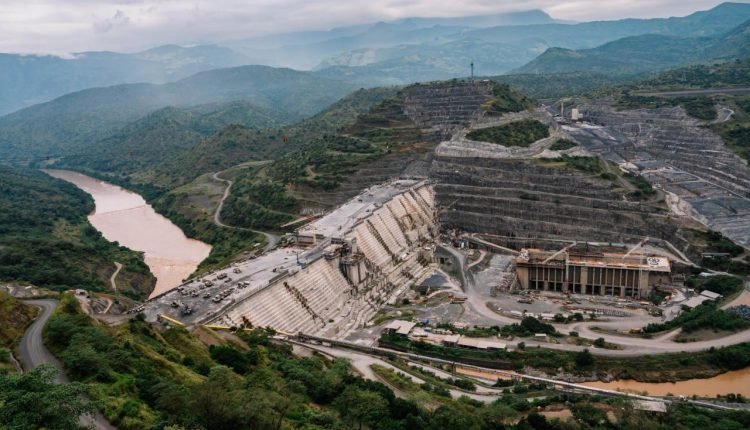
Ethiopia's USD 2.8 billion Koysha Hydroelectric Project on the Omo River will generate 2,200 megawatts through eight 270-megawatt Francis turbines fed by a 170-metre roller-compacted concrete dam with a nine billion cubic metre reservoir. Annual generation will reach approximately 6,460 gigawatt-hours. Koysha is the fourth dam in the Omo River cascade following Gilgel Gibe I, II, and III, built by Webuild, the same contractor responsible for Gibe III and GERD. Combined with the 5,150-megawatt GERD and the 1,870-megawatt Gibe III, Koysha's completion would place Ethiopia among Africa's largest electricity producers. Ethiopia already exports power to Kenya, Sudan, and Djibouti, with additional East African interconnection projects expanding. The strategic objective is to create electricity surplus for export, doing with hydropower what Qatar did with natural gas: building a long-term foreign exchange earning export sector while supporting domestic industrialisation. As East Africa's manufacturing, mining, logistics, and urban infrastructure investment accelerates demand for power, Ethiopia's generation surplus positions it as the region's energy supplier of first resort. Ethiopia is not building dams. It is building an energy export industry. Koysha is the latest instalment in a decades-long strategy whose payoff, abundant cheap electricity flowing to East Africa's fastest-growing economies, is close enough now to see from the construction site.
ADDIS ABABA — Ethiopia's USD 2.8 billion Koysha Hydroelectric Project on the Omo River is not another infrastructure investment in a country that has become known for building large things. It is the latest instalment in one of the most deliberate long-term economic strategies on the African continent: a multi-decade campaign to transform Ethiopia into Africa's dominant electricity producer and the region's primary energy exporter.
Located in southwestern Ethiopia, the 2,200-megawatt Koysha project is the fourth major dam in the Omo River cascade following Gilgel Gibe I, Gilgel Gibe II, and Gibe III. When completed, it will generate approximately 6,460 gigawatt-hours of electricity annually, making it one of the largest hydropower facilities on the continent by output. The project is being developed by Ethiopian Electric Power and constructed by Webuild, formerly Salini Impregilo, the Italian engineering firm that built Gibe III and the Grand Ethiopian Renaissance Dam on the Blue Nile. At full capacity, Koysha will feature eight 270-megawatt Francis turbines fed by a 170-metre roller-compacted concrete dam with a reservoir capable of storing approximately nine billion cubic metres of water, linked to the national grid through new transmission infrastructure connecting to Gibe III.
The technical specifications are impressive. The strategic context is more important.
The energy state Ethiopia is building
For more than two decades, while other African resource economies focused on oil, gas, or mineral exports, Ethiopia pursued a different resource strategy. It placed electricity at the centre of its long-term development plan and began systematically building the hydropower portfolio whose scale, once assembled, would make the country's energy position on the continent structurally distinctive.
The portfolio is now large enough to make the strategy legible. The Grand Ethiopian Renaissance Dam on the Blue Nile, at 5,150 megawatts the largest hydropower project in Africa, is in advanced operational stages. Gibe III at 1,870 megawatts is operational. Gilgel Gibe I and II are operational. Koysha at 2,200 megawatts is under construction. The combined generation capacity of these projects alone, exceeding 11,000 megawatts from a single country, positions Ethiopia among Africa's largest electricity producers when Koysha and GERD reach full operational output.
The objective running through every project in the portfolio is not simply to meet domestic demand, though closing Ethiopia's own electricity access gap is a genuine and pressing priority for a country of 125 million people where a significant share of the population remains without reliable grid connection. The objective beyond domestic supply is to create surplus power for export at the scale that constitutes an industry rather than an incidental bilateral arrangement.
Ethiopia already exports electricity to Kenya, Sudan, and Djibouti. Additional interconnection projects targeting East African markets are under development. The trajectory is deliberate and the direction is consistent: building generation capacity that exceeds domestic absorption at the pace of industrialisation and exporting the surplus to neighbours whose own generation capacity has not kept pace with their economic growth.
The Qatar comparison that frames the strategy honestly
The most clarifying way to understand what Ethiopia is attempting with its electricity generation programme is the comparison to Qatar's natural gas strategy, not because the resources or the geopolitics are similar, but because the economic logic is identical.
Qatar identified a natural resource whose global demand was growing, invested in the production and export infrastructure required to supply that demand at scale, and built the foreign exchange earnings base that has made a small country into a globally significant economic actor whose sovereign wealth fund and diplomatic influence are disproportionate to its population. The strategy was not reactive to market signals. It was a deliberate construction of a market position over decades of consistent investment.
Ethiopia is attempting the same logic with hydroelectricity. Identify a resource, in this case the water of the Blue Nile, the Omo River, the Awash River, and the other river systems whose combined hydropower potential is among the largest on the continent. Invest in production infrastructure at a scale that creates genuine export surplus. Build the transmission interconnections that turn bilateral power sales into a regional energy market. Collect the foreign exchange earnings that flow from being the supplier of electricity to the industrialising economies of East Africa whose manufacturing, mining, logistics, and urban infrastructure development requires exactly the reliable and affordable power that Ethiopian hydroelectricity can provide.
The comparison is not flattering in every dimension. Qatar's gas strategy benefited from a simpler supply chain than hydropower's transmission-dependent model, and Ethiopia's geopolitical environment along the Nile is considerably more complex than Qatar's offshore gas fields. But the economic logic, create an export sector from a natural resource endowment and use the earnings to fund domestic industrialisation, is the same.
Why East Africa's electricity demand makes Ethiopia's timing well-chosen
The commercial case for Ethiopia's energy export strategy has strengthened materially over the past three years as East Africa's industrialisation acceleration has increased the region's electricity demand at a pace that domestic generation in most countries has not matched.
Tanzania's one-factory-per-day manufacturing investment pace, documented through TISEZA Director General Gilead Teri's confirmed data of over 900 project approvals in 2025, means new electricity demand is being created in Tanzania at a rate that the Julius Nyerere Hydropower Project's 2,115 megawatts is absorbing but not indefinitely surplus to. Rwanda's record Rwf 7.8 trillion 2026/27 budget is weighted toward infrastructure whose construction and operation require electricity. Uganda's oil production beginning, Kiira Motors' electric bus manufacturing, and the Kampala-Jinja Expressway's development are all generating industrial electricity demand. Kenya's fiscal constraints have slowed its own generation investment. South Sudan's electricity infrastructure is limited relative to its development needs.
Across the region, the demand for reliable, affordable, and expandable electricity is growing faster than most countries' domestic generation investment can satisfy. Ethiopia's surplus generation is positioned to supply exactly this demand at the moment when the East African Power Pool's interconnection infrastructure is sufficiently developed to make regional electricity trade commercially operational rather than aspirationally planned.
The countries that solve their electricity supply constraints first gain the manufacturing competitiveness, the mining investment attraction, and the data centre and digital infrastructure development that reliable power enables. Ethiopia's strategy is to be the solver of other countries' electricity constraints, capturing the export earnings that position generates while simultaneously using the revenue to fund its own industrial development.
Koysha within the broader energy geography shift
Koysha is also part of a broader shift underway across Africa whose direction is reshaping the continent's economic geography in ways that will compound over the coming decade.
For decades, Africa's economic geography was shaped primarily by ports, mineral deposits, and oil fields. The countries with the most valuable natural resource endowments and the best access to shipping routes dominated the foreign investment attraction and the export earnings that funded development. Infrastructure investment followed resource extraction.
Increasingly, the continent's economic geography is being shaped by energy infrastructure. The countries building the largest generation assets are not simply meeting domestic demand. They are positioning themselves as the industrial anchors of tomorrow, the places where manufacturing investment locates because reliable electricity is available at scale, where data centres operate because power costs are competitive, and where mining operations expand because the energy inputs their processing requires are accessible.
Ethiopia with its hydropower cascade, Kenya with its geothermal development, Tanzania with the Julius Nyerere Hydropower Project and its offshore gas reserves, and Morocco with its solar ambitions are each assembling energy positions that will determine their industrial competitiveness over the next two decades at least as much as their current GDP size or their position in global commodity markets.
Koysha's 2,200 megawatts adds materially to Ethiopia's position in this emerging energy geography. Its completion, alongside GERD's full operational output, would make Ethiopia's electricity surplus large enough to supply multiple neighbouring countries simultaneously rather than choosing among them. That scale is what distinguishes a bilateral power export arrangement from an energy export industry.
The race for Africa's industrial future
The broader argument that Koysha represents is one that the development economics literature has been making for decades and that the East African infrastructure investment data of 2025 and 2026 is now confirming empirically: energy availability is the binding constraint on African industrialisation, and the countries that solve it first gain a structural advantage in the competition for manufacturing investment, technology transfer, and the formal employment whose creation is the mechanism through which economic growth translates into improved living standards at scale.
Countries that continue to face power deficits will struggle to industrialise regardless of the quality of their investment codes, their ease of doing business rankings, or the ambition of their development plans. Manufacturing investors, mining operators, and logistics businesses all make location decisions that place electricity reliability and cost near the top of their evaluation criteria, alongside the governance quality and market access factors that dominate the official investment promotion narratives.
Ethiopia's hydropower strategy is a direct response to this reality. Building generation capacity that creates genuine surplus rather than simply matching projected demand is the only approach that removes electricity constraints from the investment decision entirely rather than managing them. Koysha's 2,200 megawatts, contributing to a national portfolio that will exceed 11,000 megawatts of large-scale hydro alone at full buildout, represents the scale at which energy abundance becomes a competitive positioning tool rather than a development aspiration.
The race for Africa's industrial future will not be won by the countries with the most resources in the ground. It will be won by the countries with the power to turn those resources into production. Ethiopia is building that power, one dam at a time, at a scale and consistency whose strategic logic the Koysha project makes unmistakably clear.
FAQ
What is the Koysha Hydroelectric Project? The Koysha Hydroelectric Project is a USD 2.8 billion hydropower facility under construction on the Omo River in southwestern Ethiopia. Developed by Ethiopian Electric Power and built by Webuild, it will generate 2,200 megawatts through eight 270-megawatt Francis turbines and produce approximately 6,460 gigawatt-hours of electricity annually. It is the fourth major dam in the Omo River cascade following Gilgel Gibe I, II, and III.
How does Koysha fit into Ethiopia's broader energy strategy? Koysha is part of Ethiopia's multi-decade strategy to become Africa's largest electricity producer and exporter. Combined with the 5,150-megawatt Grand Ethiopian Renaissance Dam on the Blue Nile and the 1,870-megawatt Gibe III, Koysha's completion would place Ethiopia's large-scale hydropower portfolio above 11,000 megawatts, creating the generation surplus required for large-scale electricity export to East African neighbours.
Which countries does Ethiopia export electricity to? Ethiopia currently exports power to Kenya, Sudan, and Djibouti. Additional East African Power Pool interconnection projects targeting Tanzania, Uganda, Rwanda, and South Sudan are under development, expanding the regional market as East Africa's industrialisation accelerates electricity demand faster than most countries' domestic generation investment can satisfy.
Why is Ethiopia compared to Qatar in the article? The comparison is to Qatar's natural gas export strategy rather than to Qatar's political or social model. Qatar identified a natural resource with growing global demand, invested in production and export infrastructure at scale, and built a long-term foreign exchange earnings base whose returns funded domestic development. Ethiopia is applying identical economic logic to hydroelectricity: building generation capacity that creates genuine export surplus, developing the transmission interconnections that turn bilateral sales into a regional energy market, and using the resulting earnings to fund domestic industrialisation.
What does Koysha mean for East African industrial investment? Electricity availability is the binding constraint on African industrialisation, and manufacturing investors, mining operators, and logistics businesses all prioritise electricity reliability and cost in their location decisions. Ethiopia's growing generation surplus removes electricity constraints from the investment decision for East African economies that access it, making the region more competitive for manufacturing investment. Tanzania, Uganda, Kenya, and Rwanda are all experiencing electricity demand growth from accelerating industrial investment whose supply Ethiopia's export surplus is positioned to serve.
 Uchumi360
Business Intelligence
Uchumi360
Business Intelligence
- Ethiopian Electric Power, Koysha Hydroelectric Project documentation
- USD 2.8 billion, 2,200 megawatts, eight 270-megawatt Francis turbines, 170-metre dam, nine billion cubic metre reservoir, 6,460 GWh annual generation
- Available at eep.gov.et
- Webuild Group, Koysha project construction documentation
- Formerly Salini Impregilo, contractor for Koysha, Gibe III, and GERD
- Available at webuildgroup.com
- Ethiopian Electric Power, Grand Ethiopian Renaissance Dam operational data
- 5,150 megawatts
- Available at eep.gov.et
- Ethiopian Electric Power, Gibe III operational data
- 1,870 megawatts
- Available at eep.gov.et
- East African Power Pool, regional electricity interconnection and trade documentation
- Available at eappool.org
- Gilead Teri, Director General TISEZA, Divya Briefing podcast, May 2026
- Tanzania one factory per day manufacturing investment pace and electricity demand context
- Tanzania Electric Supply Company, Julius Nyerere Hydropower Project 2,115 megawatt operational data
- Available at tanesco.co.tz
- Rwanda Ministry of Finance, 2026/27 budget Rwf 7.8 trillion infrastructure allocation
- Available at minecofin.gov.rw
- Kenya National Bureau of Statistics, Kenya electricity generation and demand data
- Available at knbs.or.ke
- African Development Bank, East Africa energy investment and demand research
- Available at afdb.org
- World Bank, Ethiopia energy sector and hydropower development data
- Available at worldbank.org
- International Energy Agency, Africa energy outlook and East Africa electricity demand projections
- Available at iea.org
- Uganda Bureau of Statistics, Uganda electricity demand and industrial development context
- Available at ubos.org
Uchumi360 covers business, investment, and economic policy across East, Central, and Southern Africa.
For the serious reader
You read to the end. That places you in a small group.
Uchumi360 is built for readers who demand precision over speed, structure over sentiment, and analysis that holds uncomfortable conclusions rather than softening them. If this work sharpens how you think about Africa's economy, help us keep building the infrastructure behind it.
Institutional Partners
Commission intelligence. Shape the conversation.
Uchumi360 works with development finance institutions, investment firms, sovereign bodies, and strategic organisations across the coverage region. Institutional partnership unlocks:
- Commissioned sector and country intelligence reports
- Branded research series under your institution's authority
- Exclusive data briefings for internal strategy teams
- Speaking and editorial presence at Uchumi360 events
- Co-published investment outlooks for your markets
Support Our Work
Independent analysis has a cost. Help us bear it.
Uchumi360 does not carry advertising. It does not take editorial direction from sponsors. Every article is produced without commercial compromise. Your contribution funds the reporting, research, and editorial infrastructure that keeps this analysis free from influence.
Secure checkout: One-time and monthly support are processed securely. Add payment credentials to enable checkout here.
Stay Connected
Keep up with every new insight.
Follow our latest analysis, policy coverage, and market intelligence as soon as it is published. If you need something specific, reach out directly and we will point you to the right research.
