
Tanzania and Angola Plan Two Ocean Railway, but TAZARA Carries Barely 2% of Its Design Capacity
Ready
Tanzania and Angola want to connect the Atlantic and Indian oceans by rail through Zambia and the Democratic Republic of Congo, potentially linking the Lobito Corridor with TAZARA and giving the Copperbelt competing routes to Dar es Salaam and Lobito. Billions of dollars are already committed to the surrounding infrastructure, including a $1.4 billion TAZARA rehabilitation, $753 million for the Lobito Atlantic Railway and a new Zambia Lobito railway now moving through procurement. The economic logic is compelling, but a functioning coast to coast freight network will require rehabilitation of weak existing railways, new construction, sufficient freight in both directions, interoperable operating standards and coordination among four governments and multiple concessionaires.
Tanzania and Angola want to create something African governments have discussed for generations but rarely managed to make commercially functional: a railway system stretching from the Atlantic Ocean to the Indian Ocean through the mineral-producing regions of the Democratic Republic of Congo and Zambia. The proposal would connect Angola’s Benguela Railway and the wider Lobito Corridor on the Atlantic coast with the Tanzania-Zambia Railway, TAZARA, which terminates at Dar es Salaam, potentially giving the Copperbelt access to two competing ocean gateways on opposite sides of the continent.
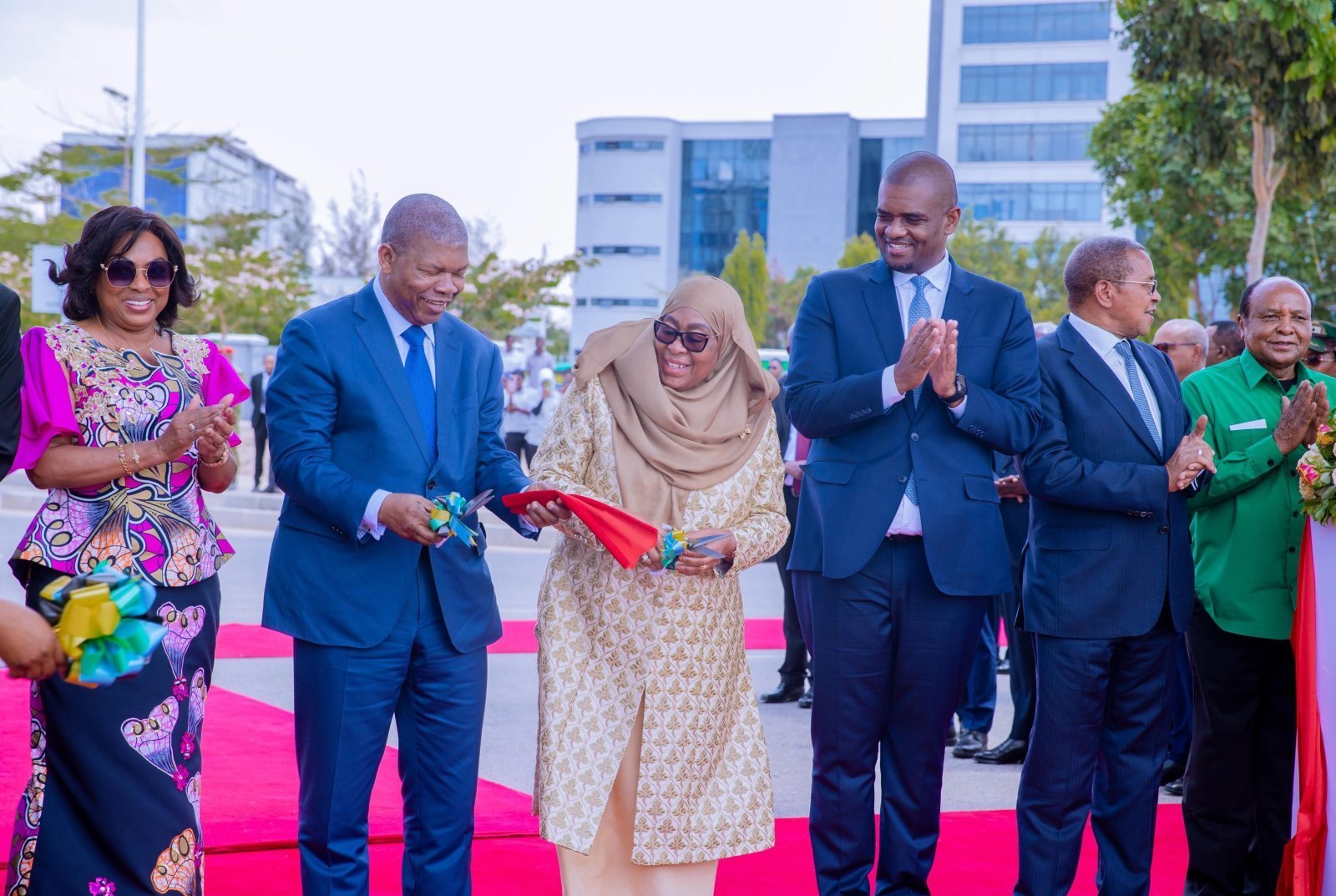
President Samia Suluhu Hassan announced the ambition following talks with Angolan President João Lourenço during his state visit to Tanzania at the end of October. The strategic logic is clear, but the announcement remains far from a bankable railway project because no construction timetable, total cost, financing structure or final alignment for the missing connections has been published. Much of the infrastructure required to make the concept possible already exists or is now receiving billions of dollars in rehabilitation and expansion investment, but converting those separate projects into one commercially functioning railway across four sovereign states will require considerably more than joining lines on a map.
On the eastern side, China Civil Engineering Construction Corporation is preparing to invest about $1.4 billion in the rehabilitation and operation of TAZARA under a long-term concession involving Tanzania, Zambia and China. On the western side, the Lobito Atlantic Railway has reached financial close on $753 million of financing for rehabilitation and long-term operation of the approximately 1,300-kilometre railway running from the Port of Lobito across Angola to the DRC border. Between those systems, Africa Finance Corporation is developing the Zambia Lobito Railway, an approximately 830 kilometre greenfield project intended to connect northwestern Zambia with the Angolan railway network.
If these investments are completed and made operationally compatible, Zambia and southern DRC would eventually sit between two major railway routes to the sea. Copper, cobalt and other minerals could move west through Lobito toward Atlantic markets or east through TAZARA toward Dar es Salaam and the Indian Ocean, while fuel, fertiliser, machinery, containers and other imports could move in the opposite direction. The economic significance, therefore, lies less in the symbolism of a train travelling from one ocean to another than in the possibility of creating competing freight routes for one of the world’s most important mineral-producing regions.
The Missing Railway Is Only One Part of the Problem
Much of the discussion surrounding the Tanzania and Angola announcement can make the project appear as though two functioning railway systems merely need to be connected. The physical network is more complicated. TAZARA runs approximately 1,860 kilometres from Dar es Salaam to New Kapiri Mposhi in Zambia, while the existing Benguela railway reaches from Lobito through Angola toward the DRC. The Zambia Lobito Railway is intended to close one of the largest remaining gaps through about 830 kilometres of new railway between northwestern Zambia and Angola.
That project has already moved substantially beyond the political announcement stage. Africa Finance Corporation has completed feasibility and technical studies, concession agreements were signed in 2024, intergovernmental agreements followed in 2025, preliminary engineering has been completed and preferred engineering, procurement and construction contractors were selected on 27 October 2026. A consortium of Webuild, Mota Engil and IC İçtaş Construction was selected as preferred bidder for the Zambian section, while Mota Engil and Odebrecht Engineering and Construction were selected for the Angolan section, with contract negotiations expected to begin in November.
The Zambian section alone involves approximately 517 kilometres of new railway, 22 bridges and viaducts, eight stations and three maintenance depots. Those figures show the difference between identifying a strategic corridor and constructing the infrastructure required to carry freight reliably across it. President Hassan acknowledged that additional railway infrastructure will still be required to connect the wider systems, but the Tanzania and Angola announcement has not yet established precisely how the proposed transcontinental ambition will integrate with the Zambia Lobito Railway already being developed, whether further construction will be required beyond that project, how the different concessions will interact or which institution will ultimately coordinate a continuous freight service from one coast to the other.
The project should therefore be understood at this stage as a strategic objective being built around several infrastructure investments already underway rather than as one fully financed railway development. Its eventual viability depends on whether the separate projects can be synchronised physically, commercially and institutionally.
TAZARA Must Recover Before It Can Anchor a Continental Freight Network
The condition of the existing eastern railway is one of the most consequential constraints. TAZARA was constructed between 1970 and 1975 with Chinese financing and technical assistance to give landlocked Zambia an alternative route to the sea at a time when several southern transport routes were politically constrained. It became one of the most important pieces of infrastructure connecting Eastern and Southern Africa and was designed to move approximately five million tonnes of freight annually.
Its current performance is far below that capacity. Zambia’s National Assembly records freight volumes of about 1.2 million tonnes in 1986 before decades of underinvestment, equipment failures and operational problems pushed traffic below 100,000 tonnes in some recent years. TAZARA’s current five year plan projects only about 110,000 tonnes of freight in 2026/27, which is barely more than 2 percent of the railway’s original design capacity.
The $1.4 billion Chinese concession is therefore fundamental to the economics of any future Atlantic to Indian Ocean corridor. Approximately $1.17 billion is expected to go into initial capital investment and rehabilitation, with another $238 million anticipated in subsequent investment. Earlier project information has included rehabilitation of the track as well as the acquisition of 32 locomotives and 762 wagons.
TAZARA expects freight traffic to recover gradually during the rehabilitation period, increasing from about 110,000 tonnes in 2026/27 to 160,186 tonnes in 2027/28 and 234,103 tonnes in 2028/29. The larger increase is expected after the concessionaire assumes freight operations, with projections reaching 1.2 million tonnes in 2029/30 and 1.8 million tonnes in 2030/31. Even if those targets are achieved, the railway would still be operating at little more than one-third of its theoretical five million-tonne design capacity.
The proposed transcontinental railway therefore depends as much on restoring existing infrastructure as it does on constructing new tracks. Building the missing connections between Zambia and Angola will achieve little if the eastern route continues carrying only a fraction of the freight required to justify a larger continental network.
Lobito Is Further Ahead, but It Is Already a Complex Network of Projects
The western side is frequently described as one project under the label Lobito Corridor, although it consists of several separately financed and operated infrastructure developments. The existing Lobito Atlantic Railway stretches approximately 1,300 kilometres across Angola toward the DRC border. In July, Africa Finance Corporation announced a financial close of $753 million for its rehabilitation, upgrading and long-term operation, including $553 million from the US International Development Finance Corporation and $200 million from the Development Bank of Southern Africa.
The Zambia extension is a separate greenfield railway intended to connect the Copperbelt more directly to the Atlantic network. The African Development Bank approved $255 million in concessional financing and a $10 million grant in August to support Zambia’s participation in the wider corridor, with the first phase including approximately 550 kilometres of railway infrastructure in Zambia alongside roads, trade facilitation systems and institutional investments. The Bank has indicated that its contribution could eventually rise to as much as $500 million in subsequent phases.
The European Union, United States, Italy, African Development Bank, Africa Finance Corporation, Angola, Zambia and DRC are all involved in different components of the corridor. The western half of the proposed transcontinental railway therefore already contains multiple governments, financiers, concessionaires and construction packages before Tanzania and TAZARA are incorporated into the operating structure.
That institutional complexity does not make the project impossible, but it helps explain why cross-border railway corridors take years to move from political agreement to reliable commercial operation. Each participating country has its own procurement rules, debt position, political calendar, regulatory institutions and infrastructure priorities. One railway segment can reach financial close while another remains in feasibility studies, and one government can change policy before infrastructure requiring a decade of preparation and construction is completed.
A Railway Across Four Countries Must Carry More Than Copper
Financing the infrastructure is only part of the commercial challenge because railways require sustained freight volumes after construction. A transcontinental system crossing Tanzania, Zambia, DRC and Angola would need enough cargo moving in both directions to pay for locomotives, waggons, signalling, track maintenance, border operations, staff and financing costs over several decades.
Copper and cobalt provide the most obvious freight base because southern DRC and northern Zambia contain one of the world’s most strategically important mineral concentrations. Demand for both commodities has increased as electric vehicles, renewable energy systems, transmission grids and battery storage expand, while governments in the United States, Europe, China and elsewhere compete for more secure mineral supply chains. That demand gives the railway a substantial anchor customer base, but mineral exports alone do not guarantee that every segment will operate profitably.
Railway economics deteriorate when wagons move full toward a port and return largely empty. A stronger corridor therefore requires freight in both directions and across a much broader range of commodities. Fuel, fertiliser, machinery, manufactured goods, agricultural products, containers and consumer imports would need to move alongside mineral exports, while industrial and agricultural activity around the railway would generate additional traffic between inland markets.
This is where the economic case becomes broader than mining. A railway passing through productive agricultural regions, industrial zones and growing cities can develop multiple sources of freight, making it less dependent on fluctuations in global copper and cobalt markets. If the corridor remains primarily a mineral evacuation route, its economic value will be more concentrated and individual sections may struggle to attract sufficient traffic outside the mining cycle.
Border Management Could Matter as Much as Track Construction
A physically continuous railway does not automatically create a commercially integrated corridor. Freight moving from Dar es Salaam to Lobito would potentially cross Tanzania, Zambia, the DRC and Angola, passing through several customs administrations and potentially several railway operators. Delays at borders, changes of locomotives, inconsistent documentation and incompatible operating procedures can eliminate much of the time advantage that rail is supposed to provide.
A viable coast to coast freight system would therefore require coordinated customs procedures, digital cargo documentation, predictable transit rules, interoperable operating standards and agreements determining how freight revenues and operating responsibilities are divided among participating railway companies. Cargo owners will compare the total transit time and cost of the route rather than simply the speed of the train once it is moving.
Africa has repeatedly built transport infrastructure without achieving the same progress in trade facilitation. A railway can carry freight efficiently for hundreds of kilometres and still lose several days at a border. For mining companies and manufacturers managing global supply chains, reliability is often as important as the nominal freight charge, which means the commercial success of the corridor will depend heavily on institutional coordination that is less visible than locomotives, bridges and new tracks.
Track Gauge Gives the Network One Important Advantage
One technical issue may be easier to manage than it appears because TAZARA uses the 1,067 millimetre Cape gauge that is common across much of the Southern African railway system. TAZARA already identifies network connections with Zambia Railways, DRC’s SNCC and railway systems serving Zimbabwe, Botswana, Namibia, Mozambique and South Africa.
Gauge compatibility matters because incompatible railway standards can require cargo to be unloaded and transferred between trains, increasing costs and reducing the time advantage of rail. Tanzania already experiences this problem domestically because the newer Standard Gauge Railway uses a different gauge from TAZARA, while the historical connection between TAZARA and the Tanzania Railways network at Kidatu has required transshipment.
A Lobito to Dar es Salaam freight network built predominantly around the Southern African Cape gauge system could therefore avoid one major interoperability problem. Compatible rails, however, do not automatically produce compatible operations. Axle loads, signalling, brakes, rolling stock specifications, maintenance standards, border procedures and locomotive access still have to be coordinated across the system.
Zambia and DRC Sit at the Economic Centre of the Railway
The central economic geography of the proposed network is the Copperbelt rather than either coastline. Southern DRC and northern Zambia contain enormous copper and cobalt resources at a time when both minerals have become central to global electrification and industrial policy. That explains why infrastructure capital from China, the United States, Europe, African development institutions and private investors is converging on the same region.
Lobito offers Zambia and DRC a western route toward Atlantic markets, while TAZARA provides an eastern route through Dar es Salaam toward Indian Ocean shipping routes and Asian markets. Southern transport corridors through Zimbabwe, Botswana, Mozambique and South Africa provide further alternatives. For Zambia and DRC, the economic objective is therefore not necessarily to choose one corridor over another but to increase the number of reliable routes available to exporters and importers.
Dependence on one railway, port or border crossing gives substantial economic power to that route and makes the entire export industry vulnerable to congestion, infrastructure failure, labour disruption, political events or changes in freight tariffs. Two functioning ocean gateways would create competition between logistics providers and give mineral companies considerably more bargaining power over freight rates, schedules and service quality.
The same advantage applies to imports. Zambia and the southern DRC require fuel, fertiliser, machinery, vehicles and industrial equipment, all of which could enter through competing ports depending on price, destination and operational conditions. The economic value of the proposed system therefore comes partly from redundancy: freight would have another direction to move when one corridor becomes expensive or unreliable.
China and the West May Be Financing Competing Routes That Ultimately Connect
The financing structure has inevitably created a geopolitical interpretation. China financed the original TAZARA in the 1970s and is returning through CCECC with approximately $1.4 billion for rehabilitation and operations. The United States and European partners have made Lobito one of their most visible infrastructure initiatives in Africa, with the US International Development Finance Corporation providing $553 million to the Lobito Atlantic Railway while European institutions, Italy, the African Development Bank and other partners support different components of the wider corridor.
It is easy to describe one route as Chinese and the other as American or European, but the underlying railway economics are more practical. If the networks eventually connect, infrastructure financed by different geopolitical blocs will serve many of the same mines, farms, industrial customers and freight companies. A tonne of Zambian copper will move through whichever route offers the best combination of freight charges, reliability, transit time, port efficiency and access to the final market.
For Tanzania, Zambia, Angola and DRC, competition among foreign financiers can therefore be economically useful when it produces alternative infrastructure rather than exclusive dependence. The countries do not need to choose one geopolitical corridor if different sources of capital can be used to build multiple routes serving the same regional economy.
This makes the proposed connection between TAZARA and Lobito more interesting than the argument that one corridor is competing against the other. Their ability to compete becomes economically more valuable precisely if the networks are connected and freight customers can choose between them.
Dar es Salaam and Lobito Would Compete for the Same Hinterland
A functioning connection would also change the competitive geography of the ports at either end. Dar es Salaam already serves Tanzania and several landlocked markets including Zambia, DRC, Malawi, Rwanda and Burundi, while Lobito is being redeveloped around the proposition that Angola can capture a larger share of Copperbelt trade.
Connecting the two corridors would put Dar es Salaam and Lobito into more direct competition for overlapping cargo. That could improve logistics performance if railway operators and ports respond by reducing delays, improving reliability and keeping freight charges competitive. A copper producer facing congestion at Dar es Salaam could shift more cargo toward Lobito, while infrastructure problems or capacity constraints in Angola could push freight eastward toward Tanzania.
The resulting structure would therefore be more valuable as a network than as one linear railway. Networks allow cargo to change direction according to destination, commodity prices, congestion, freight tariffs and operational conditions. They also reduce the economic consequences when one piece of infrastructure fails.
For Tanzania, the opportunity is to strengthen Dar es Salaam’s position as an Indian Ocean gateway for the Copperbelt at the same time that Lobito is being developed as a credible Atlantic alternative. That competition would increase pressure on both ports and their railway operators to improve service rather than depending on geography alone to guarantee freight.
The Political Ambition Is Still Ahead of the Infrastructure
The strategic case is strong, but the development stages of the individual projects remain very different. TAZARA’s $1.4 billion rehabilitation agreement exists, but outstanding requirements still have to be completed before the concession reaches full implementation, while infrastructure surveys and mobilisation continue. The Lobito Atlantic Railway has already reached financial close, putting its rehabilitation on a firmer financial footing. The Zambia Lobito Railway has completed feasibility work and selected preferred contractors, but engineering, procurement and construction contracts are still being negotiated.
The new Tanzania and Angola ambition remains much earlier. No total cost, complete route, financing package, operating institution or construction timetable has been announced. Those distinctions matter because African infrastructure discussions often group political agreements, feasibility studies, signed concessions, financial close and active construction together even though each represents a very different level of project certainty.
The Tanzania and Angola proposal will become materially more credible when the participating countries establish precisely what new infrastructure remains to be built, how the TAZARA and Lobito concessions will connect operationally, how customs and railway standards will be coordinated, what additional capital will be required and which institutions will carry the construction and commercial risks.
The opportunity is nonetheless larger than the announcement itself. TAZARA was originally constructed because Zambia needed an alternative route to the sea. More than half a century later, the same economic logic is returning on a larger scale, with Zambia and DRC potentially able to access major ports in both directions while railway operators compete for their freight.
If Tanzania, Zambia, DRC and Angola can align the infrastructure, financing and operating systems required to make that network function, the most consequential result will not be the spectacle of a train travelling from Lobito to Dar es Salaam. It will be a Copperbelt with multiple routes to global markets, two ports competing for the same hinterland and a regional freight system less dependent on any single direction.
FAQ
What railway are Tanzania and Angola proposing? Tanzania and Angola have agreed to pursue a railway connection between Angola’s Benguela and Lobito transport system on the Atlantic Ocean and TAZARA, which connects Zambia with Dar es Salaam on the Indian Ocean. The wider network would involve Angola, DRC, Zambia and Tanzania.
How much will the Tanzania Angola railway cost? No total project cost has been announced for the complete connection. Separate components already involve substantial investment, including approximately $1.4 billion for TAZARA rehabilitation and $753 million in financing for the Lobito Atlantic Railway.
Is construction already underway? Different components are at different stages. The Lobito Atlantic Railway has reached financial close, TAZARA is preparing for rehabilitation under its Chinese concession, and the Zambia Lobito Railway has selected preferred construction contractors. The newly announced Tanzania and Angola connection does not yet have a disclosed financing package or construction timetable.
Why are Zambia and DRC central to the project? Southern DRC and northern Zambia contain some of the world’s most important copper and cobalt resources. Connecting the region to reliable railway routes toward both the Atlantic and Indian oceans would increase export options and reduce dependence on individual corridors.
Would TAZARA compete with the Lobito Corridor? Yes, for some mineral and general freight, but a physical and operational connection could also make the two systems complementary. Zambia and DRC would gain alternative routes to global markets, while Dar es Salaam and Lobito would compete for cargo.
Who is financing the major railway projects? China’s CCECC is expected to invest approximately $1.4 billion in TAZARA. The Lobito side involves the United States, European partners, the African Development Bank, Africa Finance Corporation, Development Bank of Southern Africa and other institutions through different financing and infrastructure arrangements.
Why are cross border railways difficult to complete? They require governments to coordinate construction, financing, customs, operating standards and long term commercial agreements across several jurisdictions. Their viability also depends on generating enough freight in both directions to cover operating, maintenance and financing costs.
 Uchumi360
Business Intelligence
Uchumi360 covers business, investment, and economic policy across East, Central, and Southern Africa.
For the serious reader
You read to the end. That places you in a small group.
Uchumi360 is built for readers who demand precision over speed, structure over sentiment, and analysis that holds uncomfortable conclusions rather than softening them. If this work sharpens how you think about Africa's economy, help us keep building the infrastructure behind it.
Institutional Partners
Commission intelligence. Shape the conversation.
Uchumi360 works with development finance institutions, investment firms, sovereign bodies, and strategic organisations across the coverage region. Institutional partnership unlocks:
- Commissioned sector and country intelligence reports
- Branded research series under your institution's authority
- Exclusive data briefings for internal strategy teams
- Speaking and editorial presence at Uchumi360 events
- Co-published investment outlooks for your markets
Support Our Work
Independent analysis has a cost. Help us bear it.
Uchumi360 does not carry advertising. It does not take editorial direction from sponsors. Every article is produced without commercial compromise. Your contribution funds the reporting, research, and editorial infrastructure that keeps this analysis free from influence.
Secure checkout: One-time and monthly support are processed securely. Add payment credentials to enable checkout here.
Stay Connected
Keep up with every new insight.
Follow our latest analysis, policy coverage, and market intelligence as soon as it is published. If you need something specific, reach out directly and we will point you to the right research.
