
East Africa Talks Integration. Its Supermarket Shelves Tell a Different Story.
Ready
Intra-regional trade accounts for roughly 15% of total EAC trade according to EAC trade data, meaning 85% of East Africa's trade still happens outside the bloc despite two decades of political integration architecture including the Customs Union, Common Market Protocol, and summit-level commitments to deeper economic integration. East African supermarket shelves in Dar es Salaam, Kigali, Kampala, Nairobi, and Bujumbura are stocked primarily with Chinese, Indian, Malaysian, Turkish, and UAE-sourced goods rather than with products from neighbouring EAC economies, reflecting the structural reality that East Africa imports together but does not manufacture together. The underlying cause is industrial complementarity failure: most EAC economies produce similar low-complexity commodity outputs and import higher-value manufactured goods from outside the continent, creating competition rather than the supply chain integration that genuinely integrated economic blocs exhibit. Non-tariff barriers, transport delays, inconsistent customs procedures, standards certification differences, weak currency convertibility, and fragmented truck clearance systems impose the operational friction that makes importing from Dubai easier for many retailers than building East African regional supply chains. The infrastructure whose design historically served export extraction rather than regional industrial circulation still points outward, with Mombasa and Dar es Salaam functioning more effectively as Asian import gateways than as integrated regional distribution hubs. The article identifies the specific mechanisms producing the integration gap, distinguishes the political integration achievement from the economic integration failure, and identifies the industrial complementarity, distribution systems, logistics harmonisation, and coordinated industrial policy whose development would make the EAC's political architecture commercially real for the consumers whose supermarket experience currently exposes the gap between integration speeches and economic reality. East Africa does not have an integration speech problem. It has an integration shelf problem. The difference between the two is the distance between where politicians meet and where consumers shop, and closing that distance requires factories, distribution systems, and regional supply chains rather than communiqués.
The East African Community has existed for more than two decades. Presidents hold summits. Ministers sign protocols. Delegations speak about common markets, monetary unions, and regional value chains whose realisation they describe as imminent, inevitable, and transformative.
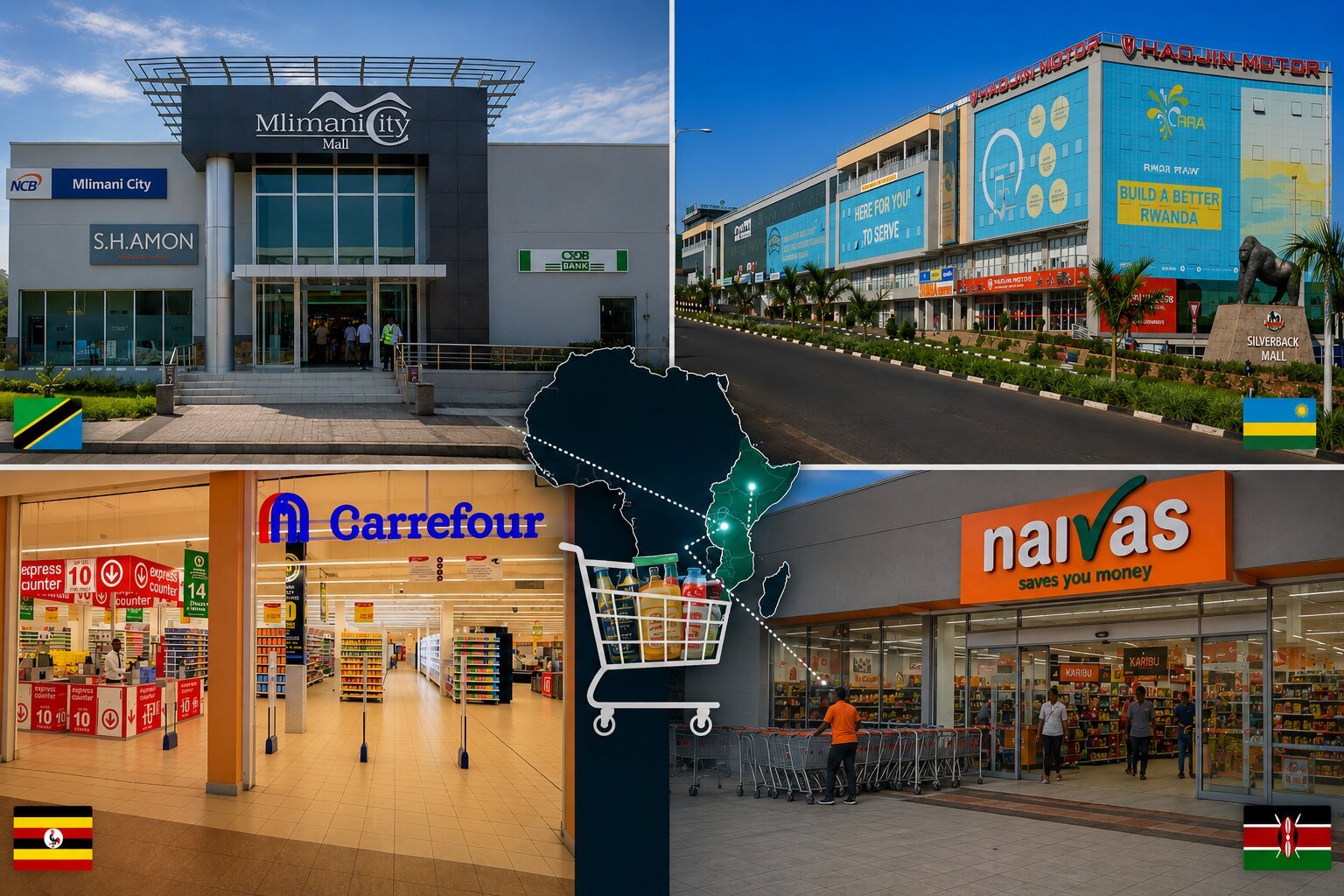
But walk into a supermarket in Dar es Salaam, Kigali, Kampala, Nairobi, or Bujumbura. The shelves tell a different story.
What the shelves actually show
A Tanzanian consumer in a Dar es Salaam supermarket can easily find toothpaste from China, biscuits from India, cooking oil from Malaysia, tiles from Turkey, electronics from Dubai, and fabrics from Pakistan. The supply chains serving those products are efficient, reliable, and commercially mature. Finding processed Ugandan goods in Tanzania, Rwandan manufactured products in Kenya, or Burundian consumer brands in Uganda remains surprisingly difficult by comparison, not because of any explicit policy preventing their presence but because the regional supply chain, distribution, and retail penetration infrastructure whose development would make East African products commercially competitive on East African shelves against Asian alternatives has not been built at the scale and efficiency that the Asian supply chains already serving those markets have achieved.
East Africa may be politically integrating. Its consumer markets are not. That contradiction matters because real regional integration is not measured by communiqués, summit declarations, or the number of protocols whose signatures grace the EAC Secretariat's files. It is measured by whether ordinary citizens consume products made by neighbouring economies every day, whether factory managers in one country source inputs from suppliers in another, and whether the supply chains whose density defines genuinely integrated economic blocs are visible in warehouses, trucks, and retail aisles rather than in political speeches.
According to EAC trade data, intra-regional trade still accounts for roughly 15% of total EAC trade, a figure that EAC leaders themselves have described as unsatisfactory. That means approximately 85% of East Africa's trade still happens outside the bloc despite two decades of political integration architecture. This is not how integrated economic regions behave.
How genuinely integrated regions look
The contrast with other integrated economic blocs makes the EAC's 15% intra-regional trade share most legible. In the European Union, regional supply chains dominate manufacturing in ways whose density is visible not only in trade statistics but in the operational interdependence that makes individual member state manufacturing sectors commercially dependent on inputs, components, and distribution from other member states. German machine parts move into Polish manufacturing facilities. French retail goods circulate into Belgian distribution networks. Italian industrial components feed factories across the continent at the transaction volumes that make the EU's internal market the world's largest by GDP concentration. The integration is not administrative. It is operational, embedded in the production decisions of millions of firms whose commercial logic the regional market's scale and homogeneity makes rational.
In ASEAN, Thailand manufactures auto parts used in Indonesian assembly plants while Vietnam exports electronics components across Southeast Asia in the supply chain relationships that have made the region the world's most significant manufacturing relocation destination for companies diversifying away from China-concentrated production. The integration is visible in the shipping manifests, customs documentation, and factory floor supplier lists whose content reflects the regional supply chain depth that political integration facilitated but commercial investment created.
East Africa, by contrast, still functions more like six adjacent import economies whose primary commercial relationship is with Asian, Middle Eastern, and European suppliers rather than with each other. The same Chinese furniture appears in Dar es Salaam and Kampala. The same Turkish ceramics appear in Kigali and Nairobi. The same Indian pharmaceuticals appear across the region. East Africa imports together. It does not manufacture together. And the distinction between those two descriptions of regional economic behaviour is the entire distance between political integration and economic integration whose conflation in the summit declaration genre is the most consistent source of confusion about what the EAC has and has not achieved.
Why the structure produces the outcome
The 15% intra-regional trade share is not a policy failure in the narrow sense of governments making wrong decisions. It is a structural outcome whose origin is the industrial complementarity failure that defines the EAC's productive landscape and whose resolution requires the industrial investment, supply chain development, and market integration that trade policy liberalisation alone cannot produce.
Regional integration requires industrial complementarity whose presence means that economies produce different things at different stages of sophistication that each other's firms and consumers need. The EU's integration produces the German-Polish supply chain because Germany produces precision manufacturing equipment and complex industrial inputs that Polish manufacturers buy, while Poland produces the manufactured components and assembly operations that German distribution networks sell to European consumers. The supply chain flows because the productive structures complement rather than replicate each other.
East African countries largely produce similar low-complexity outputs while importing higher-value manufactured goods from outside the continent. Tanzania exports gold, tobacco, cashews, and raw agricultural products. Uganda exports coffee and minerals. Kenya exports tea, horticulture, and some manufactured goods. Rwanda exports minerals and processed agricultural products. Most EAC economies still export raw or semi-processed commodities and import finished industrial products, creating competition for the same external commodity markets rather than integration through complementary industrial supply chains. Countries selling similar low-value products to external markets do not naturally build deep regional industrial supply chains because the commercial logic of complementarity whose presence in EU and ASEAN supply chains drives the regional sourcing decisions that produce the integration statistics is absent when the productive structure is replication rather than complementarity.
The non-tariff barrier landscape compounds the structural problem with operational friction whose cumulative effect on regional commercial viability makes the Dubai import route more attractive than the regional supply chain alternative for retailers and manufacturers who are making commercially rational decisions within the cost structure the operating environment creates. Transport delays at borders remain common despite the corridor improvement investments that Tanzania, Kenya, Uganda, and Rwanda have made. Standards certification differences between EAC members mean that a product certified for Tanzanian market sale requires recertification for Kenyan market entry whose cost and time the Asian import alternative does not impose because the Asian supply chains have already absorbed the certification investment. Customs procedures remain inconsistent. Currency convertibility remains weak. Truck clearance systems remain fragmented. Excise taxes and regulatory policies continue to vary substantially.
The EAC Customs Union exists on paper. Businesses still navigate the region country by country, country by country, in the specific licensing requirements, supermarket procurement systems, and retail distribution barriers whose accumulation a Tanzanian furniture producer entering Kenya encounters as the operational reality that the Customs Union's theoretical framework does not yet reflect. For many retailers, importing containers from Dubai is operationally easier than building East African regional supply chains whose development requires the logistics harmonisation, financial integration, common standards, and coordinated industrial policy that partial tariff coordination alone cannot substitute for.
The infrastructure problem whose origin is colonial and whose consequence is current
East Africa's infrastructure was historically designed for export extraction rather than regional industrial circulation, and that design inheritance is the physical foundation whose persistence explains why the political integration architecture has not produced the commercial integration whose measurement the supermarket shelf provides. Railways linked mines and plantations to ports. Road corridors moved commodities toward global shipping routes. Ports connected East Africa to Europe, India, and China rather than connecting East African cities to each other at the logistics cost that regional supply chains require to be commercially competitive against established Asian import alternatives.
The architecture of trade still points outward. Mombasa and Dar es Salaam function more effectively as gateways for Asian imports than as integrated distribution hubs for regional manufacturing whose goods circulate between East African markets through the supply chain infrastructure that genuinely integrated regions require. The Standard Gauge Railway's Central Corridor development, whose USD 2.33 billion financing Standard Chartered arranged in April 2026 and whose logistics cost reduction Uchumi360 has documented across its infrastructure coverage, is the most significant current investment in infrastructure whose design serves regional industrial circulation rather than purely export extraction. But the SGR's completion changes the logistics economics of moving goods between Dar es Salaam and Kigali without changing the industrial complementarity whose absence means there are insufficient regionally manufactured goods to move through the improved logistics corridor at the volumes that supply chain integration requires.
A middle class family in Kigali furnishing its house with Chinese sofas, Turkish tiles, Indian electronics, and UAE-sourced appliances while consuming almost no manufactured products from neighbouring Tanzania or Uganda is not making an irrational consumer choice. It is making the commercially rational response to the price, availability, and quality proposition that the Asian supply chain alternative offers versus the regional alternative whose absence or inadequacy in specific product categories reflects the industrial complementarity gap rather than any preference for imported over regional goods.
What Kenneth Ruto's deadline revealed and what Rabiu's disclosure confirmed
The gap between integration rhetoric and integration reality has been visible in two specific disclosures that Uchumi360's May 2026 coverage documented from the Africa CEO Forum in Kigali. Tanzania and Kenya agreed at the bilateral summit a 31 May 2026 deadline for eliminating non-tariff barriers between the two countries whose specific barriers Abdul Samad Rabiu, founder of BUA Group, identified at the Africa CEO Forum as the operational reality that AfCFTA is not working as it should despite its formal existence. Rabiu's direct experience of administrative barriers and legacy import structures frustrating BUA Group's regional expansion in specific African markets despite the framework's existence is the business practitioner's confirmation of the supermarket shelf's evidence: political integration architecture and commercial integration reality are different things, and the distance between them is the specific operational friction whose resolution requires the industrial investment, logistics harmonisation, and regulatory convergence that summit deadlines announce but operational follow-through creates.
According to the EAC Secretariat's non-tariff barrier elimination monitoring data, the number of reported non-tariff barriers in the EAC has declined since the systematic elimination programme whose establishment the EAC Heads of State Summit initiated, but the pace of elimination and the compliance with agreed timelines reflect the same gap between political commitment and operational implementation that the supermarket shelf makes visible at the consumer level. The elimination of a specific non-tariff barrier at the regulatory level is not the same as the commercial supply chain development that the barrier's elimination was designed to enable, and measuring integration by the number of barriers eliminated rather than by the regional trade share that the barrier elimination was intended to increase is the accounting error that allows integration to appear more advanced than the supermarket shelf confirms it to be.
The Kenyan dominance and what it reveals about unequal integration
The regional manufacturing distribution asymmetry is visible in the specific country pattern whose unevenness the supermarket analysis reveals. Kenyan products dominate parts of Uganda and Rwanda because Kenya industrialised earlier and built stronger manufacturing distribution systems whose commercial reach the EAC's internal market liberalisation allowed to expand into regional markets before equivalent Tanzanian, Ugandan, or Rwandan manufacturing distribution systems had developed. But Tanzanian manufactured goods have weak retail penetration in Kenya. Rwanda's industrial output remains small and concentrated. Burundi's consumer manufacturing presence across the region is almost invisible despite its EAC membership and the free trade access whose existence should theoretically enable regional market penetration.
The asymmetry matters because it reveals that partial integration, which is what the EAC has achieved, tends to benefit the more industrially developed member rather than distributing the integration gains across the bloc proportionally to each member's potential. Kenya's manufacturing head start means that the EAC's internal market liberalisation has allowed Kenyan goods to penetrate regional markets without equivalent regional penetration of Kenyan shelves by goods from other members, producing the integration asymmetry that creates political tension around integration commitments whose commercial benefits different members experience differently. Tanzania's protection of specific manufacturing sectors through import restrictions and regulatory barriers reflects the rational response of a less industrially developed member whose domestic manufacturers would face competitive displacement by more established regional producers without the transitional protection that infant industry development requires before regional market exposure becomes commercially sustainable.
The EAC Common External Tariff and its insufficient but necessary role
The EAC Common External Tariff was designed partly to encourage regional industrialisation by making imported finished products more expensive than regional alternatives, creating the price preference that domestic and regional manufacturing requires to be commercially competitive against Asian supply chains whose accumulated scale, logistics efficiency, and production cost advantages are the structural competitiveness advantage that the tariff is designed to offset. But tariff protection alone cannot create regional manufacturing ecosystems, and the EAC's experience demonstrates the specific limits of the trade policy instrument when the industrial complementarity, distribution systems, and logistics harmonisation whose presence converts tariff protection into productive investment are absent.
Factories require scale. Scale requires integrated markets. Integrated markets require distribution systems. Distribution systems require logistics harmonisation, financial integration, common standards, and coordinated industrial policy whose combination produces the operational environment that manufacturers require to make the regional investment commercially rational rather than abstractly desirable. East Africa has achieved partial tariff coordination without achieving production integration, and the distinction matters enormously because production integration is the condition whose presence produces the supply chain depth, industrial complementarity, and consumer market circulation that the EU and ASEAN demonstrate as the evidence that political integration has become commercial reality.
What genuine integration would require and what it would look like
The World Bank, Afreximbank, and AfCFTA discussions increasingly emphasise that Africa's integration problem is not merely tariffs but infrastructure fragmentation, weak productive capacity, and limited industrial coordination, and the diagnosis is correct as far as it goes. The additional element whose articulation the policy discussion requires is the specific industrial complementarity investment whose deliberate coordination across EAC member states would create the supply chain relationships that the market mechanism alone is unlikely to generate at the pace the integration timeline requires.
East Africa lacks regional industrial champions with continent-wide retail penetration in the manufactured consumer goods categories whose circulation on regional supermarket shelves would make integration viscerally real for the consumers whose experience currently confirms its absence. The region has banks operating across borders through Equity Group, KCB, CRDB, and NMB's regional expansion. Telecom firms operate regionally through Safaricom, MTN, and Airtel's multi-country presence. Some cement and beverage companies have regional footprints through East African Breweries, Tanzania Breweries, and Dangote Cement's regional distribution. But East Africa still lacks the dense manufacturing networks in furniture, electronics, pharmaceuticals, processed foods, textiles, and household goods that define genuinely integrated economic blocs whose consumer market circulation of regional products is the commercial evidence that the political integration has produced the industrial outcome whose measurement the supermarket shelf provides.
The AfCFTA's potential as a scale project rather than only a trade project, which Uchumi360's analysis of Africa's multiple global partners documented, is directly relevant to the EAC integration problem because the continental market's scale changes the industrial investment economics that the EAC's relatively small combined market cannot independently generate. A pharmaceutical manufacturing facility whose minimum efficient scale requires a market larger than the EAC's 300 million combined population can anchor becomes commercially viable at the 1.4 billion consumer AfCFTA market scale, and the same logic applies to the electronics assembly, textile production, processed food manufacturing, and industrial chemicals production whose domestic production in East Africa would change the supermarket shelf's content from Asian alternatives to regional products if the market scale whose combination AfCFTA creates makes the investment commercially rational.
The choice East Africa now faces
East Africa now faces the strategic choice whose resolution will determine whether the EAC's political integration architecture eventually produces the commercial integration whose absence the supermarket shelf exposes, or whether it remains the diplomatic project without a regional consumer economy underneath it that the current 15% intra-regional trade share describes.
The first path is continuing to function as multiple small import economies competing separately for Asian manufactured goods whose supply chains serve East African markets more efficiently than the regional supply chains that do not yet exist, while the political integration architecture accumulates additional protocols, summit declarations, and non-tariff barrier elimination commitments whose implementation pace lags the rhetoric by the margin that has produced the current integration gap.
The second path is deliberately building regional industrial value chains capable of circulating East African products across East African markets through the coordinated industrial production, logistics harmonisation, financial integration, common standards, and distribution system development whose combination would make the supermarket shelf's content look more like the EU's German-French-Italian product circulation and less like the parallel Asian import terminal that it currently resembles.
The second path requires moving beyond customs union rhetoric toward coordinated industrial production whose specific mechanisms, industrial complementarity investment, regional supply chain financing, logistics harmonisation implementation, and standards convergence, are less photographically compelling than summit handshakes but more commercially consequential than the declarations whose content the supermarket shelf is currently contradicting.
Real economic unions are visible in factories, trucks, warehouses, and retail aisles long before they appear in political slogans. East Africa's integration will be real when a family in Kigali furnishes its house with Tanzanian furniture, takes its medicine from a Ugandan pharmaceutical manufacturer, and charges its phone with a Kenyan-assembled charger. Until then, the supermarket shelf will continue exposing the gap between integration speeches and economic reality with the factual clarity that trade data confirms but that the physical evidence of daily consumer experience makes impossible to misread.
FAQ
What does East Africa's 15% intra-regional trade share mean? It means approximately 85% of East Africa's trade still happens outside the EAC bloc despite two decades of political integration architecture. According to EAC trade data, intra-regional trade accounts for roughly 15% of total EAC trade, a figure EAC leaders themselves have described as unsatisfactory. By comparison, the EU's intra-regional trade share is approximately 60%, reflecting the industrial supply chain depth whose development over decades of commercial integration produced the manufacturing interdependence that the EAC's political architecture has not yet translated into commercial reality.
Why are East African supermarket shelves stocked with Asian goods rather than regional products? Because the regional supply chain, distribution, and retail penetration infrastructure whose development would make East African products commercially competitive against Asian alternatives on East African shelves has not been built at the scale and efficiency that the Asian supply chains already serving those markets have achieved. For many retailers, importing containers from Dubai is operationally easier than building East African regional supply chains because of transport delays, standards certification differences, inconsistent customs procedures, weak currency convertibility, fragmented truck clearance systems, and varying excise taxes whose combination makes regional sourcing more operationally complex than established Asian import channels.
What is the structural cause of the EAC's integration failure? Industrial complementarity failure. Most EAC economies produce similar low-complexity commodity outputs, Tanzania's gold and cashews, Uganda's coffee and minerals, Kenya's tea and horticulture, Rwanda's minerals and processed agriculture, and import higher-value manufactured goods from outside the continent. Countries selling similar low-value products to external markets do not naturally build deep regional industrial supply chains because the commercial logic of complementarity, buying from neighbours what you cannot produce efficiently yourself, is absent when the productive structures replicate rather than complement each other. Regional industrial supply chains require different economies producing different things at different stages of sophistication that each other's firms and consumers need.
What would genuine EAC integration require? Coordinated industrial production whose deliberate design creates the industrial complementarity whose market mechanism alone is unlikely to generate, logistics harmonisation that makes regional supply chains operationally competitive against Asian alternatives, financial integration that reduces the currency convertibility and cross-border payment friction that regional trade costs impose, common standards that eliminate the recertification requirement whose cost the Asian import alternative does not impose, and distribution system development that gives regional manufacturers the retail penetration access that established import channels provide to Asian suppliers. Partial tariff coordination, which the EAC has achieved, is a necessary but insufficient condition for the production integration whose presence distinguishes politically integrated blocs that are also commercially integrated from those that are administratively integrated without the supply chain depth whose consumer market evidence is the supermarket shelf.
What is the difference between political integration and economic integration? Political integration is the administrative architecture of shared institutions, protocols, common external tariffs, and summit frameworks that the EAC has built over two decades. Economic integration is the commercial reality of firms in one country depending on inputs from another, consumers recognising regional brands as naturally available options, and supply chains circulating goods between regional markets as routinely as they circulate goods from Asia. The EAC has achieved significant political integration whose commercial expression in supermarket shelves, factory supplier lists, and intra-regional trade statistics remains at approximately 15% of total trade. Real integration, as the EU and ASEAN demonstrate, is visible in factories, trucks, warehouses, and retail aisles long before it appears in political slogans.
 Uchumi360
Business Intelligence
Uchumi360
Business Intelligence
- EAC Secretariat, intra-regional trade data
- Approximately 15% of total EAC trade
- Available at eac.int
- EAC Secretariat, Customs Union Protocol, Common Market Protocol, and non-tariff barrier elimination programme documentation
- Available at eac.int
- World Bank, Africa regional integration and trade research
- Available at worldbank.org
- Afreximbank, African trade and regional integration data
- Available at afreximbank.com
- AfCFTA Secretariat, implementation documentation and trade facilitation data
- Available at au-afcfta.org
- Standard Chartered Bank, SGR financing announcement, 28 April 2026
- Central Corridor logistics context
- Available at sc.com
- Africa CEO Forum, Abdul Samad Rabiu AfCFTA assessment, Kigali, May 2026
- Non-tariff barrier disclosure and BUA Group regional expansion experience
- Kenya National Bureau of Statistics, bilateral trade data with Tanzania and Uganda
- Available at knbs.or.ke
- National Bureau of Statistics Tanzania, bilateral trade data
- Available at nbs.go.tz
- Uganda Bureau of Statistics, intra-EAC trade data
- Available at ubos.org
- Rwanda National Institute of Statistics, trade and regional integration data
- Available at nisr.gov.rw
- Institut des Statistiques et des Études Économiques du Burundi, trade data
- Available at isteebu.bi
- DRC Institut National de la Statistique, regional trade data
- Available at ins-rdc.org
- European Commission, EU internal market trade statistics
- Available at ec.europa.eu
- ASEAN Secretariat, intra-ASEAN trade statistics
- Available at asean.org
- UNCTAD, Economic Development in Africa Report
- Regional integration and industrial complementarity analysis
- Available at unctad.org
- African Development Bank, regional integration and trade facilitation reports
- Available at afdb.org
- Zambia Statistics Agency, regional trade comparative data
- Available at zamstats.gov.zm
- Mozambique Instituto Nacional de Estatística, regional trade data
- Available at ine.gov.mz
Uchumi360 covers business, investment, and economic policy across East, Central, and Southern Africa.
For the serious reader
You read to the end. That places you in a small group.
Uchumi360 is built for readers who demand precision over speed, structure over sentiment, and analysis that holds uncomfortable conclusions rather than softening them. If this work sharpens how you think about Africa's economy, help us keep building the infrastructure behind it.
Institutional Partners
Commission intelligence. Shape the conversation.
Uchumi360 works with development finance institutions, investment firms, sovereign bodies, and strategic organisations across the coverage region. Institutional partnership unlocks:
- Commissioned sector and country intelligence reports
- Branded research series under your institution's authority
- Exclusive data briefings for internal strategy teams
- Speaking and editorial presence at Uchumi360 events
- Co-published investment outlooks for your markets
Support Our Work
Independent analysis has a cost. Help us bear it.
Uchumi360 does not carry advertising. It does not take editorial direction from sponsors. Every article is produced without commercial compromise. Your contribution funds the reporting, research, and editorial infrastructure that keeps this analysis free from influence.
Secure checkout: One-time and monthly support are processed securely. Add payment credentials to enable checkout here.
Stay Connected
Keep up with every new insight.
Follow our latest analysis, policy coverage, and market intelligence as soon as it is published. If you need something specific, reach out directly and we will point you to the right research.
