
If Ethiopia Wants Unhindered Access To The Sea, Why Doesn't It Join The East African Community?
Ready
Ethiopia is landlocked, surrounded by countries with access to the Red Sea and Indian Ocean, and it wants reliable maritime access, diversified trade corridors and greater strategic influence over the routes connecting its economy to global markets. Addis Ababa is already pursuing this bilaterally, through a Somaliland memorandum, port equity stakes, and a rejected offer on Djibouti's Port of Tadjoura, and Ethiopian officials are now explicitly framing sea access using the exact language of regional integration. But there is another option Addis Ababa rarely discusses with the seriousness it deserves: actually joining the East African Community.
ADDIS ABABA — Ethiopia's search for access to the sea has become one of the most consequential geopolitical questions in East Africa. It is also, on closer inspection, one of the most revealing, because the solution Addis Ababa is currently pursuing and the solution already sitting next door look considerably more similar than the current bilateral, port-by-port diplomacy suggests.
How Dependent Is Ethiopia on a Single Corridor, Really?
A country of more than 130 million people, with one of Africa's largest economies and a rapidly expanding industrial and consumer base, remains overwhelmingly dependent on a single maritime corridor. The World Bank and IMF both put the figure at more than 95% of Ethiopia's import and export trade by volume moving through the Addis Ababa-Djibouti corridor specifically, generating an estimated $1.5 billion annually for Djibouti and tying both countries' economic fates together to a degree unusual even among close neighbours. That dependence gives Djibouti enormous economic importance and gives Ethiopia a genuine strategic vulnerability simultaneously: when the corridor works, both economies benefit; when it doesn't, as the 2024 Red Sea shipping crisis demonstrated through elevated freight costs and rerouting around the Cape of Good Hope that persisted well after the initial disruption eased, both pay.
Addis Ababa has spent recent years actively searching for alternatives, and it's worth being specific about what that search already looks like in practice, since it's more advanced than a purely hypothetical discussion. Eritrea's Assab and Massawa have entered the conversation. Somaliland's Berbera has become increasingly relevant, with DP World leading major port modernisation and Ethiopia itself taking an equity stake in the project following a January 2024 memorandum of understanding for potential sea access, an arrangement controversial enough that Somalia formally objected and Turkey had to mediate, resulting in the December 2024 Ankara Declaration to de-escalate tensions. Somalia has a strategic position on the Gulf of Aden in its own right. Kenya has the Port of Mombasa and the Lamu corridor. Tanzania has Dar es Salaam and an expanding network of road and railway connections into the interior. As recently as 11 April 2026, Ethiopia rejected a 60% stake it was offered in Djibouti's own Port of Tadjoura, with Ethiopian officials reportedly framing the decision around a broader "Corridor Doctrine": for a nation of this size, half-measures of access amount to no meaningful access at all.
The geography, and Ethiopia's own recent behaviour, both point toward the same conclusion. Ethiopia doesn't need one sea. It needs several reliable corridors to the sea, and it's already negotiating, and in some cases rejecting, deals in pursuit of exactly that. What receives far less attention is a more basic question: if Ethiopia's problem is fundamentally one of regional connectivity, why is the answer being pursued mainly through bilateral geopolitical arrangements rather than through deeper East African integration? Why not join the East African Community?
Does Ethiopia Actually Need to Own a Coastline?
This distinction is central to the entire argument. Ethiopia's problem is not literally that it has no coastline. Its problem is that it doesn't control one. Those are genuinely different things. A landlocked country can have highly reliable maritime access without possessing sovereign territory on the coast at all, Switzerland doesn't need a coastline to participate fully in European trade, and neither does Austria, Uganda, Rwanda, South Sudan or Zambia. Their economic strategies depend instead on corridors, transit agreements, ports, railways, roads, customs arrangements and regional markets, precisely the systems East Africa has spent decades building.
The EAC's Customs Union already provides for free trade among Partner States subject to its rules, while the Common Market provides for movement of goods, people, labour, services and capital, alongside rights of establishment and residence. The region is now discussing even deeper political integration: in 2026, the EAC has been conducting consultations on a Constitution for an East African Political Confederation, intended as a transitional model toward eventual political federation. That's not simply a trade agreement. It's an attempt to gradually reduce the economic significance of national borders altogether, which for a landlocked country is strategically significant in exactly the way Ethiopia's current bilateral corridor negotiations are trying, piece by piece, to achieve anyway.
What Would Joining the EAC Actually Give Ethiopia?
Membership would not immediately solve Ethiopia's maritime problem, and it would not automatically deliver a port. It would, however, create several genuine strategic possibilities, starting with access to a considerably larger regional market. The EAC currently represents more than 331 million people and approximately $357 billion in combined GDP, according to the EAC Secretariat. For an economy of Ethiopia's scale, that market access matters almost as much as physical port access: its industrial strategy requires consumers, its manufacturers require suppliers, its farmers require regional buyers, its banks need regional opportunities, its logistics companies need cargo, and its investors need scale, all things a larger, rules-based regional market can provide more reliably than a series of individually negotiated bilateral corridor deals.
Kenya is particularly relevant here. Mombasa already serves major parts of East and Central Africa, and Kenya's northern corridor connects it to Uganda, Rwanda, Burundi, eastern DRC and South Sudan; Ethiopia sits immediately north, meaning a deeper Ethiopia-Kenya relationship could create another major corridor linking Ethiopian producers and consumers directly to the Indian Ocean, without Ethiopia needing to own Mombasa, only needing predictable, institutionally guaranteed access to it. Tanzania offers a parallel, if longer, option: Dar es Salaam is already connected to the interior through established transport networks central to moving goods into Zambia, Malawi, the DRC and other landlocked markets, and while a Tanzania corridor would run longer than the Djibouti route, distance is only one variable in a corridor's actual value. Port efficiency, rail capacity, road quality, border procedures, customs clearance, transit fees, security and reliability all matter as much as raw distance, meaning a longer but genuinely predictable corridor can sometimes outperform a shorter one vulnerable to political or logistical disruption.
Is Ethiopia's Own Diplomatic Language Already Moving This Direction?
In a genuinely striking parallel to this argument, it already is, at least rhetorically. At an April 2026 Red Sea and Gulf of Aden Dialogue held in Addis Ababa, Ethiopian officials explicitly framed sea access as a "win-win" question tied directly to regional integration, shared maritime governance, and the African Union's own Agenda 2063. Vice Admiral Kindu Gezu argued that inclusive maritime governance should involve both coastal and landlocked states together, while the Institute of Foreign Affairs' Executive Director Jafar Bedru stressed that Ethiopia's position was not aimed at undermining any country's sovereignty, but at adding regional capacity through more trade, more predictable rules, and stronger cooperation. That's very close to the exact case this piece is making for EAC accession specifically, Ethiopia's own officials are already describing the solution to their maritime problem in the language of regional integration, predictable rules and shared capacity. What's missing is the institutional step of actually pursuing that integration through an existing, functioning regional body rather than continuing to build it deal by deal, port by port.
What Would Ethiopia Have to Give Up to Join?
This is where the argument has to become genuinely serious rather than purely aspirational. Joining the EAC would not mean Ethiopia gets preferential access to Kenyan or Tanzanian ports while retaining complete freedom over its own trade policy. The Customs Union operates around a common external tariff and shared customs arrangements; the Common Market involves the movement of goods, labour, services and capital across borders. Membership would require Ethiopia to accept regional rules, coordinate customs, negotiate tariffs, extend defined treatment to foreign investors, permit movement of people, and submit to shared dispute settlement mechanisms, a real surrender of unilateral policy flexibility that Ethiopia's historically strong, state-directed economic model has generally avoided. Whether the strategic benefits of integration would outweigh the policy autonomy Ethiopia would sacrifice is a legitimate debate, not a foregone conclusion, and it's likely the real reason this question receives so little serious attention in Addis Ababa despite the logic pointing toward it.
Would Membership in One Body Actually Solve Anything, Given Ethiopia's Existing Memberships?
Ethiopia's own experience elsewhere is a genuine reason for caution here. Ethiopia is already a member of COMESA, but the World Bank notes it does not participate in the COMESA Free Trade Area, meaning small-scale traders along the Kenya-Ethiopia border don't receive the full duty-free treatment the FTA is supposed to provide. That experience should make Ethiopia genuinely cautious about assuming that joining another regional organisation automatically solves anything on its own. Membership without implementation is little more than a diplomatic photograph, and if Ethiopia joined the EAC but failed to actually implement customs reforms, harmonise standards, facilitate transit or integrate infrastructure, the underlying maritime dependence problem would simply remain unresolved regardless of what the membership certificate says. The proposition, then, isn't simply "join the EAC." It's "join the EAC and actually integrate," a considerably more demanding standard.
Could Ethiopia Become the EAC's Northern Gateway?
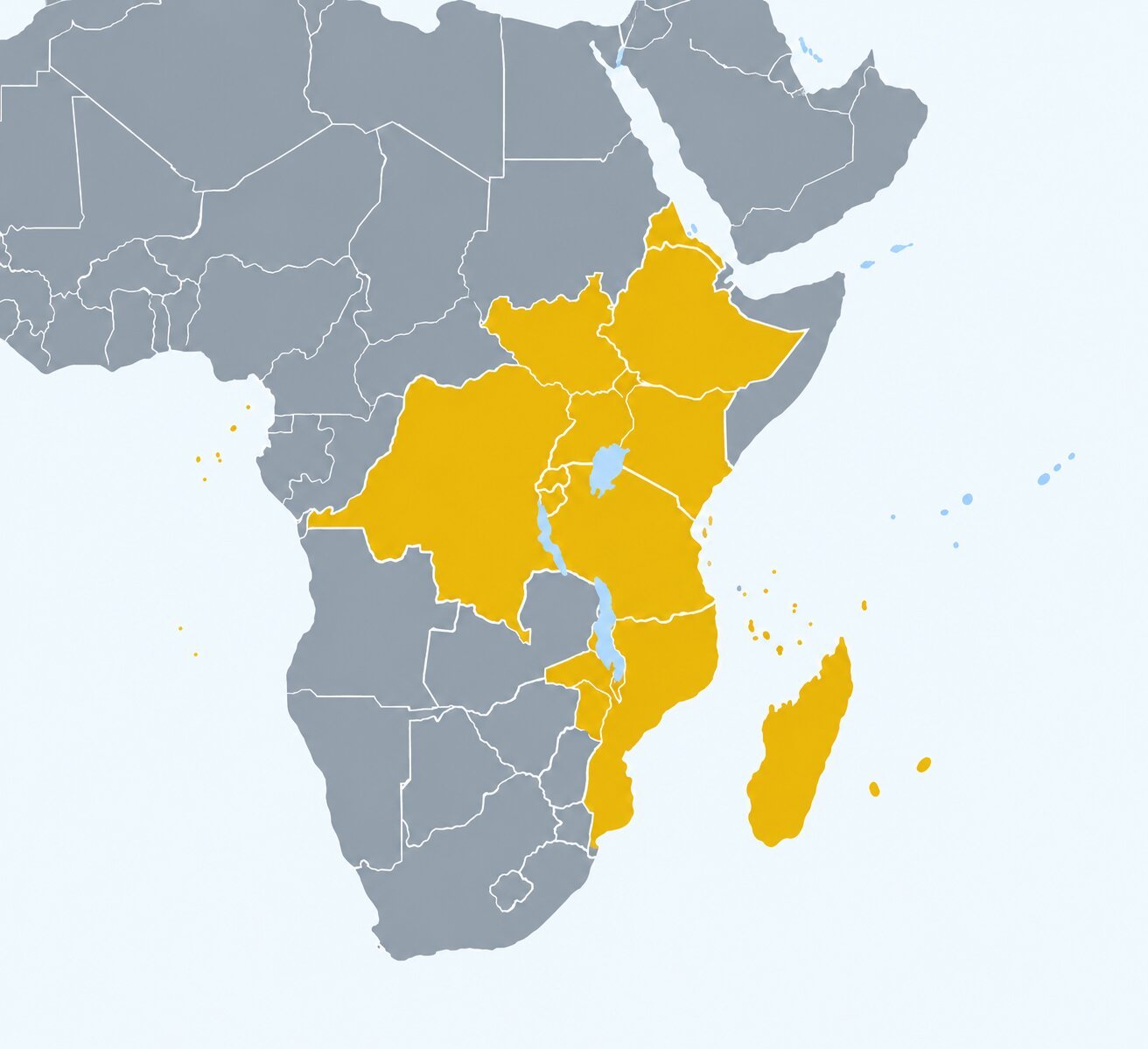
The EAC currently stretches from the Indian Ocean to the Great Lakes and, through Somalia's March 2024 accession, toward the Horn and Gulf of Aden. Adding Ethiopia would push the Community considerably further north, creating a regional economic space connecting the Red Sea, the Gulf of Aden, the Indian Ocean, the Great Lakes, Central Africa and the Horn simultaneously, with Ethiopia serving as the bloc's northern industrial and population anchor, Kenya and Tanzania providing major Indian Ocean gateways, Somalia providing Gulf of Aden access, South Sudan connecting to the Nile Basin, Uganda and Rwanda deepening the Great Lakes connection, and the DRC adding substantial mineral and consumer market potential.
There's a further, more provocative dimension worth naming directly: Ethiopia's relationship with Eritrea has grown increasingly tense specifically around security and maritime access, and the history between the two countries makes that tension especially dangerous. If Ethiopia had multiple commercially viable corridors through an integrated East African market, the strategic importance of obtaining a sovereign or quasi-sovereign maritime foothold specifically in the Red Sea could plausibly decline, not because Ethiopia would stop wanting Red Sea access, but because it would no longer depend on that one particular coastline to get it. That distinction could genuinely reduce the geopolitical pressure surrounding Assab and reduce the perception among neighbouring states that Ethiopia's search for maritime access necessarily implies territorial or military ambition. Integration, in that sense, could function as a security mechanism, not by eliminating national interests, but by giving those interests more peaceful channels through which to actually operate.
Is This Realistic, or Just an Interesting Thought Experiment?
Africa already has too many overlapping regional organisations, and adding Ethiopia to the EAC without coordinating between the EAC, IGAD and COMESA would risk creating another layer of bureaucracy rather than genuine progress. The EAC is also itself an unfinished integration project: non-tariff barriers remain, member states continue protecting some domestic industries, trade disputes persist, and implementation varies considerably across the bloc. Ethiopia would not be joining a finished union. It would be joining a project still genuinely under construction, though perhaps that's precisely the point rather than a disqualifying flaw, regional integration is not something Ethiopia should wait to join after it's complete. It's something Ethiopia could actually help shape from the inside.
Joining wouldn't require Ethiopia to abandon IGAD, COMESA, its relationship with Djibouti, or its search for Red Sea access through Somaliland or elsewhere. It would mean adding another layer of economic integration on top of those existing relationships, and it could plausibly strengthen Ethiopia's negotiating position across every one of its existing corridors simultaneously: if Ethiopian cargo can credibly move through Djibouti, Berbera, Mombasa, Lamu and Dar es Salaam, port operators, transport companies and financial institutions all begin competing for that cargo rather than Ethiopia negotiating from a position of single-corridor dependence, exactly the leverage a genuinely diversified corridor strategy is supposed to produce.
What's the Actual Question Ethiopia Should Be Asking?
Ethiopia has spent years asking how it gets to the sea. The more useful question may be how it makes the borders between Ethiopia and the sea economically irrelevant instead. The first question leads naturally toward ports, leases, corridors and bilateral negotiations, exactly the Somaliland MOU, the Tadjoura stake rejection, and the ongoing Red Sea dialogue Ethiopia is already pursuing. The second leads toward customs unions, common markets, regional infrastructure, free movement, shared standards and eventually common institutions, a genuinely different strategy, though not necessarily an incompatible one. Ethiopia's own officials are already using the language of the second approach while pursuing the tactics of the first. Ethiopia doesn't need to own the sea to benefit from it. It needs to make access to the sea a regional economic right rather than a geopolitical privilege negotiated port by port, and East Africa already has an institution explicitly designed to move in that direction. It's called the East African Community, and the question of why Ethiopia remains outside it is worth asking with considerably more seriousness than it currently receives.
FAQ
How dependent is Ethiopia on the Djibouti corridor specifically? More than 95% of Ethiopia's international trade by volume, according to the World Bank and IMF, generating an estimated $1.5 billion annually for Djibouti's economy.
Is Ethiopia already trying to diversify its maritime access? Yes, bilaterally. It signed a memorandum of understanding with Somaliland in January 2024 for potential access through Berbera, has taken an equity stake in that port's development, and as recently as April 2026 rejected a 60% stake offered in Djibouti's Port of Tadjoura as insufficient.
Is Ethiopia a member of the East African Community? No. The EAC's Partner States are Burundi, DRC, Kenya, Rwanda, Somalia, South Sudan, Tanzania and Uganda.
Would EAC membership give Ethiopia a port? No, Ethiopia would remain landlocked. Membership would instead create a framework for deeper trade, customs and transport integration with countries that control or connect to major regional gateways.
Are Ethiopian officials already talking about this in terms of regional integration? Yes. At an April 2026 Red Sea and Gulf of Aden Dialogue, Ethiopian officials explicitly framed sea access as a "win-win" tied to regional integration and the African Union's Agenda 2063, language closely aligned with the EAC accession argument.
What would Ethiopia have to give up to join the EAC? Meaningful policy autonomy, including accepting a common external tariff, customs coordination, and rules on the movement of goods, labour, services and capital across borders.
Why hasn't Ethiopia joined already if the logic seems compelling? Ethiopia already belongs to COMESA and IGAD, and its experience with COMESA, where it doesn't participate in the Free Trade Area despite membership, shows that joining a regional body doesn't automatically deliver integration without genuine implementation. Coordinating a new EAC relationship alongside those existing commitments would be a genuine institutional and political challenge.
 Uchumi360
Business Intelligence
Uchumi360
Business Intelligence
Uchumi360 covers business, investment, and economic policy across East, Central, and Southern Africa.
For the serious reader
You read to the end. That places you in a small group.
Uchumi360 is built for readers who demand precision over speed, structure over sentiment, and analysis that holds uncomfortable conclusions rather than softening them. If this work sharpens how you think about Africa's economy, help us keep building the infrastructure behind it.
Institutional Partners
Commission intelligence. Shape the conversation.
Uchumi360 works with development finance institutions, investment firms, sovereign bodies, and strategic organisations across the coverage region. Institutional partnership unlocks:
- Commissioned sector and country intelligence reports
- Branded research series under your institution's authority
- Exclusive data briefings for internal strategy teams
- Speaking and editorial presence at Uchumi360 events
- Co-published investment outlooks for your markets
Support Our Work
Independent analysis has a cost. Help us bear it.
Uchumi360 does not carry advertising. It does not take editorial direction from sponsors. Every article is produced without commercial compromise. Your contribution funds the reporting, research, and editorial infrastructure that keeps this analysis free from influence.
Secure checkout: One-time and monthly support are processed securely. Add payment credentials to enable checkout here.
Stay Connected
Keep up with every new insight.
Follow our latest analysis, policy coverage, and market intelligence as soon as it is published. If you need something specific, reach out directly and we will point you to the right research.
