
Africa's Debt Returns After Two Decades of Relief, With Sudan at 334% of GDP
Ready
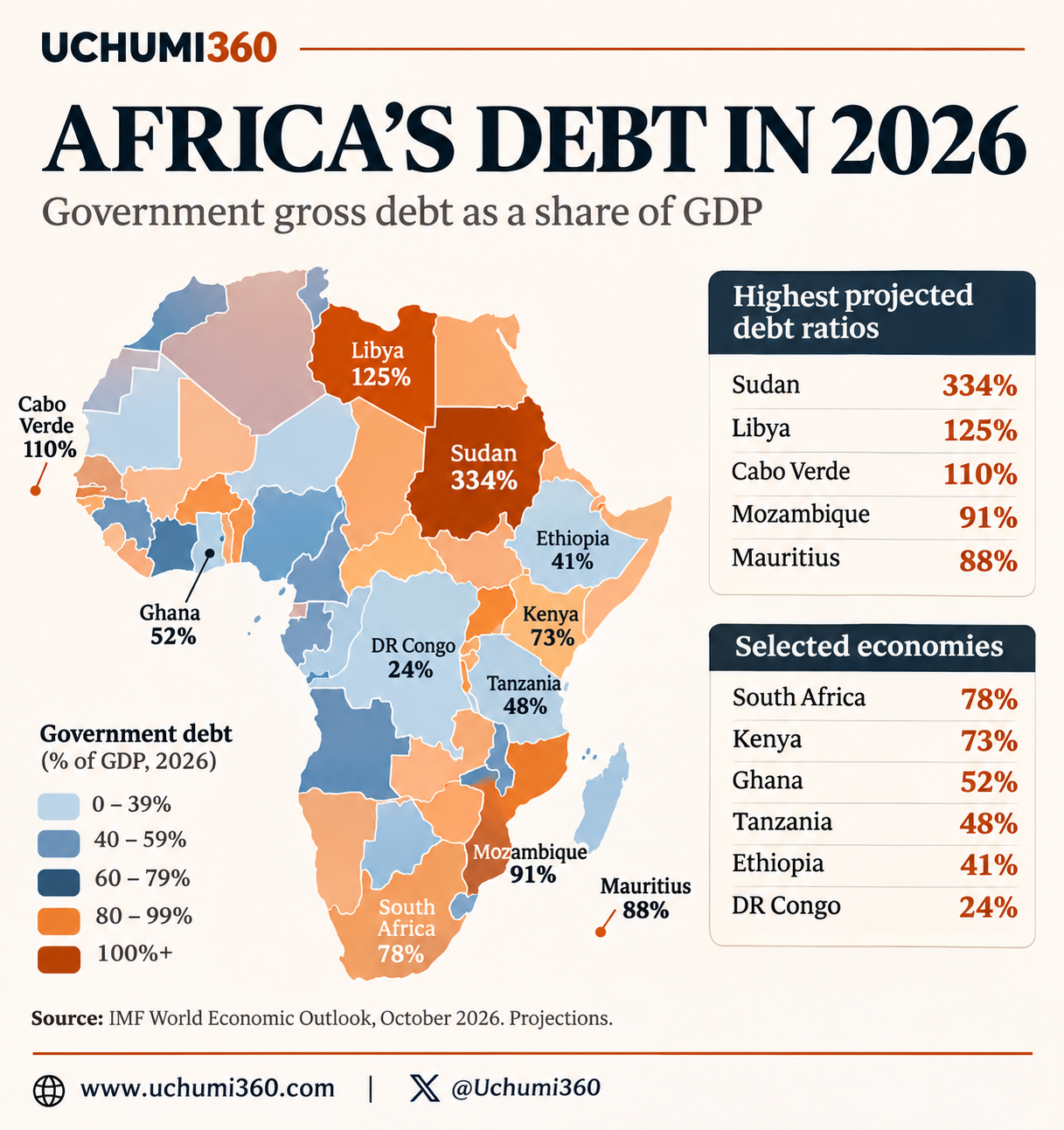
The IMF's October 2026 projections place Sudan's government debt at 334.4% of GDP, followed by Senegal at 132.3%, Libya at 125.2% and Cabo Verde at 109.9%. Kenya is projected at 72.9%, South Africa at 78% and Tanzania at 48.1%, reflecting vastly different fiscal conditions across the continent. Two decades after major international debt relief programmes reduced obligations for many African governments, renewed borrowing, economic shocks and high interest costs have increased pressure on public finances, with debt servicing consuming approximately 12% of government revenue in the typical sub Saharan African economy.
New IMF projections show that government debt exceeds annual economic output in four African countries, while Kenya, South Africa, Zambia and several other economies carry debt ratios above 70% of GDP. Although debt relief substantially reduced liabilities across parts of the continent during the 2000s, renewed borrowing, fiscal deficits, economic shocks and high financing costs have complicated the recovery of public finances.
Africa enters the final months of 2026 with public debt levels that vary dramatically across its economies, reflecting two decades of borrowing, debt relief, infrastructure investment, economic shocks and changes in government financing. The International Monetary Fund's October 2026 World Economic Outlook projects government gross debt at 334.4% of gross domestic product in Sudan, 132.3% in Senegal, 125.2% in Libya and 109.9% in Cabo Verde, making them the four African countries whose projected debt ratios exceed 100% of GDP.
The latest figures also place Mozambique at 91%, Mauritius at 87.6%, Tunisia at 86.1%, Egypt at 84%, Zambia at 82.1% and South Africa at 78%. Kenya, East Africa's largest economy by nominal GDP, is projected to carry government debt equivalent to 72.9% of GDP, compared with 55.1% in Uganda, 48.1% in Tanzania and 40.7% in Ethiopia.
These differences demonstrate the uneven distribution of public debt across the continent. A high ratio can result from extensive borrowing, slow economic growth, currency depreciation, accumulated arrears or the contraction of GDP during conflict. A lower ratio can reflect prudent borrowing, successful debt restructuring, faster economic expansion or limited access to financing. The debt figure alone cannot establish whether a government can meet its obligations, since affordability also depends on interest rates, maturity schedules, domestic revenue and the currency composition of borrowing.
Nevertheless, the overall trajectory represents a substantial change from the period following international debt relief initiatives in the 2000s. The Heavily Indebted Poor Countries Initiative and Multilateral Debt Relief Initiative reduced external debt obligations for many low income African economies, allowing governments to redirect resources towards development expenditure and regain access to financing. In subsequent years, governments increasingly relied on bilateral creditors, commercial lenders, domestic debt markets and international bonds to finance public investment and fiscal deficits.
The return of higher debt burdens has become more consequential as borrowing costs have risen and government revenue growth has struggled to keep pace with financing requirements. In its October 2026 Regional Economic Outlook, the IMF warned that, despite improvements in some fiscal indicators, sub Saharan African governments continue to face high interest costs, limited financial buffers and declining external assistance.
Sudan Leads Africa's Debt Rankings, but the Causes Differ Across Countries
IMF 2026 GOVERNMENT GROSS DEBT PROJECTIONS Sudan's estimated debt ratio is exceptional even by the standards of heavily indebted economies. At 334.4% of GDP, the country's liabilities are projected to exceed three times its annual economic output. However, Sudan's position must be interpreted against the destruction of economic activity associated with its prolonged civil conflict, the collapse of productive capacity, institutional disruption and the extreme uncertainty surrounding economic statistics. The IMF's figure represents a projection under difficult data conditions, rather than a precise measure of readily collectible liabilities.
Senegal presents a different case. Its projected debt ratio of 132.3% reflects the consequences of previously undisclosed public liabilities and subsequent revisions to government debt statistics. The country has faced difficult negotiations with international lenders following revelations that earlier fiscal reporting understated its obligations.
Libya's projected 125.2% debt ratio is affected by prolonged political fragmentation, unstable public finances and fluctuations in oil production and revenues. Cabo Verde, at 109.9%, carries a high debt burden associated with its relatively small economic base and longstanding public financing requirements, although the country's institutional and financing circumstances differ markedly from those of conflict affected economies.
These examples explain why ranking countries by debt relative to GDP provides a useful comparison of liabilities but cannot substitute for an assessment of fiscal solvency or repayment risk.
Kenya and South Africa Face High Debt Ratios Despite Larger Economic Bases
Kenya's projected government debt ratio of 72.9% places it among Africa's more indebted economies, although below countries such as Zambia, South Africa and Egypt. The country's debt accumulation has been associated with infrastructure investments, persistent fiscal deficits, exchange rate pressures and the growing cost of servicing both domestic and external obligations.
Kenya's economic size provides a substantial revenue base, but its fiscal position is constrained by the relationship between tax collections and debt payments. The government must finance public services and development expenditure while meeting interest obligations and refinancing debt that reaches maturity.
South Africa faces related pressures at a projected 78% of GDP. Years of weak economic growth, fiscal deficits and substantial borrowing have increased the country's debt burden. Even where most debt is denominated in domestic currency, elevated interest expenditure can restrict budgetary allocations to other government priorities.
The distinction between domestic and external borrowing matters. Governments borrowing predominantly in local currency generally face less direct exposure to exchange rate movements on those liabilities, although they remain exposed to domestic interest costs and refinancing conditions. Countries with substantial foreign currency debt can see their debt burden rise when the domestic currency depreciates, even without taking on additional foreign currency principal.
The IMF's October regional assessment reinforces this concern. It estimates that interest payments absorb approximately 12% of government revenue in the typical sub Saharan African country. This represents resources committed to financing past obligations before governments can allocate the remaining revenue to public services, infrastructure and other spending priorities.
Tanzania and Uganda Carry Lower Ratios, but Still Face Financing Constraints
Tanzania's projected debt ratio of 48.1% is substantially below those of Kenya and South Africa, while Uganda is projected at 55.1% and Rwanda at 63.4%. Ethiopia stands at 40.7%, although its external debt restructuring and financing arrangements require consideration beyond the headline debt ratio.
These differences reflect separate economic and fiscal circumstances. Tanzania has continued investing in railways, electricity generation, ports and other infrastructure while maintaining a comparatively moderate government gross debt ratio. Uganda has expanded its borrowing to support roads, energy infrastructure, oil development and other public investment programmes.
For both countries, debt sustainability will depend on the performance of investments financed through borrowing, the growth of government revenue and the cost of meeting future obligations.

One limitation of the debt to GDP ratio is that it measures liabilities against total economic output rather than the government's capacity to collect taxes. Two countries with similar debt ratios may face very different financing pressures if one collects substantially more revenue relative to GDP, borrows at lower interest rates or has longer repayment periods.
This becomes particularly relevant for African economies where large informal sectors, tax exemptions, administrative weaknesses and narrow revenue bases can constrain the government's ability to service debts even as GDP expands.
The composition and maturity of borrowing are equally consequential. Governments with concessional loans from development institutions may face lower annual repayment costs than countries relying heavily on commercial bonds or short term domestic securities. A moderate debt ratio can therefore coexist with substantial fiscal pressure when interest rates are elevated or major repayments become due.
The Legacy of Debt Relief and the Return of Commercial Borrowing
The rise in debt levels becomes clearer when examined against the international debt relief programmes implemented during the 2000s.
Under the HIPC Initiative and Multilateral Debt Relief Initiative, international creditors cancelled substantial obligations owed by eligible developing countries. African beneficiaries included Tanzania, Uganda, Ghana, Zambia, Mozambique and several other countries that had accumulated considerable external debts during previous decades.
The programmes reduced debt servicing requirements and helped restore borrowing capacity. According to the IMF's historical assessments, debt service payments among participating countries fell substantially relative to exports during the period, creating additional room for government expenditure.
However, debt relief was followed by a different financing environment. African governments increasingly accessed international capital markets, negotiated bilateral infrastructure loans and expanded domestic borrowing. International investors searching for higher yields also provided opportunities for governments to issue sovereign bonds that had previously been difficult or expensive to place.
Those financing channels supported infrastructure construction and budget expenditure, but they introduced exposure to commercial interest rates, refinancing risks and changes in international investor sentiment.
The circumstances changed further after the COVID pandemic, the rise in global interest rates and subsequent shocks to energy and food prices. Government revenues were disrupted, expenditure requirements increased and refinancing became more costly.
For countries borrowing in foreign currencies, depreciation against the US dollar and other major currencies increased the domestic currency value of existing debt obligations.
The result has been a divergence across Africa. Some governments have reduced debt ratios through growth, fiscal adjustment or restructuring. Others continue to face rising liabilities or repayment pressures even when their economies are expanding.
The IMF's October 2026 assessment acknowledges progress in fiscal adjustment and declining debt ratios in parts of sub Saharan Africa. However, the Fund also warns that fiscal buffers remain limited, while high interest expenditure and declining international assistance constrain governments' ability to respond to new economic shocks.
Countries With Low Debt Ratios Are Not Necessarily Free of Financial Risk
At the lower end of the rankings, the Democratic Republic of Congo has projected government debt of 23.7% of GDP, followed by Djibouti at 28.7%, Chad at 31.1%, Equatorial Guinea at 32.9% and Zimbabwe at 33.5%.
DR Congo's low debt ratio contrasts with its substantial mineral resources, particularly copper and cobalt, and the country's large infrastructure and public service requirements.
A low ratio can provide additional theoretical borrowing capacity, but it may also reflect constrained access to long term financing, limited domestic revenue mobilisation or the effects of previous debt relief. Other liabilities, including contingent government obligations and debts held by state enterprises, may not be fully captured by the same statistical measures.
For mineral exporting countries, government finances can be especially sensitive to commodity prices. A decline in export earnings can affect tax revenues, foreign exchange availability and economic growth, making existing debt obligations more difficult to service.
Therefore, comparing Africa's most and least indebted economies requires examining not only liabilities but also revenue capacity, interest costs, repayment schedules and the stability of the economic activities supporting public finances.
Africa's Next Debt Challenge Is the Cost of Servicing Existing Obligations
The latest IMF projections show that many African governments continue to carry substantial debt burdens despite earlier relief initiatives and recent fiscal adjustments. Yet the more immediate pressure facing public finances comes from the cost of servicing those obligations.
High interest payments reduce the resources available for capital investment, healthcare, education and other expenditure. Short repayment periods can require governments to refinance large amounts of debt even when they have not increased their underlying borrowing. Currency depreciation can further raise the cost of servicing foreign currency liabilities.
For countries seeking to maintain infrastructure investment while controlling debt, the economic performance of publicly financed projects will become increasingly consequential. Railways, electricity facilities, ports and highways can support economic expansion, but their contribution to public finances depends on construction costs, utilisation, operating efficiency and the extent to which they generate revenue or wider taxable economic activity.
Projects that deliver measurable improvements in productivity and trade can strengthen the economic base supporting government debt. Those that generate insufficient returns while requiring continuing subsidies can increase fiscal obligations without producing corresponding financial capacity.
The challenge is also institutional. Governments require credible debt statistics, transparent borrowing agreements, realistic revenue forecasts and effective oversight of public investment. These measures influence borrowing costs and the confidence of investors and development finance institutions.
Africa's debt position in 2026 consequently reflects several distinct experiences rather than a single continental trajectory. Some governments are recovering from restructurings, others are financing rapid infrastructure expansion, while conflict affected countries face severe economic disruption that complicates conventional assessments of debt sustainability.
The IMF's projections indicate that the continent's financial constraints remain substantial, but the debt ratio of any individual economy is only the starting point for understanding them. The capacity to collect revenue, refinance obligations and manage interest payments will determine how much of future economic growth can be directed towards development rather than servicing past borrowing.
 Uchumi360
Business Intelligence
Uchumi360 covers business, investment, and economic policy across East, Central, and Southern Africa.
For the serious reader
You read to the end. That places you in a small group.
Uchumi360 is built for readers who demand precision over speed, structure over sentiment, and analysis that holds uncomfortable conclusions rather than softening them. If this work sharpens how you think about Africa's economy, help us keep building the infrastructure behind it.
Institutional Partners
Commission intelligence. Shape the conversation.
Uchumi360 works with development finance institutions, investment firms, sovereign bodies, and strategic organisations across the coverage region. Institutional partnership unlocks:
- Commissioned sector and country intelligence reports
- Branded research series under your institution's authority
- Exclusive data briefings for internal strategy teams
- Speaking and editorial presence at Uchumi360 events
- Co-published investment outlooks for your markets
Support Our Work
Independent analysis has a cost. Help us bear it.
Uchumi360 does not carry advertising. It does not take editorial direction from sponsors. Every article is produced without commercial compromise. Your contribution funds the reporting, research, and editorial infrastructure that keeps this analysis free from influence.
Secure checkout: One-time and monthly support are processed securely. Add payment credentials to enable checkout here.
Stay Connected
Keep up with every new insight.
Follow our latest analysis, policy coverage, and market intelligence as soon as it is published. If you need something specific, reach out directly and we will point you to the right research.
