
A Child Born in Tabora Has a 26 Percent Chance of Reaching Secondary School. A Child Born in Kilimanjaro Has a 66 Percent Chance. Tanzania's 2022 Census Has Mapped the Geography of Opportunity. The Map Is Damning.
Ready
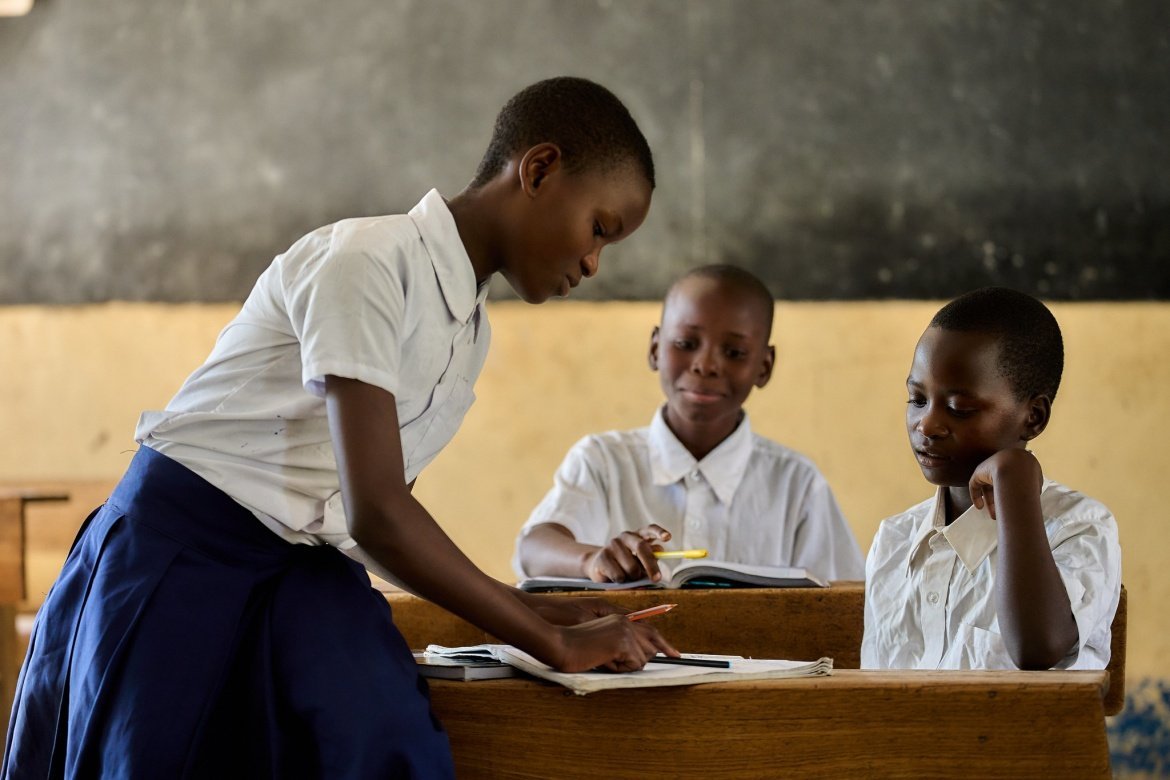
Tanzania's 2022 Census Education and Literacy Monograph, published by NBS in May 2025, documents regional education disparities that are among the largest of any variable measured in the census. Secondary school net enrolment ranges from 26.3 percent in Tabora to 65.8 percent in Kilimanjaro, a 39-percentage-point gap within a single country. Primary school net enrolment ranges from 63.2 percent in Tabora to 93.8 percent in Dar es Salaam. Adult literacy ranges from 68.0 percent in Tabora to 97.5 percent in Dar es Salaam. University and tertiary net enrolment ranges from 2.1 percent in Katavi to 9.2 percent in Dar es Salaam. Rural secondary enrolment nationally is 36.7 percent against urban secondary enrolment of 57.9 percent. The five most educationally disadvantaged regions by secondary enrolment are Tabora at 26.3 percent, Katavi at 27.0 percent, Simiyu at 30.5 percent, Shinyanga at 33.4 percent, and Rukwa at 32.3 percent. The five most educationally advantaged regions are Kilimanjaro at 65.8 percent, Dar es Salaam at 63.1 percent, Mjini Magharibi Zanzibar at 66.3 percent, Iringa at 58.8 percent, and Arusha at 56.0 percent. The geographic inequality documented in this census is not a measurement artifact. It is a policy outcome whose perpetuation across successive censuses confirms that Tanzania's education investment has not been distributed in proportion to need.
DAR ES SALAAM — Tanzania's National Bureau of Statistics published the Education and Literacy Analysis Monograph from the 2022 Population and Housing Census in May 2025. It is a document of considerable technical detail and considerable political discomfort.
The discomfort lies not in any single number but in the pattern the numbers collectively describe: a country in which the probability of a child reaching secondary school, becoming literate, and accessing university education varies by a factor of two to three depending solely on which region they were born in. Not which family. Not which school. Which region.
That is the geography of opportunity in Tanzania, documented in 2022 by the most comprehensive data collection exercise the country has ever conducted. And it is the geography that Vision 2050's human capital ambitions must reckon with honestly if the ambitions are to be achievable rather than aspirational.
The secondary school gap
The secondary school net enrolment rate is the single most consequential education statistic for a country at Tanzania's development stage. Primary enrolment, at 82.1 percent nationally, is high and broadly distributed. The gap that determines economic trajectories opens at secondary level, where the skills whose development requires structured education in mathematics, sciences, and analytical reasoning are either built or missed permanently.
The 2022 census data shows that secondary school net enrolment rates in lower secondary education range from 26.3 percent in Tabora to 65.8 percent in Kilimanjaro within Mainland Tanzania, and from 55.3 percent in Kaskazini Unguja to 66.3 percent in Mjini Magharibi within Tanzania Zanzibar.
The five most disadvantaged regions by secondary enrolment tell a specific geographic story. Tabora at 26.3 percent, Katavi at 27.0 percent, Simiyu at 30.5 percent, Rukwa at 32.3 percent, and Shinyanga at 33.4 percent are all in Tanzania's western and central interior. They share geography, distance from Dar es Salaam, limited infrastructure investment historically, and the educational outcomes those conditions produce across multiple census cycles.
The five most advantaged regions tell the complementary story. Kilimanjaro at 65.8 percent, Dar es Salaam at 63.1 percent, Mjini Magharibi at 66.3 percent, Iringa at 58.8 percent, and Arusha at 56.0 percent are all either urban centres or historically well-served highland regions with strong missionary and colonial education investment. Their advantage in 2022 is the compounded product of decisions made across the century.
A child born in Tabora today faces a one in four chance of enrolling in secondary school. A child born in Kilimanjaro faces a two in three chance. The two children live in the same country, are governed by the same education policy, and will present themselves to the same labour market. The probability that the Kilimanjaro child enters that market with secondary qualifications is approximately two and a half times higher than the probability for the Tabora child, before either child has made a single decision about their own life.
The literacy gap that compounds across generations
Adult literacy rates in Tanzania range from 68.0 percent in Tabora Region to 97.5 percent in Dar es Salaam Region, with urban areas at 93.5 percent outperforming rural areas at 76.5 percent across all regions.
The 29-percentage-point gap between Tabora and Dar es Salaam in adult literacy is not simply a historical legacy. It is a present-tense constraint that shapes the economic productivity, the parenting capacity, the civic participation, and the generational transmission of educational aspiration of every adult in those regions today. A parent who is not literate cannot help a child with homework. A community with 68 percent adult literacy produces a different educational environment for its children than one with 97.5 percent, regardless of what school infrastructure policy provides.
Literacy rates in the regions with the lowest secondary enrolment are consistently among the lowest in the country. Tabora is lowest on both measures. Katavi, at 70.4 percent adult literacy, ranks near the bottom. Simiyu, at 75.0 percent, and Kigoma, at 76.7 percent, are similarly positioned. The correlation is not coincidental. Low parental literacy reduces the home educational environment that school quality alone cannot substitute for. The geographic inequality in secondary enrolment and the geographic inequality in adult literacy are the same phenomenon observed at different points in the educational pipeline.
The university gap that determines economic trajectory
University and tertiary net enrolment ranges from 2.1 percent in Katavi to 9.2 percent in Dar es Salaam, with the national average at 5.0 percent.
These are not large numbers anywhere in Tanzania. A national tertiary enrolment rate of 5.0 percent is low by any regional comparison, as Uchumi360's analysis of the Ataraxis Global Outsourcing Talent Index documented when George Atuahene identified Tanzania's 7.83 percent gross tertiary enrolment ratio as a binding constraint on outsourcing competitiveness. But the variation within that low national average is itself significant.
Dar es Salaam at 9.2 percent, Arusha at 8.1 percent, and Kilimanjaro at 9.1 percent produce tertiary graduates at rates that approach or exceed the national average by a substantial margin. Katavi at 2.1 percent, Tabora at 2.4 percent, Lindi at 2.3 percent, and Mtwara at 2.9 percent produce them at less than a third of Dar es Salaam's rate. The pipeline between birth region and university is not determined by talent. It is determined by secondary enrolment rates, which are determined by geography.
The urban-rural divide within the regional divide
The regional numbers contain a further layer of inequality that the aggregates obscure. Within every region, urban and rural educational outcomes diverge substantially.
Rural secondary net enrolment nationally is 36.7 percent against urban secondary enrolment of 57.9 percent, a gap of 21.2 percentage points that is consistent across virtually all regions in the 2022 census data.
This means that even within Kilimanjaro, whose regional secondary enrolment rate of 65.8 percent is the highest in Mainland Tanzania, rural children face a substantially lower probability of secondary enrolment than urban children. And within Tabora, whose regional rate of 26.3 percent is the lowest, rural children face rates even below the already low regional figure.
The geography of educational opportunity in Tanzania therefore operates at two scales simultaneously. The regional scale, where western and central interior regions face systematic disadvantage relative to coastal, highland, and urban regions, and the urban-rural scale within each region, where the same gradient repeats itself between the district's urban centre and its rural hinterland.
A rural child in Tabora sits at the intersection of both disadvantages. The cumulative probability reduction from national average secondary enrolment to rural Tabora enrolment describes the educational fate that geography imposes on the children born there before they have had any opportunity to demonstrate talent, effort, or ambition.
What produced the gap and what sustains it
The geographic inequality documented in the 2022 census is not new. The 2012 census documented similar regional patterns. The 2002 census documented them before that. The persistence of the gap across three census cycles is the most important analytical finding, not its existence in any single year.
A gap that persists across twenty years of sustained economic growth, infrastructure investment, and education policy reform is a gap whose reproduction is structural rather than incidental. It is not the product of neglect in any single budget cycle. It is the product of a resource allocation system that has consistently distributed educational investment in ways that do not reduce the geographic inequality as fast as the inequality compounds.
Teacher deployment is the most direct mechanism. The regions with the lowest secondary enrolment rates are the regions where qualified teacher shortages are most acute, where posting to rural schools is least desirable for professionally ambitious teachers, and where the private tuition ecosystem that supplements formal schooling in wealthier urban areas is least developed. A secondary school in Tabora competes for qualified mathematics and science teachers with schools in Mwanza, Dodoma, and ultimately Dar es Salaam, where salaries, living conditions, and career prospects are materially better. The market clears against Tabora on every dimension.
Infrastructure is the second mechanism. Secondary schools require laboratories, libraries, internet connectivity, and functioning sanitation to deliver the learning environment whose outputs the census measures. These facilities are distributed in proportion to historical investment, which is distributed in proportion to proximity to centres of colonial and post-colonial administrative attention, which is distributed in patterns that favour the same regions that now show the highest enrolment and attainment.
The road that connects a rural village to the nearest secondary school is the most literal expression of the infrastructure-education connection. The NBS survey confirms that literacy rates in rural areas are consistently lower than urban rates within every region. The transport and connectivity infrastructure that determines school accessibility is itself unequally distributed in ways that track the geographic inequality the education data documents.
The five most disadvantaged and five most advantaged regions
The 2022 census data allows a specific ranking whose publication makes the geographic inequality concrete in ways that aggregate national statistics obscure.
The five most educationally disadvantaged regions by secondary net enrolment rate in Mainland Tanzania are Tabora at 26.3 percent, Katavi at 27.0 percent, Simiyu at 30.5 percent, Rukwa at 32.3 percent, and Shinyanga at 33.4 percent. All five have adult literacy rates below 80 percent. All five have university enrolment rates below 4 percent. All five are in western or central Tanzania.
The five most educationally advantaged regions in Mainland Tanzania by secondary net enrolment rate are Kilimanjaro at 65.8 percent, Dar es Salaam at 63.1 percent, Iringa at 58.8 percent, Arusha at 56.0 percent, and Mbeya at 52.0 percent. All five have adult literacy rates above 84 percent. All five have university enrolment rates above 6 percent. All five are either major urban centres or historically well-served highland regions.
Table: Tanzania's Educational Opportunity Gap by Region, 2022 Census
| Region | Secondary NER | Adult Literacy | University NER | Category |
| Dar es Salaam | 63.1% | 97.5% | 9.2% | Most advantaged |
| Kilimanjaro | 65.8% | 94.2% | 9.1% | Most advantaged |
| Arusha | 56.0% | 84.8% | 8.1% | Most advantaged |
| Iringa | 58.8% | 89.5% | 6.6% | Most advantaged |
| Mbeya | 52.0% | 87.9% | 6.5% | Most advantaged |
| National average | 43.2% | 82.8% | 4.9% | Benchmark |
| Kagera | 42.2% | 80.1% | 3.4% | Below average |
| Geita | 35.2% | 77.0% | 3.1% | Below average |
| Rukwa | 32.3% | 74.1% | 2.4% | Most disadvantaged |
| Shinyanga | 33.4% | 77.3% | 3.0% | Most disadvantaged |
| Simiyu | 30.5% | 75.0% | 3.2% | Most disadvantaged |
| Katavi | 27.0% | 70.4% | 2.1% | Most disadvantaged |
| Tabora | 26.3% | 68.0% | 2.4% | Most disadvantaged |
Source: NBS, Education and Literacy Analysis in Tanzania, 2022 Population and Housing Census, May 2025.
What this means for Vision 2050
Tanzania's Vision 2050 targets a USD 1 trillion economy built on manufacturing, technology, and high-productivity services. The Ataraxis Index 2026 ranks Tanzania 100th globally in outsourcing talent availability. The NBS Household Energy Consumption Survey 2023 shows that 68.8 percent of Tanzanians have only primary education as their highest level.
The 2022 census education monograph adds the geographic dimension that those aggregate statistics obscure. The human capital deficit that constrains Tanzania's economic ambitions is not uniformly distributed. It is concentrated in specific regions whose educational outcomes have been systematically below the national average for at least three census cycles. Closing the national aggregate gap requires closing the regional gap first, and closing the regional gap requires directing educational investment to the five most disadvantaged regions at a rate that exceeds their population share rather than simply tracking it.
The current budget allocation model does not consistently do this. Tanzania's education budget is distributed through a combination of central ministry programming and local government allocations whose relationship to need rather than existing capacity is inconsistent. A school funding formula that allocates per-pupil resources in proportion to the inverse of a region's secondary enrolment rate, directing the highest per-student investment to the regions with the lowest enrolment, would begin to address the geographic inequality rather than sustaining it.
The argument the census data makes
A child born in Tabora did not choose to be born in Tabora. A child born in Kilimanjaro did not choose to be born in Kilimanjaro. The 39-percentage-point gap in their probability of reaching secondary school is not a product of choices either child has made. It is a product of a resource distribution system that has maintained that gap across the entire period for which Tanzania has census data.
Talent is distributed geographically at birth in approximately equal proportions. The children born in Tabora in any given year contain roughly the same distribution of intellectual potential, learning capacity, and academic aptitude as the children born in Kilimanjaro. What differs is not the children. What differs is the educational infrastructure their geography provides them access to.
A country that genuinely believes in meritocracy cannot simultaneously accept a system in which your district of birth predicts your educational outcomes more reliably than your demonstrated capability. The 2022 census has provided the data to make that contradiction visible at the regional level for the first time in comprehensive digital form.
The data is now published. The gap is documented. The policy response is the remaining question.
FAQ
What is Tanzania's secondary school net enrolment rate nationally? Tanzania's lower secondary school net enrolment rate is 43.8 percent nationally, according to the 2022 Population and Housing Census. This means fewer than half of children aged 14 to 17 were enrolled in secondary school at the time of the census.
Which Tanzanian regions have the lowest secondary school enrolment? The five most disadvantaged regions by secondary net enrolment rate in Mainland Tanzania are Tabora at 26.3 percent, Katavi at 27.0 percent, Simiyu at 30.5 percent, Rukwa at 32.3 percent, and Shinyanga at 33.4 percent. All five are in western or central Tanzania and all five have adult literacy rates below 80 percent.
Which regions have the highest secondary school enrolment? Kilimanjaro at 65.8 percent, Dar es Salaam at 63.1 percent, Iringa at 58.8 percent, Arusha at 56.0 percent, and Mbeya at 52.0 percent lead Mainland Tanzania. Mjini Magharibi in Tanzania Zanzibar leads the country at 66.3 percent.
How large is the gap between Tanzania's most and least educationally advantaged regions? The secondary enrolment gap between Kilimanjaro at 65.8 percent and Tabora at 26.3 percent is 39.5 percentage points. The adult literacy gap between Dar es Salaam at 97.5 percent and Tabora at 68.0 percent is 29.5 percentage points. The university enrolment gap between Dar es Salaam at 9.2 percent and Katavi at 2.1 percent is 7.1 percentage points.
Has this regional inequality improved since previous censuses? The 2022 census monograph compares primary enrolment with 2012 data and confirms that the national rate improved. However, regional disparities have persisted across census cycles in broadly similar patterns. The regions that ranked lowest in 2012 remain broadly the lowest in 2022. The gap has not closed at the rate that economic growth and education investment would predict if resources were distributed in proportion to need.
 Uchumi360
Business Intelligence
Uchumi360
Business Intelligence
- National Bureau of Statistics Tanzania and Office of the Chief Government Statistician, Education and Literacy Analysis in Tanzania, 2022 Population and Housing Census, May 2025
- Secondary NER by region: Tabora 26.3 percent, Katavi 27.0 percent, Kilimanjaro 65.8 percent, Dar es Salaam 63.1 percent
- Adult literacy by region: Tabora 68.0 percent, Dar es Salaam 97.5 percent
- University NER by region: Katavi 2.1 percent, Dar es Salaam 9.2 percent
- Rural secondary NER 36.7 percent, urban 57.9 percent
- Available at nbs.go.tz
- Ataraxis Management, 2026 Global Outsourcing Talent Index
- Tanzania rank 100th globally
- George Atuahene CEO, talent availability as primary constraint
- Available at ataraxismgmt.com
- Uchumi360, "68.8 Percent of Tanzanians Have No Education Beyond Primary School," July 2026
- NBS Household Energy Consumption Survey 2023 analysis
- Available at uchumi360.com
- Uchumi360, "The School Postcode Problem," July 2026
- Private versus public school quality gap in Dar es Salaam
- Available at uchumi360.com
- Tanzania National Development Plan 2026/27, National Planning Commission
- Education investment targets and TVET enrolment
- Available at planning.go.tz
Uchumi360 covers business, investment, and economic policy across East, Central, and Southern Africa.
For the serious reader
You read to the end. That places you in a small group.
Uchumi360 is built for readers who demand precision over speed, structure over sentiment, and analysis that holds uncomfortable conclusions rather than softening them. If this work sharpens how you think about Africa's economy, help us keep building the infrastructure behind it.
Institutional Partners
Commission intelligence. Shape the conversation.
Uchumi360 works with development finance institutions, investment firms, sovereign bodies, and strategic organisations across the coverage region. Institutional partnership unlocks:
- Commissioned sector and country intelligence reports
- Branded research series under your institution's authority
- Exclusive data briefings for internal strategy teams
- Speaking and editorial presence at Uchumi360 events
- Co-published investment outlooks for your markets
Support Our Work
Independent analysis has a cost. Help us bear it.
Uchumi360 does not carry advertising. It does not take editorial direction from sponsors. Every article is produced without commercial compromise. Your contribution funds the reporting, research, and editorial infrastructure that keeps this analysis free from influence.
Secure checkout: One-time and monthly support are processed securely. Add payment credentials to enable checkout here.
Stay Connected
Keep up with every new insight.
Follow our latest analysis, policy coverage, and market intelligence as soon as it is published. If you need something specific, reach out directly and we will point you to the right research.
