
The UAE is Quietly Building Africa's Infrastructure Empire. East Africa May Be Its Next Strategic Frontier.
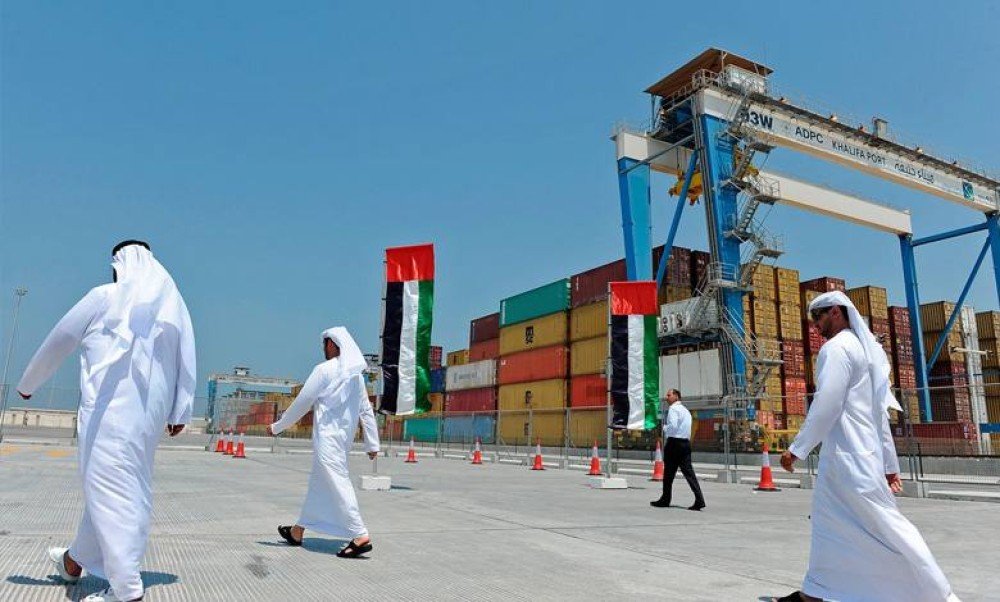
Ready
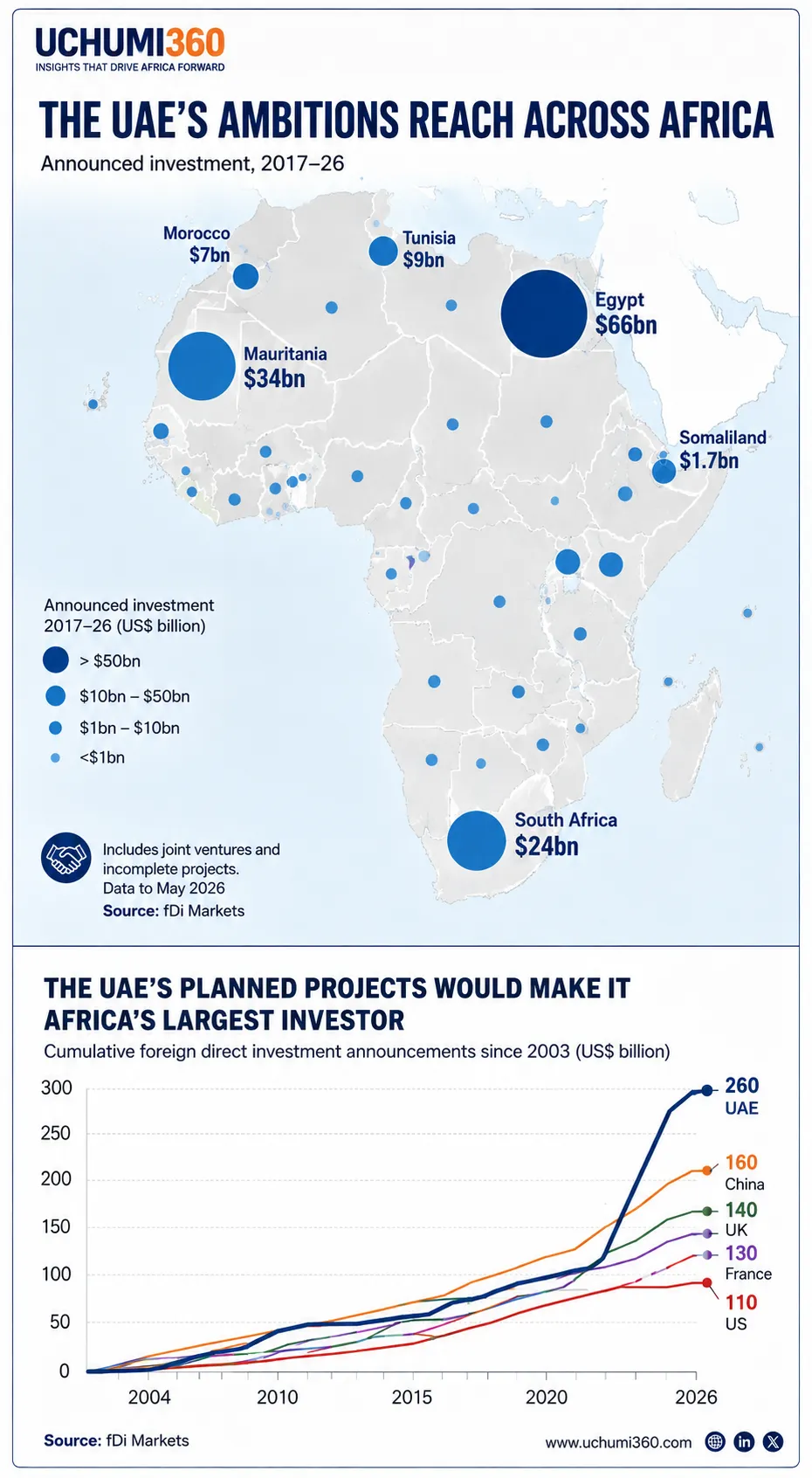
Cumulative announced UAE investment in Africa has surpassed US$250 billion since 2003, per fDi Markets, overtaking China, the UK, France and the US, though this measures announced and often incomplete project value, not realised FDI stock, where UNCTAD data still places Europe and the US ahead. The investment is concentrated geographically: Egypt ($66bn, anchored by the $35bn Ras El Hekma deal), Mauritania ($34bn, the Infinity Power renewable project), South Africa ($24bn), with smaller but strategically placed stakes in Tunisia, Morocco and Somaliland. The pattern is corridor-based, not market-based: ports, minerals, energy and logistics assets that control how goods move, exemplified by DP World's expansion into Dar es Salaam, Mombasa and beyond. Kenya's cancelled Adani-Adani Group port deal is the cautionary counterweight this strategy hasn't fully reckoned with yet.
For nearly two decades, conversations about foreign investment in Africa revolved around familiar names. China built railways and highways. The United States promoted private investment through Prosper Africa. European countries remained major sources of development finance and FDI stock. While attention stayed fixed on those players, the UAE quietly changed the investment map, and the numbers now support the claim rather than just the narrative.
The number, and the caveat it needs
According to fDi Markets, cumulative announced UAE investment in Africa has surpassed US$250 billion since 2003, overtaking China, the UK, France and the US in the process. That figure deserves one immediate qualification the headline version usually skips: fDi Markets tracks announced greenfield investment, including joint ventures and projects still incomplete as of the May 2026 data cut. It measures intent and commitment, not capital that has actually landed and been deployed.
That distinction matters because other data sources tell a different story on a different metric. UNCTAD's stock-based figures, which measure actual foreign-owned assets rather than announcements, still show Europe and the US holding larger cumulative positions in Africa than the UAE, and even China's FDI stock reportedly still trails several Western economies despite its visibility. The honest read of the $250 billion figure is that the UAE has become the largest source of newly announced investment momentum in Africa, arriving faster and in larger single transactions than any other country right now, not that it has necessarily overtaken everyone on accumulated ownership. Both things can be true, and the distinction is the difference between measuring a trend and measuring a stock.
Where the money is actually going
The geographic distribution is the more analytically useful part of the picture, and it's concentrated rather than broad-based. Egypt has attracted approximately $66 billion, anchored by the $35 billion Ras El Hekma coastal development deal led by Abu Dhabi's ADQ, among the largest single FDI transactions ever concluded on the continent. Mauritania follows at $34 billion, driven substantially by the Infinity Power renewable energy project, a Masdar joint venture with Egypt's Infinity. South Africa has received $24 billion, Tunisia $9 billion, Morocco $7 billion, and even Somaliland, despite its unresolved international status, has attracted $1.7 billion.
 UAE investments in Africa tracked.
These aren't the countries with Africa's largest economies or consumer markets. They're countries that occupy strategic maritime chokepoints or control access to shipping routes, export corridors or mineral supply chains. Mauritania's Atlantic coastline positions it for green hydrogen export to Europe. Egypt controls the Suez approach. Somaliland sits on the Gulf of Aden. The UAE isn't investing country by country. It's investing corridor by corridor, and the map in the accompanying chart makes that pattern visible in a way the country-level headline figures don't.
What the East Africa numbers actually show
DP World's move into Dar es Salaam is the clearest East African data point available, and it's more instructive examined closely than as a headline. DP World signed a 30-year concession in October 2023 to operate berths 4 to 7 at the Port of Dar es Salaam, committing an initial $250 million with the investment structured to potentially reach $1 billion across the concession period. The measurable result so far: ship turnaround times fell from seven days to three, and the partnership had generated TZS 325.3 billion in government revenue by late 2024, according to Tanzania Ports Authority figures, reinvested into projects including Mgao Island Port and Dhow Wharves.
A second UAE-linked deal followed: AD Ports, in partnership with Adani Ports, secured a separate 30-year concession to operate Container Terminal 2 at the same port, layering a second Gulf-linked operator onto Tanzania's principal gateway. Beyond Dar es Salaam, DP World now operates in roughly ten African ports across the continent, including Djibouti, Senegal, the DRC, Mozambique, Egypt, Algeria, Rwanda and Somalia, giving it a genuinely regional rather than single-country footprint.
The Kenya counterexample the strategy hasn't resolved
The regional picture isn't uniformly smooth, and the article's earlier draft skipped the part of the story that complicates it. Kenya's own port privatisation attempt collapsed in November 2024, when an Adani Group deal for Mombasa and Lamu port assets was scrapped following public outcry and allegations of opaque dealings. The fallout strained UAE-Kenya relations badly enough that President Ruto travelled to Abu Dhabi specifically to repair the relationship. As of mid-2025, Kenya's Treasury had quietly relaunched the Mombasa and Lamu concession process, with DP World speculated as a frontrunner but notably silent, having submitted no formal offer.
That episode is worth weighing against the Tanzania success story rather than treating the region as a single, frictionless investment corridor. Gulf capital's preferred structure, equity stakes, long-term concessions and operational control rather than the sovereign-backed loans China typically extends, carries a different risk profile: it requires sustained political buy-in and public trust in a way debt financing doesn't, and Kenya's experience shows what happens when that trust breaks down mid-negotiation.
Minerals are the second half of the corridor logic
The corridor strategy extends beyond ports into the mineral supply chains those ports and railways ultimately serve. Abu Dhabi's International Resources Holding has acquired a majority stake in Zambia's Mopani copper mine and a controlling stake in a major tin mine in the DRC. Saudi Arabia's Manara Minerals, a comparable Gulf vehicle, has committed up to $15 billion toward African copper, cobalt and lithium assets. Tanzania's own graphite and rare earth development, Uganda's emerging oil exports, and Mozambique's LNG buildout all sit downstream of the same logic: whoever controls the transport corridor captures value regardless of who owns the mine itself.
DP World's own materials on the Dar es Salaam concession make this connection explicit, describing the port's role in strengthening its position as the maritime gateway for green energy metals moving out of the copper belt in Southern-Central Africa. That's not incidental language. It's the strategy stated directly.
The financing gap this is filling, partially
The scale of Gulf investment makes more sense against Africa's actual infrastructure financing shortfall. The African Development Bank estimates the continent needs approximately $170 billion annually in infrastructure investment, against current actual investment of $80–90 billion, leaving an annual gap of roughly $80 billion. UAE capital, at $110 billion committed between 2019 and 2023 alone according to Gulf News reporting on UAE Ministry of Economy figures, is filling a meaningful share of that gap in specific years, though nowhere close to closing it on a sustained annual basis. Renewable energy alone absorbed roughly $70 billion of that 2019–2023 total, with Masdar separately committing $10 billion toward 10 gigawatts of renewable capacity across sub-Saharan Africa by 2030.
What East African governments should actually take from this
The lesson isn't that more capital is arriving, which is the easy and somewhat empty read of the headline figure. It's that Gulf capital is explicitly regional in its logic, and the countries capturing durable value from it are the ones whose infrastructure connects effectively to neighbours rather than the ones simply hosting the largest single project. A modern port in Tanzania that serves Zambia, Burundi, Rwanda, Uganda and the eastern DRC captures more strategic relevance, and more negotiating leverage, than an equivalent port serving only domestic trade.
The Kenya episode adds a second lesson the optimistic version of this story tends to skip: Gulf capital's preferred equity-and-concession model requires sustained institutional trust that debt financing doesn't demand in the same way, and losing that trust mid-deal has real, visible costs, including diplomatic repair trips and stalled procurement processes that outlast the news cycle that caused them.
The Uchumi360 insight
The UAE isn't investing in Africa because it discovered new markets. It's investing because it has priced Africa's future differently than traditional donors and lenders have: not around who owns the commodities, but around who controls the corridors those commodities move through. East Africa sits at the intersection of several of those corridors, which is what makes the region genuinely significant here. But the $250 billion headline number needs the same scrutiny any large FDI announcement deserves, announced isn't deployed, and Kenya's experience is the reminder that Gulf capital's speed cuts both ways when the politics around a deal go wrong.
FAQ
Is the UAE really Africa's largest foreign investor? By announced investment tracked through fDi Markets since 2003, yes, at over $250 billion, ahead of China, the UK, France and the US. By realised FDI stock, UNCTAD data still shows Europe and the US holding larger positions, so the ranking depends heavily on which metric is used.
Which African countries have received the most UAE investment? Egypt ($66bn), Mauritania ($34bn) and South Africa ($24bn) lead, with smaller but strategically concentrated investment in Tunisia, Morocco and Somaliland.
What does DP World actually operate in Tanzania? A 30-year concession over berths 4-7 at the Port of Dar es Salaam, signed October 2023, with an initial $250 million investment structured to reach up to $1 billion over the concession period.
What happened with the UAE-linked port deal in Kenya? An Adani Group deal for Mombasa and Lamu port assets was cancelled in November 2024 following public backlash over transparency concerns, straining UAE-Kenya relations before Kenya relaunched the concession process in 2025.
Why does the UAE's strategy focus on ports and minerals together? Because controlling the transport corridor, ports, railways, logistics, captures strategic and commercial value from mineral exports regardless of who owns the extraction site itself, a pattern visible in DP World's own description of Dar es Salaam as a gateway for regional copper exports.
 Uchumi360
Business Intelligence
Uchumi360
Business Intelligence
- fDi Markets (chart data, 2017–26 and cumulative FDI since 2003);UNCTAD
- African Development Bank
- Gulf News;Global Finance Magazine;ORF Middle East;DP World
- The EastAfrican
- Kenya Insights;The National;Model Diplomat/Chatham House
Uchumi360 covers business, investment, and economic policy across East, Central, and Southern Africa.
For the serious reader
You read to the end. That places you in a small group.
Uchumi360 is built for readers who demand precision over speed, structure over sentiment, and analysis that holds uncomfortable conclusions rather than softening them. If this work sharpens how you think about Africa's economy, help us keep building the infrastructure behind it.
Institutional Partners
Commission intelligence. Shape the conversation.
Uchumi360 works with development finance institutions, investment firms, sovereign bodies, and strategic organisations across the coverage region. Institutional partnership unlocks:
- Commissioned sector and country intelligence reports
- Branded research series under your institution's authority
- Exclusive data briefings for internal strategy teams
- Speaking and editorial presence at Uchumi360 events
- Co-published investment outlooks for your markets
Support Our Work
Independent analysis has a cost. Help us bear it.
Uchumi360 does not carry advertising. It does not take editorial direction from sponsors. Every article is produced without commercial compromise. Your contribution funds the reporting, research, and editorial infrastructure that keeps this analysis free from influence.
Secure checkout: One-time and monthly support are processed securely. Add payment credentials to enable checkout here.
Stay Connected
Keep up with every new insight.
Follow our latest analysis, policy coverage, and market intelligence as soon as it is published. If you need something specific, reach out directly and we will point you to the right research.
