
Ethiopia Takes 12 Su 35 Jets as Russian Arms Push Meets a Tight Fiscal Reform Programme
Ready
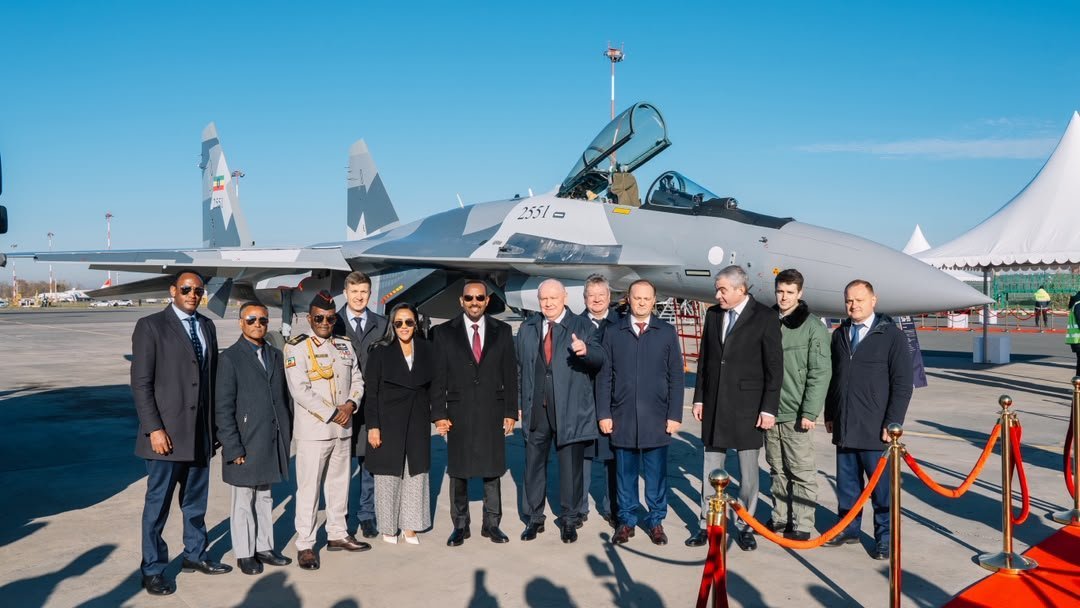
Ethiopia has taken delivery of 12 Russian Su 35 fighter jets and plans to receive four S 400 air defence batteries, but the government has not disclosed the price or financing terms. Comparable Su 35 export deals suggest the aircraft package alone could exceed USD1 billion, placing the acquisition alongside Ethiopia’s wider effort to restructure debt, rebuild foreign exchange liquidity and contain public spending.
Ethiopia has taken delivery of 12 Russian Su 35 fighter jets and plans to receive four S 400 air defence batteries, a major military acquisition that strengthens Addis Ababa’s air power while placing defence spending inside a wider economic debate over fiscal priorities, foreign exchange, industrial capacity and the value of national security at a time when the country is still restructuring external debt, rebuilding reserves and tightening public finances under an IMF supported reform programme.
Prime Minister Abiy Ahmed announced the delivery on October 28, saying the aircraft had arrived a year ahead of schedule under an earlier agreement with Moscow and that Ethiopia would also receive four S 400 air defence systems. He described the acquisition as part of a wider effort to strengthen national security and “preemptively deter aggression,” while Reuters reported that the government had not disclosed the value of the agreement, the financing terms or the delivery schedule for the air defence systems. The lack of those financial details is significant because comparable Su 35 export agreements have historically been worth more than USD100 million per aircraft once training, maintenance, spare engines and support equipment are included, suggesting that the aircraft package alone could represent a commitment above USD1 billion before the S 400 systems and their associated infrastructure are added.
The timing makes the acquisition economically important because Ethiopia is simultaneously trying to improve debt sustainability, rebuild foreign exchange buffers, reduce subsidies and preserve confidence in the fiscal adjustment programme that followed years of external financing stress and domestic conflict. Addis Ababa is therefore making a large security investment while operating under tighter financial constraints than many of the countries that normally purchase such advanced systems, which means the economic case for the procurement depends not only on what the equipment costs, but also on whether stronger defence capacity reduces economic risk, protects infrastructure and contributes to domestic technical capability.
Defence Spending Can Function as Economic Insurance
Military expenditure is usually assessed through its opportunity cost because resources committed to defence cannot simultaneously finance roads, hospitals, schools or other development priorities, and research by the Stockholm International Peace Research Institute has repeatedly shown that military spending can crowd out public investment with higher social returns. That concern remains relevant in Ethiopia, but it does not mean every defence acquisition is economically unproductive, particularly in a country where conflict has already destroyed infrastructure, disrupted trade, weakened investment and imposed large reconstruction costs.
For Ethiopia, credible defence capacity can therefore function as a form of economic insurance if it lowers the probability of another major conflict, protects strategic infrastructure and reduces the risk premium attached to operating in the country. Power plants, airports, industrial parks, transport corridors, telecommunications networks and public infrastructure represent accumulated capital that can be destroyed or disrupted rapidly during war, which means spending designed to protect those assets can have an economic return even if the return does not appear as conventional revenue on a government balance sheet.
The value of that protection depends on whether the additional capability actually reduces the probability and economic consequences of conflict, rather than simply contributing to an arms race or raising tensions with neighbouring states. Ethiopia’s security environment remains sensitive because of renewed instability in the north, deteriorating relations with Eritrea and unresolved regional tensions, which means the economic calculation involves both deterrence benefits and the possibility that greater military capability could intensify regional competition.
The Fiscal Trade-Off Remains Significant
Ethiopia is implementing an IMF supported programme that requires tighter expenditure management, stronger domestic revenue mobilisation and continued reductions in subsidies at the same time that the government is restructuring its external debt. The country reached revised terms with holders of its defaulted USD1 billion Eurobond in 2026, while official creditors have continued to monitor whether the restructuring provides comparable treatment across creditor groups. These reforms are intended to restore debt sustainability and improve access to external financing after several years in which foreign exchange shortages, conflict and debt distress constrained the economy.
A large defence programme therefore has to be assessed alongside the government’s effort to demonstrate fiscal discipline. The acquisition may be manageable if financing is spread over many years or supported by favourable bilateral credit from Russia, while the impact would be significantly heavier if Ethiopia is required to make large upfront payments in hard currency. No public information has yet established which of these structures applies, so the contract value alone would not provide a complete picture even if it were disclosed.
The more relevant fiscal question is how much annual budget space the programme will consume once debt service, fuel, training, maintenance, missiles and replacement parts are included. Modern combat aircraft and advanced air defence systems require recurring expenditure long after delivery, which means the real economic commitment extends across the life of the systems rather than ending with the initial purchase.
Foreign Exchange May Be the More Immediate Constraint
The pressure on foreign exchange could be more important than the headline fiscal cost because Ethiopia is still rebuilding reserves and trying to improve the functioning of its foreign exchange market. The country spent years operating under severe foreign currency shortages, rationing and a large gap between official and parallel exchange rates, and although reforms have improved market conditions, Ethiopia still has to balance demand for fuel, fertiliser, machinery, pharmaceuticals and other essential imports against a limited supply of hard currency.
Military imports draw on the same pool of foreign exchange unless Russia has agreed to long term credit, deferred settlement or another financing mechanism that reduces immediate dollar demand. The structure of the agreement is therefore central to understanding the macroeconomic implications because a procurement programme financed over ten or fifteen years would place far less immediate pressure on reserves than one requiring large near term payments.
The country’s ability to continue rebuilding reserves is also important because stronger foreign exchange buffers reduce the risk of renewed currency stress and give the government more room to absorb external shocks. Defence procurement can coexist with reserve accumulation if foreign currency inflows are strong enough, but the balance becomes more difficult when external financing is tight and import demand remains high.
The Economic Case Becomes Stronger if Ethiopia Builds Capability at Home
The most convincing economic argument for defence spending emerges when the expenditure creates domestic capabilities beyond the immediate military function. Advanced aircraft and air defence systems require engineers, avionics technicians, software specialists, radar operators, logistics professionals, precision maintenance and complex supply chains, all of which can contribute to a wider technical base if those capabilities are developed inside the country.
Ethiopia’s defence establishment has already been trying to increase domestic production and maintenance in areas including ammunition, armoured vehicles, drones, radar systems and military engineering, with the government presenting self reliance as both a security objective and a technology policy. If the Su 35 and S 400 programme includes local maintenance facilities, technician training, electronics support, engineering transfer and deeper integration with Ethiopian technical institutions, part of the expenditure could support skills that are also relevant to civilian aviation, manufacturing, telecommunications and industrial maintenance.
If the programme remains heavily dependent on imported technicians, imported parts and foreign maintenance contracts, the economic spillovers will be much weaker because most of the value added will continue to accrue outside Ethiopia. The distinction between imported capability and domestically embedded capability is therefore central to whether the programme can be defended economically beyond its security function.
Security Has a Direct Relationship With Investment and Growth
The economic cost of insecurity is already well understood in Ethiopia because the conflict that began in 2020 damaged infrastructure, disrupted commerce, reduced investment and forced the government to redirect resources toward military operations and humanitarian response. Even where physical assets are not destroyed, prolonged insecurity raises transport costs, increases insurance premiums, delays investment decisions and weakens business confidence, which reduces the rate at which private capital is deployed.
A stronger deterrence capability can therefore have an economic return if it reduces those risks and protects the continuity of trade and investment. The value is particularly significant for a country that is trying to attract manufacturing, expand industrial parks, increase exports and build major infrastructure because these sectors depend heavily on political stability and predictable operating conditions.
This does not mean military spending automatically produces growth, because the return depends on whether security expenditure genuinely lowers risk and whether the country avoids allowing defence spending to displace more productive investment. The economic argument is strongest when military capability complements, rather than competes excessively with, investment in infrastructure, education, health and productive industry.
Russia Gains a Long Term Economic Relationship
The transaction also deepens Russia’s commercial relationship with Ethiopia because advanced defence systems create long term dependence on the supplier for maintenance, upgrades, weapons, training and spare parts. A fighter aircraft sale can generate decades of follow on revenue and technical cooperation, while an air defence system creates a similar long term relationship around missiles, radar, software and command infrastructure.
For Moscow, this gives the defence agreement economic value beyond the original contract and strengthens Russia’s wider engagement in Africa, where defence exports sit alongside nuclear energy, mining, fertilisers, grain and other sectors in which Russian companies remain competitive. For Ethiopia, the relationship provides access to advanced military technology without relying on Western suppliers, but it also means that a growing share of critical defence capability becomes tied to Russian logistics and technical support.
The strategic relationship therefore has an economic dimension on both sides because Russia gains a long term customer while Ethiopia gains access to military technology that would otherwise be difficult or politically complicated to obtain.
The Economic Return Will Depend on What Ethiopia Builds Around the Purchase
The delivery of 12 Su 35 fighters and the planned acquisition of four S 400 batteries should not be read only as a military story because the programme intersects directly with Ethiopia’s foreign exchange position, debt restructuring, fiscal policy and industrial ambitions. The scale of the commitment is likely to be substantial, but the final economic judgement will depend less on the headline purchase price than on the financing terms, the recurring operating costs and the extent to which the programme contributes to domestic engineering and industrial capability.
If the acquisition reduces the risk of another major conflict, protects strategic infrastructure, supports investor confidence and accelerates local technical development, part of the expenditure can reasonably be viewed as an investment in economic resilience. If it instead creates a large foreign currency burden, remains dependent on imported support and displaces higher return public investment, the economic case becomes significantly weaker.
Ethiopia is therefore making a strategic bet that military modernisation can coexist with fiscal reform and economic reconstruction. Whether that bet pays off will depend on whether the country can convert greater defence capability into lower national risk, stronger domestic technological capacity and a more secure environment for investment and growth.
 Uchumi360
Business Intelligence
Uchumi360 covers business, investment, and economic policy across East, Central, and Southern Africa.
For the serious reader
You read to the end. That places you in a small group.
Uchumi360 is built for readers who demand precision over speed, structure over sentiment, and analysis that holds uncomfortable conclusions rather than softening them. If this work sharpens how you think about Africa's economy, help us keep building the infrastructure behind it.
Institutional Partners
Commission intelligence. Shape the conversation.
Uchumi360 works with development finance institutions, investment firms, sovereign bodies, and strategic organisations across the coverage region. Institutional partnership unlocks:
- Commissioned sector and country intelligence reports
- Branded research series under your institution's authority
- Exclusive data briefings for internal strategy teams
- Speaking and editorial presence at Uchumi360 events
- Co-published investment outlooks for your markets
Support Our Work
Independent analysis has a cost. Help us bear it.
Uchumi360 does not carry advertising. It does not take editorial direction from sponsors. Every article is produced without commercial compromise. Your contribution funds the reporting, research, and editorial infrastructure that keeps this analysis free from influence.
Secure checkout: One-time and monthly support are processed securely. Add payment credentials to enable checkout here.
Stay Connected
Keep up with every new insight.
Follow our latest analysis, policy coverage, and market intelligence as soon as it is published. If you need something specific, reach out directly and we will point you to the right research.
