
Kenya Has Broken Ground on a KSh 700 Billion SGR Extension to Malaba and Kisumu. The Northern Corridor's Transformation From Road to Rail Is Now Under Construction.
Ready
Kenya has started construction on the 370km SGR extension to Malaba and Kisumu, targeting 22 million tonnes of annual freight capacity and a 40 percent reduction in logistics costs. Uganda has a EUR 2.7 billion contract for the 272km Malaba-to-Kampala section, backed by IsDB and AfDB financing. A bilateral engineering pact resolves the Chinese-versus-European design standard incompatibility at the border. If both sides deliver, Mombasa-to-Kampala transit time falls from four to five days to 24 hours and container costs drop from approximately USD 3,500 to USD 1,600.
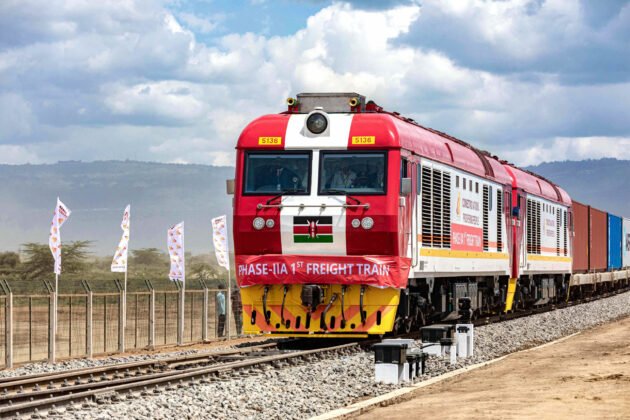
NAIROBI — Kenya has officially broken ground on the Phase 2B and 2C extensions of its Standard Gauge Railway, pushing the network 370 kilometres from its current Naivasha terminus through nine counties to the Malaba border crossing with Uganda. A branch line to Kisumu Port is included in the works. Separately, a 15km commuter rail link from Syokimau to the Nairobi CBD has gone to public tender, targeting the capital's chronic road congestion rather than regional freight.
The combined programme is estimated at between KSh 500 billion and KSh 700 billion. Construction is underway.
What is actually being built
The mainline extension is the strategically significant piece. Running from Naivasha through western Kenya to Malaba, it connects the existing Mombasa-Naivasha corridor to Uganda's border for the first time by standard gauge rail. The Kisumu branch extends a spur to Lake Victoria, which revives the port's historic role as a tri-nation trade hub linking Kenya, Uganda, and Tanzania through lake ferry connections.
The Syokimau-Nairobi CBD link is a separate and more localised intervention, 15 kilometres of urban commuter rail designed to pull daily workers off Mombasa Road. It addresses a different problem from the mainline extension, city-level congestion rather than regional freight costs, and is proceeding through tender rather than construction commencement.
Uganda is building from the other end
The Northern Corridor integration story is more compelling than either country's individual project because both sides are building toward the same border simultaneously.
Uganda has transitioned from planning to physical implementation on its 272km Malaba-to-Kampala SGR line, backed by a EUR 2.7 billion engineering contract. Financing has been secured from the Islamic Development Bank and the African Development Bank, with a sovereign Sukuk bond planned to supplement both. That financing architecture is more advanced than Uganda's SGR funding position has been at any previous point.
The coordination is deliberate. Kenya's extension toward Malaba creates the connection Uganda needed to justify its own capital commitment. Uganda's implementation gives Kenya's extension a destination rather than a terminus at an empty border post.
The engineering compatibility problem and how it was solved
For years, a technical obstacle sat at the centre of Northern Corridor integration. Kenya's SGR was built to Chinese design standards. Uganda opted for European specifications. Track geometry, axle loads, signalling, rolling stock, and electrification systems were incompatible at the border.
Both governments have signed a bilateral engineering pact requiring design modifications that make the two networks interoperable at Malaba. Uganda's turnkey contractor is legally obligated to guarantee that its systems interface with Kenya's at the border station, permitting uninterrupted cross-border operations without cargo transfer between trains.
This is not a small administrative detail. It is the difference between a corridor and two separate railways that happen to end near each other.
The freight economics if it works
The targets are ambitious but not implausible if the corridor delivers as designed.
The network is projected to handle 22 million tonnes of annual freight capacity, with logistics costs falling 40 percent relative to the current road-dominated system. Mombasa-to-Kampala transit time is targeted at 24 hours against the current four to five days by road and metre-gauge rail. Container freight costs are projected to fall from approximately USD 3,500 to USD 1,600 per unit.
Those numbers assume the corridor operates as an integrated system rather than as two national railways with a connection point. The bilateral engineering pact is the mechanism designed to make that assumption hold.
What Western Kenya gains specifically
The Kisumu branch and the mainline routing through western Kenya are not incidental to the freight economics. Western Kenya is an agricultural production zone, tea, sugarcane, fresh produce, whose market access has historically been constrained by road freight costs and transit times to Mombasa.
Direct SGR access to Mombasa Port reduces the landed cost of exports and improves the competitive position of western Kenyan producers in international markets. The Kisumu Port connection adds a lake freight dimension, with cargo moving by vessel to Ugandan and Tanzanian lake ports as a complement to the overland rail corridor.
The Northern Corridor integration framework
The railway construction is the physical expression of two broader agreements that have existed on paper for longer than the tracks have been in the ground.
The Northern Corridor Integration Projects protocol mandates that partner states develop a high-capacity, uniform transport grid. The 1998 Kenya-Uganda Railway Cooperation Agreement is being updated to reflect modern rail realities, with provisions for eventual extension to Rwanda, South Sudan, and the DRC. Kenya's construction commencement and Uganda's contract award are converting those paper commitments into active infrastructure.
Whether they convert into a functioning corridor on the timelines both governments are projecting is the question that financing continuity, construction execution, and political durability across multiple election cycles will determine.
FAQ
What is the SGR Phase 2B and 2C extension? A 370km railway line from Naivasha, the current western terminus of Kenya's SGR, to Malaba on the Ugandan border, with a branch to Kisumu Port. Construction began in 2026. Estimated cost is between KSh 500 billion and KSh 700 billion.
What is Uganda building on its side? A 272km SGR line from Malaba to Kampala, covered by a EUR 2.7 billion engineering contract and financed by the Islamic Development Bank, the African Development Bank, and a planned sovereign Sukuk bond.
How was the design standards incompatibility resolved? Kenya built to Chinese standards; Uganda chose European specifications. A bilateral engineering pact requires design modifications making both networks interoperable at Malaba. Uganda's contractor is legally required to guarantee seamless interface with Kenya's system at the border.
What are the freight targets? 22 million tonnes of annual freight capacity, 40 percent reduction in logistics costs, Mombasa-to-Kampala transit time reduced from four to five days to 24 hours, and container costs falling from approximately USD 3,500 to USD 1,600.
What does the Kisumu Port branch add? It connects the mainline to Lake Victoria, allowing cargo to move by vessel to Ugandan and Tanzanian lake ports as a complement to the overland rail route. It also gives western Kenya's agricultural producers direct rail access to Mombasa Port, reducing export logistics costs.
 Uchumi360
Business Intelligence
Uchumi360
Business Intelligence
Uchumi360 covers business, investment, and economic policy across East, Central, and Southern Africa.
For the serious reader
You read to the end. That places you in a small group.
Uchumi360 is built for readers who demand precision over speed, structure over sentiment, and analysis that holds uncomfortable conclusions rather than softening them. If this work sharpens how you think about Africa's economy, help us keep building the infrastructure behind it.
Institutional Partners
Commission intelligence. Shape the conversation.
Uchumi360 works with development finance institutions, investment firms, sovereign bodies, and strategic organisations across the coverage region. Institutional partnership unlocks:
- Commissioned sector and country intelligence reports
- Branded research series under your institution's authority
- Exclusive data briefings for internal strategy teams
- Speaking and editorial presence at Uchumi360 events
- Co-published investment outlooks for your markets
Support Our Work
Independent analysis has a cost. Help us bear it.
Uchumi360 does not carry advertising. It does not take editorial direction from sponsors. Every article is produced without commercial compromise. Your contribution funds the reporting, research, and editorial infrastructure that keeps this analysis free from influence.
Secure checkout: One-time and monthly support are processed securely. Add payment credentials to enable checkout here.
Stay Connected
Keep up with every new insight.
Follow our latest analysis, policy coverage, and market intelligence as soon as it is published. If you need something specific, reach out directly and we will point you to the right research.
