
Tanzania Begins Feasibility Study for Dar es Salaam Monorail as Dodoma Seeks Financing for Its Own Commuter Rail
Ready
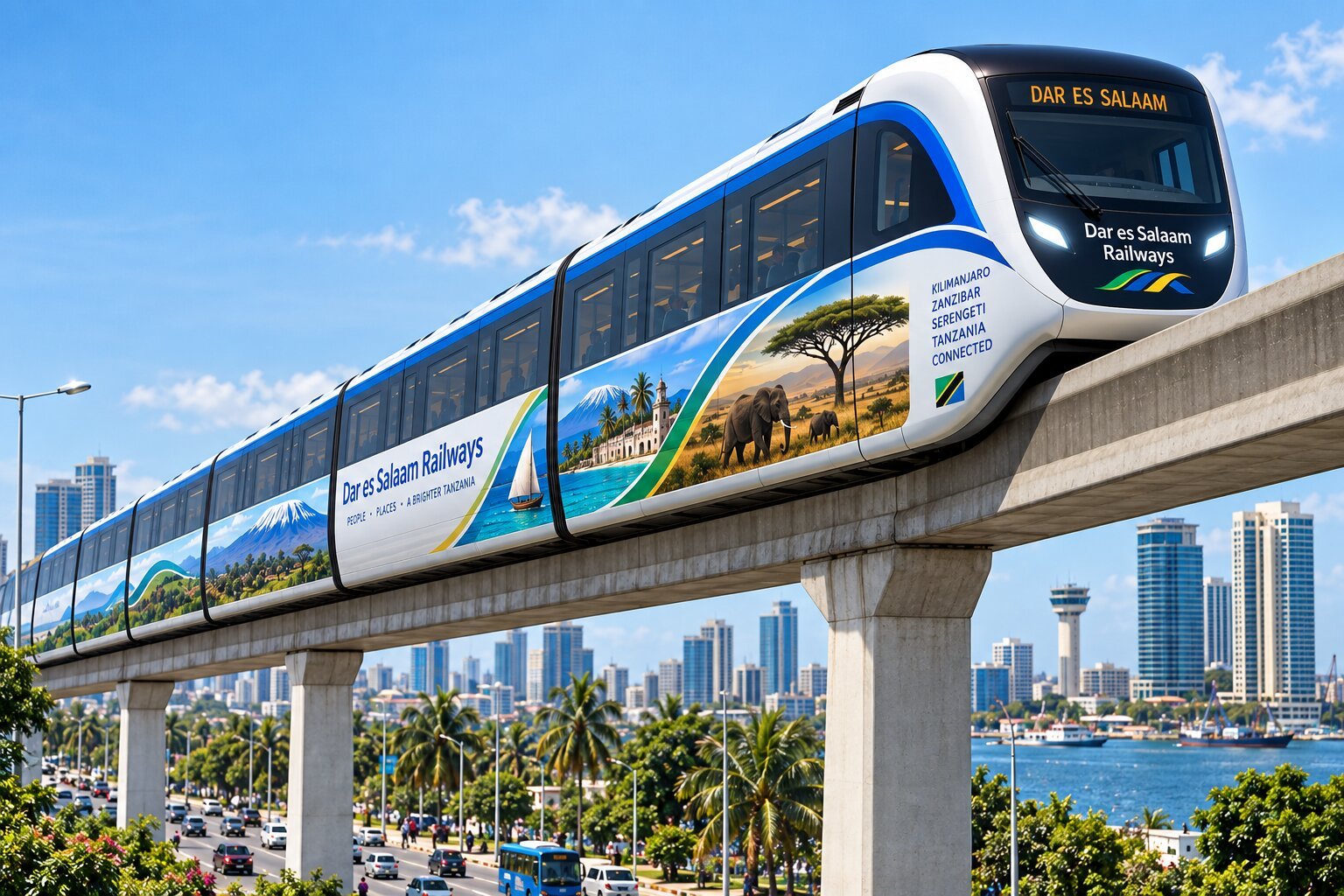
Tanzania is moving from building railways between its cities to planning railways inside them. Tanzania Railways Corporation held its first meeting with French consultancy Systra on 17 September 2026, formally launching a feasibility study for a proposed Dar es Salaam monorail. Dodoma's equivalent project is already a step ahead, TRC has completed a 107-kilometre commuter rail feasibility study for the capital and is now searching for private financing. Neither project should be confused with the existing Dar es Salaam-Dodoma Standard Gauge Railway, which already carries over two and a half million passengers a year between the two cities. These are different systems entirely, built to move people within a single city rather than between two of them, and TRC says Mwanza and Mbeya are next in line after that.
DAR ES SALAAM — Tanzania is preparing to build new urban railway systems in Dar es Salaam and Dodoma, moving the country's rail ambitions from connecting cities to connecting neighbourhoods within them. Both projects are being developed by Tanzania Railways Corporation, but they sit at meaningfully different stages: Dar es Salaam has just entered a new feasibility phase, while Dodoma has already completed its feasibility study and is now searching for financing.
What Actually Happened in Dar es Salaam This Week?
TRC held its first formal meeting with French engineering consultancy Systra on 17 September 2026, marking the start of a feasibility study for a proposed urban monorail. In a statement issued the same day, TRC said the study would assess the project's requirements, including the proposed route, appropriate construction technology, estimated costs and the most suitable implementation model, intended to guide decisions on how the system can best respond to the city's growing transport needs. TRC Director General Machibya Shiwa said the proposed monorail is expected to reduce travel time and costs, ease traffic congestion, and improve access to workplaces, business centres and essential services across the city, adding that the project could contribute to economic activity by improving business efficiency, creating employment and investment opportunities, and increasing the value of areas the rail system serves, while helping reduce the economic losses associated with time lost to traffic congestion. "All these efforts are part of the government's initiatives to strengthen urban transport in line with the Tanzania Development Vision 2050, which seeks to build modern infrastructure and support sustainable urban and national economic growth," Shiwa said.
Is This Actually a New Idea, or Has Tanzania Been Here Before?
The Dar es Salaam urban rail concept has existed in various forms for some time, and it's worth being precise about the different versions currently in circulation. Tanzania's Investment and Special Economic Zones Authority (TISEZA) has previously listed a considerably broader commuter railway network covering Dar es Salaam and its surrounding municipalities, including proposed connections toward Pugu and the airport, Bagamoyo, Kibaha, Kigamboni, and an outer urban circle linking several rapidly growing settlements, estimated at $8 billion and proposed for delivery through a public-private partnership. Separately, the government's current PPP pipeline lists a narrower $2.2 billion Dar es Salaam commuter railway project, including dedicated railway infrastructure, modern rolling stock, signalling and telecommunications, passenger terminals and associated commercial facilities, currently sitting at the concept note stage with Tanzania's PPP Centre.
This week's Systra feasibility study represents the formal start of determining which version, or what combination of these plans, actually becomes buildable. It follows a May 2026 announcement from the Ministry of Transport that the 2026/27 transport budget would fund the start of exactly this kind of feasibility study, meaning TRC's September meeting confirms a process the government had already committed to funding months earlier.
How Far Ahead Is Dodoma's Project?
Considerably further. TRC has already completed a feasibility study for a 107-kilometre urban commuter railway network in Dodoma and is now actively seeking financing, discussing the project with potential partners under a PPP model. Shiwa told The Citizen that several potential partners had expressed interest as the corporation works to secure funding, while also inviting integration with existing informal and formal transport: "We warmly welcome other stakeholders, including municipal buses (daladalas), taxis, bajajs and bodabodas, to integrate with our system so we can create a highly connected multi-modal transit hub."
The proposed network centres on a Central Dodoma Station at Jamatini, connecting the new urban railway with the existing SGR and other public transport. The first phase comprises three lines: a 52.9-kilometre Red Line with 41 stations, a 28.6-kilometre Purple Line with 23 stations, and a 23.1-kilometre Green Line with 18 stations. The network's routing follows the geography of Tanzania's rapidly expanding capital directly, with one important corridor running along Arusha Road from the central station toward the planned Msalato International Airport, while the Red Line separately connects the central station with Ihumwa and Nala and links Msalato Airport with the Government City area in Mtumba. A second phase would extend the Purple Line by a further 13.3 kilometres and the Green Line by 62.9 kilometres, meaning the full master plan ultimately envisions a considerably larger network than the 107 kilometres covered by the initial project alone.
The feasibility work itself was carried out under a €2.5 million TRC contract awarded to a consortium of Spain's Ardanuy Ingenieria, India's Intercontinental Consultants and Technocrats, and South Korea's Soosung Engineering. The project is being coordinated with broader urban development initiatives already underway in the capital, specifically the World Bank-supported Dodoma Integrated and Sustainable Transport Project (DIST) and the Transforming and Accelerating the Implementation of the Dodoma Concept (TACTIC) programme, which together cover urban greening, climate resilience, improved drainage, tree planting, universal accessibility and electric vehicle charging infrastructure, with discussions involving TRC, the Tanzania Rural and Urban Roads Agency (TARURA), SGR officials and the Swedish Embassy specifically on integrating the new railway with the existing Dodoma SGR station.
Is This Different From the Existing Dar es Salaam-Dodoma SGR?
Yes, and the distinction matters considerably for understanding what Tanzania is actually building. Tanzania already operates an electrified Standard Gauge Railway connection between Dar es Salaam and Dodoma, BBC has described it as East Africa's first electric train, covering the 460-kilometre route in under four hours as the first phase of a larger planned 2,560-kilometre network eventually linking Tanzania with Burundi, Rwanda and the DRC. That intercity service carried 2.51 million passengers between July 2025 and March 2026, up from 2.05 million during the comparable period the previous year, a genuinely strong and growing ridership figure in its own right.
The new Dar es Salaam and Dodoma projects are something else entirely: urban transport systems designed to move people within each city, not to connect the two cities to each other. That creates an increasingly layered railway system for Tanzania: the SGR handles intercity and freight movement between major centres, the planned Dar es Salaam monorail would address metropolitan mobility within the country's largest commercial city specifically, and the planned Dodoma network would serve the expanding national capital's residential, administrative and airport corridors internally.
Is This Limited to Just Two Cities?
No, and this is a genuinely important piece of context beyond the immediate Dar es Salaam and Dodoma announcements. TRC's own past statements indicate the corporation views this as a national urban rail programme rather than a two-city initiative: Dodoma's project has previously been described as coming first, "followed by Mbeya and Mwanza, ensuring nationwide connectivity," according to remarks from TRC leadership in 2025. Tanzania's transport authorities are increasingly treating rail as an urban mobility system in its own right rather than purely long-distance infrastructure, a shift reinforced by DART's separate, parallel plans to develop bus rapid transit systems in Dodoma, Tanga, Arusha, Mbeya and Mwanza, suggesting a coordinated push across multiple secondary cities to build modern urban transport simultaneously with the two capital-scale rail projects currently furthest along.
What Does This Actually Signal About Tanzania's Infrastructure Strategy?
The shift from intercity to urban rail marks a meaningful evolution in how Tanzania approaches transport infrastructure more broadly. TRC frames the Dar es Salaam project as expected to reduce travel time, transport costs and congestion while improving access to employment, commerce and public services, exactly the kind of urban productivity argument this publication has made separately about East Africa's housing and transport deficits acting as a genuine constraint on metropolitan economic output. In Dodoma specifically, the railway is being planned as one part of a coordinated multimodal system alongside buses, taxis, bajajis and bodabodas rather than as a standalone replacement for existing transport, a more realistic integration approach than treating a single new rail line as a complete solution on its own.
The stronger economic question raised by both projects isn't simply how many kilometres of track will eventually be built. It's whether Tanzania can actually finance and integrate these systems well enough to genuinely change how its two largest administrative and commercial centres move people, given that Dar es Salaam's project remains at the earliest feasibility stage while even Dodoma's more advanced, fully-studied network still needs to clear financing before a single kilometre of track gets laid.
FAQ
What did Tanzania Railways Corporation actually announce for Dar es Salaam? The start of a feasibility study for a proposed urban monorail, following a first meeting with French consultancy Systra on 17 September 2026, expected to determine the route, technology, cost and implementation model.
How far along is Dodoma's urban rail project compared to Dar es Salaam's? Considerably further. Dodoma's 107-kilometre commuter rail feasibility study is already complete, and TRC is now seeking financing under a public-private partnership, while Dar es Salaam's project has only just begun its feasibility study phase.
Is this the same as the existing Dar es Salaam-Dodoma railway? No. The existing Standard Gauge Railway connects the two cities and carried 2.51 million passengers between July 2025 and March 2026. The new projects are separate urban systems designed to move people within Dar es Salaam and within Dodoma individually.
How much will the Dar es Salaam project actually cost? That remains unclear. A broader TISEZA-listed vision estimated an $8 billion network across Dar es Salaam and surrounding municipalities, while the government's current PPP pipeline lists a narrower $2.2 billion project at concept note stage. The Systra feasibility study now underway is expected to help settle a final cost estimate.
What does Dodoma's planned network actually look like? A first phase of three lines totalling 107 kilometres, a 52.9km Red Line, a 28.6km Purple Line, and a 23.1km Green Line, centred on a Central Dodoma Station connecting to the existing SGR, with a second phase planned to add a further 76.2 kilometres across the Purple and Green Lines.
Will other Tanzanian cities get similar urban rail systems? TRC has indicated Mwanza and Mbeya are expected to follow Dodoma and Dar es Salaam as part of a broader national urban rail strategy, alongside separate bus rapid transit plans already underway in several secondary cities.
 Uchumi360
Business Intelligence
Uchumi360
Business Intelligence
Uchumi360 covers business, investment, and economic policy across East, Central, and Southern Africa.
For the serious reader
You read to the end. That places you in a small group.
Uchumi360 is built for readers who demand precision over speed, structure over sentiment, and analysis that holds uncomfortable conclusions rather than softening them. If this work sharpens how you think about Africa's economy, help us keep building the infrastructure behind it.
Institutional Partners
Commission intelligence. Shape the conversation.
Uchumi360 works with development finance institutions, investment firms, sovereign bodies, and strategic organisations across the coverage region. Institutional partnership unlocks:
- Commissioned sector and country intelligence reports
- Branded research series under your institution's authority
- Exclusive data briefings for internal strategy teams
- Speaking and editorial presence at Uchumi360 events
- Co-published investment outlooks for your markets
Support Our Work
Independent analysis has a cost. Help us bear it.
Uchumi360 does not carry advertising. It does not take editorial direction from sponsors. Every article is produced without commercial compromise. Your contribution funds the reporting, research, and editorial infrastructure that keeps this analysis free from influence.
Secure checkout: One-time and monthly support are processed securely. Add payment credentials to enable checkout here.
Stay Connected
Keep up with every new insight.
Follow our latest analysis, policy coverage, and market intelligence as soon as it is published. If you need something specific, reach out directly and we will point you to the right research.
