
Tanzania Has Commissioned a Salt Processing Plant in Kilwa, Lindi. It Is a Small Project With a Large Argument Behind It.
Ready
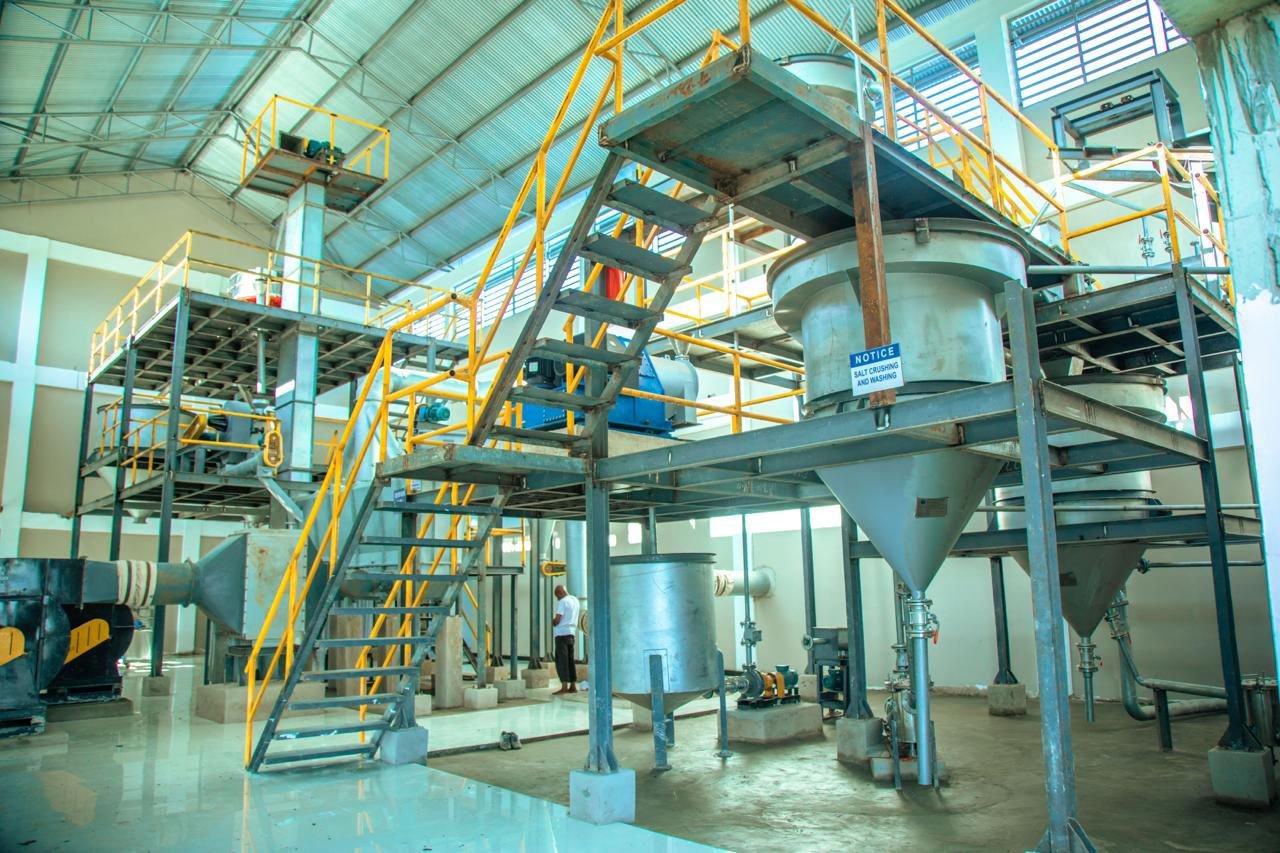
STAMICO has commissioned a salt processing plant in Kilwa District, Lindi Region, inaugurated by Minister for Minerals Anthony Mavunde in the presence of Parliamentary Standing Committee Chairperson Subira Mgalu and Lindi Regional Commissioner Zainabu Telack. The facility has a processing capacity of three tonnes per hour, is expected to process 15,000 to 25,000 tonnes annually, costs approximately TZS 4.5 billion, and will serve as both a processing facility and a training centre for salt producers. The project was implemented following a directive from President Samia Suluhu Hassan responding to concerns from salt producers about unreliable markets and limited processing capacity. TASPA Chairperson Hawa Ghasia described the plant as a shared national asset that could strengthen the entire salt value chain. STAMICO Managing Director Dr. Venance Mwasse said the corporation's objective is not only to purchase salt but to help producers improve quality and productivity for better prices and more stable markets. Minister Mavunde directed STAMICO to accelerate investments in additional mineral processing facilities and committed to working with the Ministry of Industry and Trade to strengthen domestic salt markets and reduce import reliance. The article reports the commissioning, situates it within Tanzania's domestic value addition and mineral beneficiation agenda, and identifies why a TZS 4.5 billion salt plant is analytically significant as a policy statement even when its industrial scale is modest relative to the larger investments that Tanzania's industrialisation narrative concentrates on. Tanzania does not industrialise in a single announcement. It industrialises in the accumulation of processing facilities, training centres, quality standards, and market access mechanisms whose individual modesty obscures their collective direction. The Kilwa salt plant is one facility. The argument it makes is national.
KILWA, LINDI — Tanzania has commissioned a salt processing plant in Kilwa District, Lindi Region, constructed by the State Mining Corporation STAMICO and inaugurated on Thursday by Minister for Minerals Anthony Mavunde in a ceremony at Lingaula attended by senior government officials and representatives of the Tanzania Salt Producers Association.
The facility was commissioned following a directive from President Samia Suluhu Hassan responding to concerns raised by small-scale salt producers about unreliable markets and limited processing capacity that have constrained the sector's development despite growing production volumes along Tanzania's coastal regions.
"The government received concerns from salt producers regarding the lack of a reliable market for their products. This facility is intended to address that challenge by creating a stable off-take mechanism while supporting value addition within the country," Mavunde said at the launch.
What the plant does and what it costs
The Kilwa facility has a processing capacity of three tonnes per hour and is expected to process between 15,000 and 25,000 tonnes of salt annually once fully operational. STAMICO Managing Director Dr. Venance Mwasse confirmed the project is expected to cost approximately TZS 4.5 billion upon completion, and will serve not only as a processing facility but also as a training centre for salt producers whose quality standards and production techniques the corporation intends to support as part of the off-take arrangement.
"Our objective is not only to purchase salt but also to help producers improve quality and productivity so they can access better prices and more stable markets," Mwasse said.
The dual function, processing facility and producer training centre simultaneously, reflects a model whose importance extends beyond the specific commodity. Small-scale producers across Tanzania's extractive sectors consistently face the same structural constraints: the production exists, the raw material is available, but the quality standards, the consistency, and the market access infrastructure whose absence separates raw material from market value are missing. A processing facility that purchases the raw material and simultaneously trains the producers to improve it is addressing both ends of that gap rather than simply adding an industrial stage downstream while leaving the upstream production constraints in place.
Tanzania Salt Producers Association Chairperson Hawa Ghasia described the plant as a major intervention for a sector that has historically faced marketing constraints despite growing production. "Producers viewed the facility as a shared national asset that could help strengthen the entire salt value chain," she said.
The market access problem the plant addresses
Salt production in Tanzania's coastal regions, particularly in Lindi and Pwani, has historically been characterised by the structural vulnerability that affects small-scale extractive producers across most of Tanzania's natural resource sectors: production capacity that exceeds the reliable market access available to convert that production into stable income. Small-scale salt harvesters have faced years of unstable demand, seasonal market disruptions, and the price volatility that unprocessed commodity sale into fragmented informal markets produces when no guaranteed off-take mechanism exists.
The consequence of that market access gap is familiar from comparable situations across Tanzania's agricultural and mineral sectors. Producers who cannot guarantee a reliable buyer at a stable price reduce production to the level whose consumption the immediate informal market absorbs rather than the level whose production their land, equipment, and labour capacity would enable. The under-production that market access constraints create is invisible in the aggregate statistics that measure production volume but is present in the gap between actual production and potential production whose realisation the market access infrastructure would enable.
STAMICO's off-take mechanism changes the incentive structure for Kilwa's salt producers by providing the guaranteed market whose existence makes production investment commercially rational rather than speculative. A producer who knows that STAMICO will purchase between 15,000 and 25,000 tonnes annually at a defined quality standard can invest in the production capacity, equipment, and quality improvement whose cost the uncertain informal market could not previously justify.
The import substitution argument
Mavunde's commitment to working with the Ministry of Industry and Trade to strengthen domestic salt markets and reduce reliance on imports frames the Kilwa facility within the import substitution logic that Tanzania's industrialisation agenda applies across multiple sectors simultaneously.
Tanzania imports processed salt despite producing raw salt domestically, a pattern whose economic irrationality reflects the processing capacity gap whose resolution the STAMICO facility is beginning to address. The value addition that transforms raw salt into processed, iodised, quality-certified product for retail and industrial consumption occurs outside Tanzania when the domestic processing capacity is insufficient to handle the available raw material production, exporting the processing margin to the importing country whose industrial capacity performs the transformation that Tanzania's raw material exports make possible.
"We want to see Tanzania producing, processing, and consuming its own salt while also creating opportunities for local producers to benefit from higher-value markets," Mavunde said. The statement is modest in the specific commodity it addresses and precise in the economic logic it expresses. Processing the commodity domestically before consumption captures the value addition margin that import substitution eliminates from the current external payment. The same logic at larger scale in graphite processing, petroleum refining, pharmaceutical manufacturing, and agricultural commodity processing is the industrial policy argument whose application Tanzania's minerals governance reforms, the Dangote refinery discussions, the Kwala solar manufacturing complex, and the broader beneficiation agenda are all making simultaneously.
STAMICO's mandate and the acceleration directive
Mavunde directed STAMICO to accelerate investments in additional mineral processing facilities across the country, arguing that value addition remains essential if Tanzania is to capture a greater share of the economic benefits generated by its natural resources. The directive situates the Kilwa salt plant not as a standalone project but as the template for a processing facility expansion programme whose replication across Tanzania's mineral and agricultural commodity sectors is the stated policy intention.
STAMICO's mandate as the State Mining Corporation covers the development, promotion, and management of mining operations whose national strategic significance the government determines. The corporation's expansion into salt processing reflects an interpretation of that mandate whose breadth extends beyond the high-value minerals that dominate the mining sector's economic attention into the smaller-scale but socially significant commodity sectors whose producers face the market access and processing capacity constraints that large-scale private sector investment does not typically address because the commercial return at small commodity scale does not justify the processing infrastructure investment that would be commercially rational at graphite or nickel scale.
The government's use of STAMICO as the vehicle for addressing the salt sector's market access and processing constraints reflects the recognition that state-owned enterprise deployment in the processing infrastructure gap can address the sector failures that private sector commercial logic leaves unaddressed, consistent with the broader industrial policy argument that Mariana Mazzucato's Entrepreneurial State framework identifies as the historically validated model through which industrial transformation addresses the market failures that determine whether a country's natural resources generate broad economic benefit or narrow extraction revenue.
What the ceremony confirmed about the project's political significance
The attendance at the Kilwa ceremony communicates the project's political significance beyond its industrial scale. Parliamentary Standing Committee on Energy and Minerals Chairperson Subira Mgalu and Lindi Regional Commissioner Zainabu Telack were both present and described the project as contributing to economic development, employment creation, and industrial growth in the region. Their attendance alongside the minister signals that the Kilwa facility is being treated as a policy statement about the government's commitment to addressing the market access constraints that coastal region producers have raised consistently, rather than as a routine STAMICO infrastructure project whose commissioning warrants only technical documentation.
Lindi Region's inclusion in Tanzania's strategic mineral and industrial development narrative has been growing in 2026. The graphite prospecting licence agreements for Ruangwa District that the Ministry of Minerals signed on 30 May 2026, involving Eminent Minerals Limited and Grafica Resources Limited through joint venture structures with the government, placed Lindi at the centre of Tanzania's critical minerals positioning for the global energy transition. The salt processing plant's commissioning in the same region in the same period situates Lindi within Tanzania's industrial development agenda across both the strategic mineral and the small-scale commodity dimensions whose simultaneous advancement reflects a regional development approach whose breadth is more comprehensive than the single-sector industrial zones that previous development phases produced.
The broader argument the small plant makes
The Kilwa salt processing plant will not appear in the headline economic statistics that measure Tanzania's industrial transformation progress. Its TZS 4.5 billion cost is a fraction of the USD 17 billion Dangote refinery discussions, the USD 300 million Tanzol solar manufacturing complex, and the USD 2.33 billion SGR financing that characterise the large-scale industrial investment narrative that 2026 has produced. Its 15,000 to 25,000 tonne annual processing capacity will not move Tanzania's manufacturing GDP share toward the 20 to 30% that Vision 2050 requires from the current 8 to 10%.
But the argument it makes is the same argument that all of those larger investments make at their respective scales: that the gap between raw material production and processed product value is where Tanzania's economic transformation must be focused, that closing that gap requires processing infrastructure whose construction the state must in some cases anchor where private sector commercial logic does not justify it, that the producers whose market access constraints have historically prevented them from benefiting from their production must be part of the industrial development narrative rather than peripheral to it, and that industrialisation in a country of Tanzania's productive diversity happens not only in the headline projects whose announcements attract international attention but in the accumulation of processing facilities, training centres, quality standards, and market access mechanisms whose individual modesty obscures their collective direction.
"The government received concerns from salt producers regarding the lack of a reliable market for their products," Mavunde said. That sentence is the clearest available description of what industrial policy is supposed to do: respond to the productive system's constraints with the infrastructure whose construction the private sector cannot or will not provide. The Kilwa salt plant is a TZS 4.5 billion response to a documented market failure in a coastal region whose small-scale producers had been raising the same concern for years.
Tanzania does not industrialise in a single announcement. It industrialises in the accumulation of decisions whose individual scale is modest and whose collective direction is not. The Kilwa salt plant is one facility. The argument it makes is national.
FAQ
What has been commissioned in Kilwa, Lindi? STAMICO has commissioned a salt processing plant at Lingaula in Kilwa District, Lindi Region, with a processing capacity of three tonnes per hour and an expected annual output of 15,000 to 25,000 tonnes. The facility costs approximately TZS 4.5 billion and will serve as both a processing plant and a training centre for salt producers. It was inaugurated by Minister for Minerals Anthony Mavunde following a directive from President Samia Suluhu Hassan to address market access challenges facing small-scale salt producers.
Why was the plant built and what problem does it solve? Small-scale salt producers in Lindi and other coastal regions have faced years of unreliable markets, unstable demand, and limited processing capacity that prevented them from converting growing production into stable income. STAMICO's off-take mechanism provides a guaranteed market whose existence makes production investment commercially rational. The dual training centre function addresses the upstream quality constraint simultaneously, helping producers improve techniques and standards to access better prices rather than simply adding a processing stage to unchanged raw material quality.
What is the import substitution significance? Tanzania imports processed salt despite producing raw salt domestically, exporting the processing margin to the countries whose industrial capacity performs the transformation that Tanzanian raw material exports make possible. The Kilwa facility begins addressing that import substitution gap by processing domestic raw salt for domestic consumption, capturing the value addition margin that import substitution eliminates from the current external payment.
Why is a TZS 4.5 billion salt plant analytically significant? Because the argument it makes is the same argument that Tanzania's graphite processing ambitions, Dangote refinery discussions, Kwala solar manufacturing complex, and broader mineral beneficiation reforms are making at much larger scales: that the gap between raw material production and processed product value is where Tanzania's economic transformation must focus. The Kilwa plant makes that argument in the small-scale commodity sector whose producers face the market access and processing constraints that large-scale private sector investment does not address because the commercial return at salt scale does not justify the infrastructure investment that is commercially rational at graphite or petroleum scale.
What comes next following the commissioning? Minister Mavunde directed STAMICO to accelerate investments in additional mineral processing facilities across the country. The Ministry committed to working with the Ministry of Industry and Trade to strengthen domestic salt markets and reduce import reliance. The Kilwa facility is positioned as the template for a processing facility expansion programme whose replication across Tanzania's mineral and agricultural commodity sectors is the stated policy intention rather than a standalone intervention.
 Uchumi360
Business Intelligence
Uchumi360
Business Intelligence
- Minister for Minerals Anthony Mavunde, inauguration speech at Lingaula, Kilwa District, Lindi Region, Thursday commissioning ceremony
- All direct quotations and project specifications cited from official ministerial statement
- STAMICO Managing Director Dr
- Venance Mwasse, statement at commissioning ceremony
- TZS 4.5 billion project cost, training centre function, producer support objectives cited from official statement
- Tanzania Salt Producers Association Chairperson Hawa Ghasia, statement at commissioning ceremony
- Cited from official event documentation
- State Mining Corporation STAMICO, mandate and operations documentation
- Available at stamico.go.tz
- Tanzania Ministry of Minerals, salt processing facility documentation and mineral policy framework
- Available at madini.go.tz
- Tanzania Ministry of Minerals, Ruangwa District graphite prospecting licence agreements, 30 May 2026, Eminent Minerals Limited and Grafica Resources Limited
- Lindi Region minerals context
- Parliamentary Standing Committee on Energy and Minerals, Chairperson Subira Mgalu, attendance at commissioning ceremony
- Cited from official event documentation
- Lindi Regional Commissioner Zainabu Telack, attendance at commissioning ceremony
- Cited from official event documentation
- Tanzania Revenue Authority, import statistics for processed salt
- Available at tra.go.tz
- National Bureau of Statistics Tanzania, manufacturing GDP share data
- Available at nbs.go.tz
- Mariana Mazzucato, The Entrepreneurial State: Debunking Public vs
- Private Sector Myths
- State enterprise role in industrial policy framework
- State House United Republic of Tanzania, President Samia directive on salt sector market access
- Context cited from ministerial statement
- Tanzania Mineral Policy, domestic beneficiation and local processing framework
- Available through Ministry of Minerals
- Rwanda Development Board, regional minerals and processing comparative data
- Available at rdb.rw
- Uganda Bureau of Statistics, minerals processing data
- Available at ubos.org
- DRC Institut National de la Statistique, minerals processing data
- Available at ins-rdc.org
- Zambia Statistics Agency, mineral processing and value addition data
- Available at zamstats.gov.zm
Uchumi360 covers business, investment, and economic policy across East, Central, and Southern Africa.
For the serious reader
You read to the end. That places you in a small group.
Uchumi360 is built for readers who demand precision over speed, structure over sentiment, and analysis that holds uncomfortable conclusions rather than softening them. If this work sharpens how you think about Africa's economy, help us keep building the infrastructure behind it.
Institutional Partners
Commission intelligence. Shape the conversation.
Uchumi360 works with development finance institutions, investment firms, sovereign bodies, and strategic organisations across the coverage region. Institutional partnership unlocks:
- Commissioned sector and country intelligence reports
- Branded research series under your institution's authority
- Exclusive data briefings for internal strategy teams
- Speaking and editorial presence at Uchumi360 events
- Co-published investment outlooks for your markets
Support Our Work
Independent analysis has a cost. Help us bear it.
Uchumi360 does not carry advertising. It does not take editorial direction from sponsors. Every article is produced without commercial compromise. Your contribution funds the reporting, research, and editorial infrastructure that keeps this analysis free from influence.
Secure checkout: One-time and monthly support are processed securely. Add payment credentials to enable checkout here.
Stay Connected
Keep up with every new insight.
Follow our latest analysis, policy coverage, and market intelligence as soon as it is published. If you need something specific, reach out directly and we will point you to the right research.
