
Why Tanzania Maintained 3.3 Percent Inflation While Neighbours Faced Higher Prices
Ready
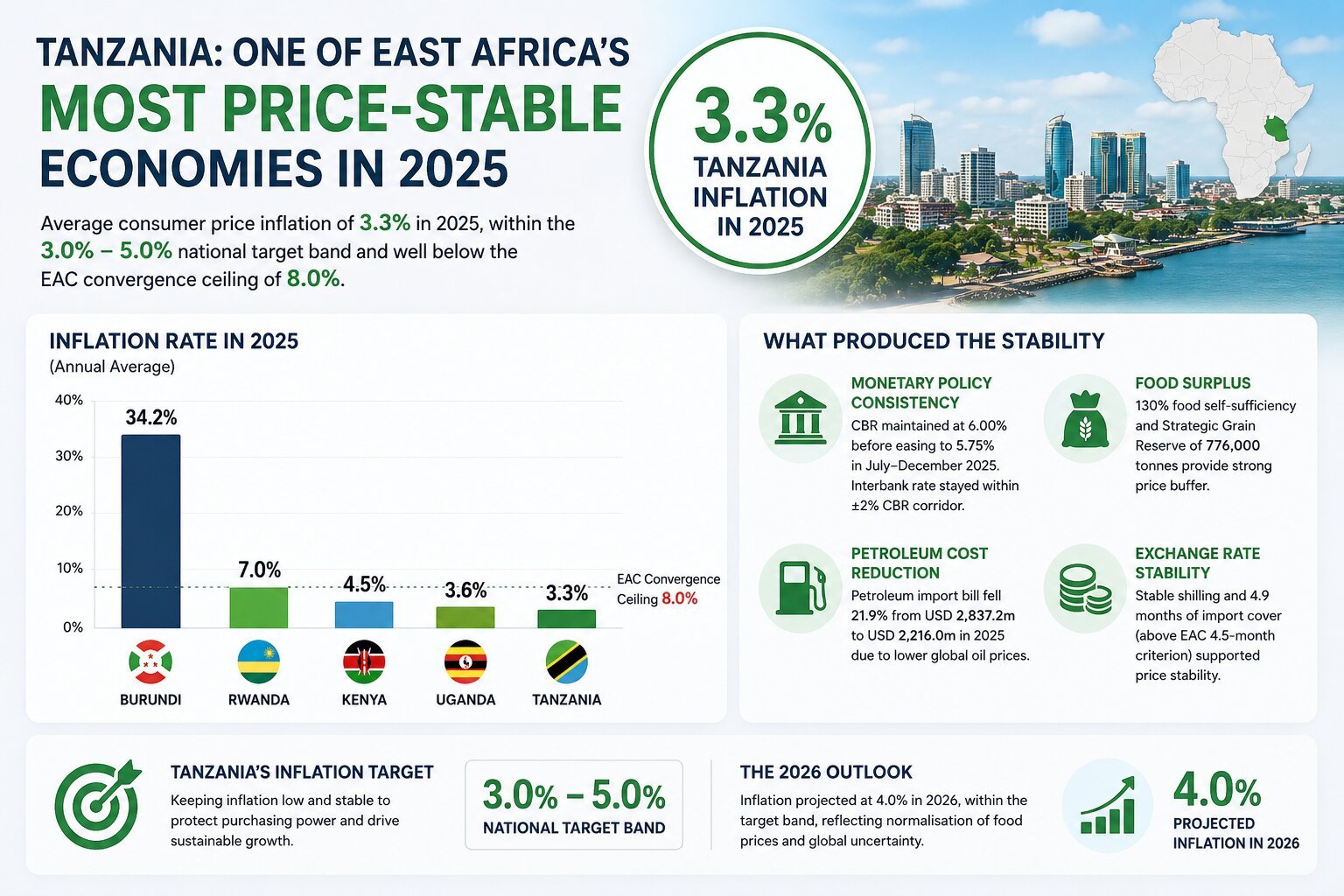
Tanzania's average consumer price inflation in 2025 was 3.3 percent, up marginally from 3.1 percent in 2024 and within the 3.0 to 5.0 percent national target band and the EAC convergence criterion of below 8.0 percent. Regional comparison confirmed in the National Development Plan 2026/27: Burundi 34.2 percent, Rwanda 7.0 percent, Kenya 4.5 percent, Uganda 3.6 percent, Tanzania 3.3 percent. The slight increase from 2024 was attributed to reduced food supply in domestic markets following increased sales to neighbouring countries. The Bank of Tanzania reduced the Central Bank Rate from 6.00 to 5.75 percent in the July to December 2025 period, signalling confidence in the inflation trajectory. Lending rates declined from 15.71 to 15.24 percent. Deposit rates rose slightly to 8.36 percent. The monetary policy committee maintained interbank lending rates within the ±2 percent CBR corridor. Petroleum import value fell 21.9 percent from USD 2,837.2 million in 2024 to USD 2,216.0 million in 2025. Inflation is projected at 4.0 percent in 2026 within the same 3.0 to 5.0 percent band. Tanzania's inflation rate is not just a macroeconomic statistic. It is a measure of the purchasing power protection that monetary discipline provides to the 70 million people whose wage growth is measured against price increases.
DAR ES SALAAM — Tanzania maintained average consumer price inflation of 3.3 percent in 2025, confirming its position as one of East Africa's most price-stable economies. The rate is up marginally from 3.1 percent in 2024, driven by a temporary food supply reduction resulting from increased sales of domestic food production to neighbouring markets, but remains within Tanzania's 3.0 to 5.0 percent national target band and well below the EAC convergence ceiling of 8.0 percent.
The regional comparison
Tanzania's 3.3 percent stands in sharp contrast to the inflationary experience of several regional neighbours. Burundi recorded 34.2 percent average inflation in 2025, up from 20.2 percent in 2024, driven by fiscal pressure, exchange rate weakness, and import cost increases. Rwanda recorded 7.0 percent, up from 4.8 percent in 2024, approaching the top of its target range amid food and energy price pressures. Kenya recorded 4.5 percent, managing to stay within its target range despite currency depreciation episodes in 2024. Uganda recorded 3.6 percent, just above Tanzania's rate but similarly stable.
The EAC regional average inflation rate, weighted across member states, was substantially higher than Tanzania's rate because of Burundi's extreme figure and South Sudan's continued hyperinflationary environment. Tanzania's individual performance therefore represents a genuine relative achievement rather than a regional trend it happens to share.
What produced the stability
Four factors explain Tanzania's inflation performance.
Monetary policy consistency: The Bank of Tanzania maintained the Central Bank Rate at 6.00 percent through early FY2025/26 before reducing it to 5.75 percent in July to December 2025, signalling confidence that inflation was sufficiently contained to allow easing without price pressure. The interbank lending rate remained within the ±2 percent CBR corridor throughout the period, confirming that liquidity management matched the policy stance.
Food surplus: Tanzania's 130 percent food self-sufficiency rate means domestic food prices are not driven by import costs or seasonal scarcity in ways that create the inflation spikes seen in net food-importing neighbours. The Strategic Grain Reserve at 776,000 tonnes provides a price stabilisation buffer.
Petroleum cost reduction: The value of petroleum imports fell 21.9 percent from USD 2,837.2 million to USD 2,216.0 million in 2025, following global oil price moderation. Petroleum-driven cost-push inflation, which contributed to price pressures in 2022 and 2023 across East Africa, was not a significant factor in Tanzania's 2025 inflation dynamics.
Exchange rate stability: The Tanzania shilling maintained relative stability against major trading currencies, avoiding the imported inflation that currency depreciation episodes generate in import-dependent economies. Foreign reserves at 4.9 months of import cover, above the EAC's 4.5-month criterion, provided the buffer that sustained exchange rate confidence.
The 2026 outlook
The plan projects inflation at 4.0 percent in 2026, within the same 3.0 to 5.0 percent target band. The slight projection increase from 3.3 percent actual to 4.0 percent projected reflects anticipated food price normalisation as domestic sales to neighbours moderate and as global commodity price uncertainty in 2026 is factored into the projection.
 Uchumi360
Business Intelligence
Uchumi360
Business Intelligence
Uchumi360 covers business, investment, and economic policy across East, Central, and Southern Africa.
For the serious reader
You read to the end. That places you in a small group.
Uchumi360 is built for readers who demand precision over speed, structure over sentiment, and analysis that holds uncomfortable conclusions rather than softening them. If this work sharpens how you think about Africa's economy, help us keep building the infrastructure behind it.
Institutional Partners
Commission intelligence. Shape the conversation.
Uchumi360 works with development finance institutions, investment firms, sovereign bodies, and strategic organisations across the coverage region. Institutional partnership unlocks:
- Commissioned sector and country intelligence reports
- Branded research series under your institution's authority
- Exclusive data briefings for internal strategy teams
- Speaking and editorial presence at Uchumi360 events
- Co-published investment outlooks for your markets
Support Our Work
Independent analysis has a cost. Help us bear it.
Uchumi360 does not carry advertising. It does not take editorial direction from sponsors. Every article is produced without commercial compromise. Your contribution funds the reporting, research, and editorial infrastructure that keeps this analysis free from influence.
Secure checkout: One-time and monthly support are processed securely. Add payment credentials to enable checkout here.
Stay Connected
Keep up with every new insight.
Follow our latest analysis, policy coverage, and market intelligence as soon as it is published. If you need something specific, reach out directly and we will point you to the right research.
