
Tanzania Has Resolved to Establish an International Financial Centre in Dar es Salaam. It Will Be the Seventh on the African Continent and the First in the Country's History.
Ready
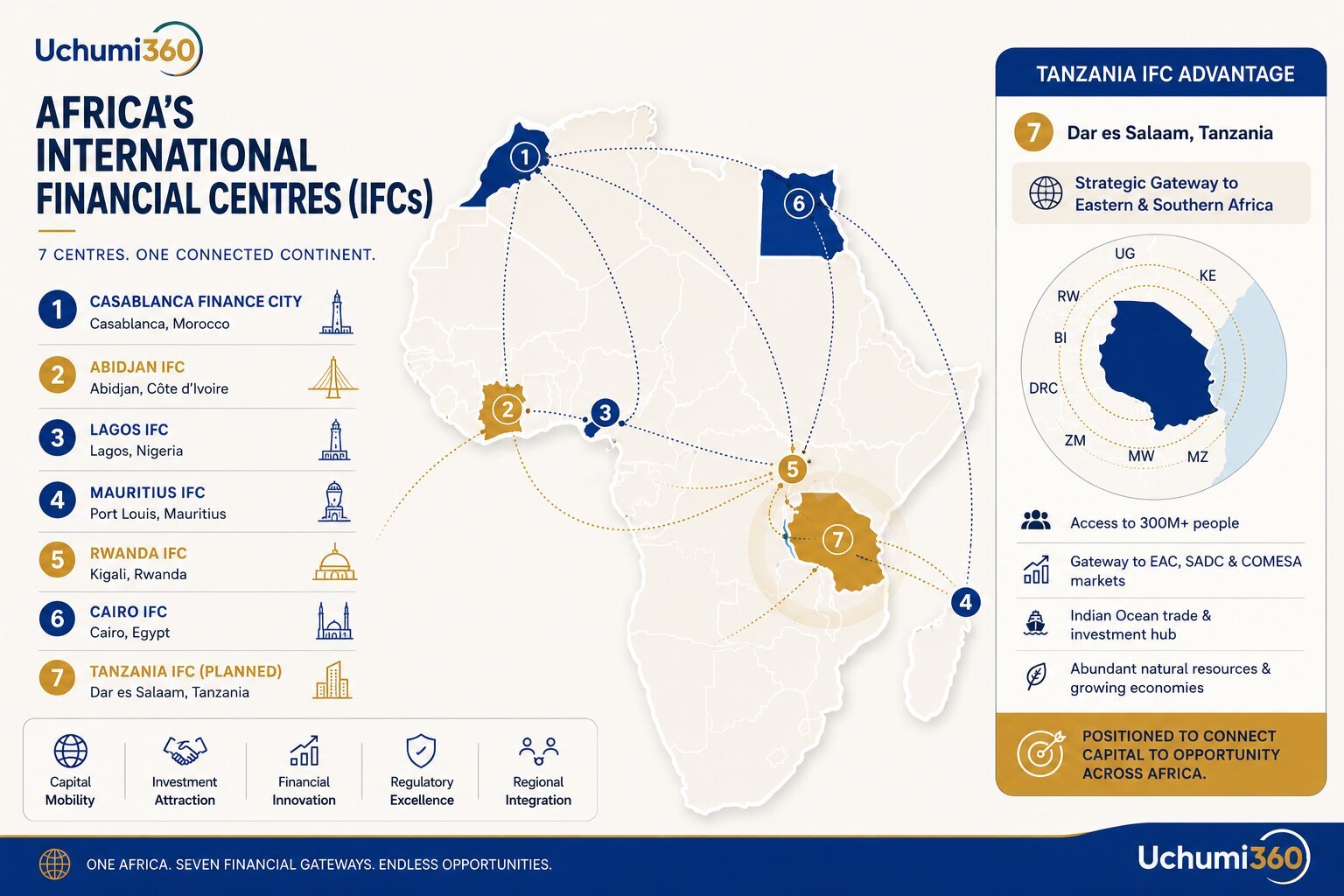
Tanzania's National Business Council Executive Committee, chaired by Chief Secretary Ambassador Dr Moses Kusiluka, has resolved at its 38th meeting at State House to establish an International Financial Centre in Dar es Salaam, making Tanzania the seventh African country to host such a centre after Kenya, Rwanda, and four others. Bank of Tanzania Governor Emmanuel Tutuba presented the Finance Working Group's recommendations, confirming Tanzania meets the key requirements for hosting an IFC including political stability, national security, and a strong banking sector operating to international standards. The IFC's stated objectives are to attract local and foreign investment, increase access to capital, facilitate financing for large-scale development projects, strengthen international financial activities, promote knowledge and technology transfer, and develop a highly skilled Tanzanian workforce in financial and business sectors. Investors using the centre will access a combined market of over 1.4 billion people through Tanzania's EAC, SADC, and AfCFTA memberships. A legal framework will be enacted following formal government approval. The decision follows recommendations from the TNBC Finance Working Group's March 2026 meeting. The same TNBC meeting also agreed to establish an awards system recognising public and private sector institutions for outstanding contributions to national development. Tanzania has been building the infrastructure, the institutional quality, and the regional connectivity that an International Financial Centre requires for years. The TNBC resolution is the formal decision whose announcement changes the question from whether Tanzania should establish an IFC to how quickly it can build one that international capital finds compelling.
DAR ES SALAAM — Tanzania has resolved to establish an International Financial Centre in Dar es Salaam, a decision that will make Tanzania the seventh African country to host such a centre and the first to offer international capital simultaneous access to the East African Community, the Southern African Development Community, and the African Continental Free Trade Area's combined market of more than 1.4 billion people from a single jurisdiction.
The resolution was confirmed at the 38th Executive Committee meeting of the Tanzania National Business Council, held at State House in Dar es Salaam, and announced by Chief Secretary and Committee Chairman Ambassador Dr Moses Kusiluka. The decision follows recommendations made by the TNBC Finance Working Group during its March 2026 meeting, whose analysis identified the need for a specialised financial framework capable of attracting greater investment capital and addressing the challenges that private sector stakeholders have been raising with the government as obstacles to efficient investment operations.
What drove the decision and who made it
Ambassador Dr Kusiluka confirmed that the resolution was driven by the government's recognition of the need to further improve Tanzania's business and investment environment, and by the government's sustained attention to concerns raised by the private sector whose feedback the TNBC's institutional structure is specifically designed to channel into government policy responses.
"Based on the challenges identified by the private sector, we have agreed to establish an International Financial Centre that will help address some of the obstacles facing investors and enhance Tanzania's competitiveness in attracting international capital," Ambassador Kusiluka said. He added that the government will continue creating a conducive environment for investment to boost national revenue, support economic growth, and generate employment opportunities through various development projects.
Bank of Tanzania Governor Emmanuel Tutuba presented the Finance Working Group's technical recommendations to the Executive Committee, confirming that Tanzania has reached a stage of economic development that positions it well to establish and operate an international financial centre. Tutuba's presentation identified Dar es Salaam as the most suitable location on the basis of its favourable business environment and existing infrastructure, and confirmed that Tanzania already meets the key requirements for hosting an IFC including political stability, national security, and a strong banking sector operating in line with international standards.
What the IFC will do and who it will serve
The International Financial Centre's stated objectives, as presented by Governor Tutuba and confirmed by the TNBC Executive Committee resolution, cover four primary functions whose combination describes a financial services platform designed for both domestic economic development and international capital attraction simultaneously.
The first function is capital access improvement. The IFC will enhance Tanzania's ability to attract capital from within and outside Africa, facilitate financing for large-scale development projects, and strengthen international financial activities by providing the specialised legal, regulatory, and operational framework that international financial institutions require before committing significant capital to a jurisdiction. The second function is investor service. Financial institutions, investors, and companies will gain easier access to capital through the IFC's platform, reducing the friction that the absence of a specialised financial centre framework currently imposes on investment structuring, fund domicile, and cross-border capital movement in and through Tanzania.
The third function is knowledge and technology transfer. The IFC will attract international financial experts whose presence develops Tanzania's domestic professional capabilities in financial and business sectors, creating the human capital pipeline that a financial centre requires to sustain its competitive position over time rather than remaining dependent on expatriate expertise indefinitely. Governor Tutuba was direct about this dimension: "This presents an important opportunity for Tanzanians to learn from international experts and strengthen their professional capabilities in various financial fields."
The fourth function is market access provision. Investors using the IFC will gain access through Tanzania's simultaneous EAC, SADC, and AfCFTA memberships to a combined African market of more than 1.4 billion people, a market access geometry that no other African IFC host can offer from a single jurisdiction. Tanzania's membership in both the EAC's Eastern African economic space and SADC's Southern African economic space, combined with AfCFTA's continental free trade framework, means that an investor structured through the Dar es Salaam IFC has preferential market access relationships with the broadest geographic spread of any African financial centre jurisdiction.
Tanzania as the seventh African IFC: the competitive context
Governor Tutuba confirmed that six African countries currently host International Financial Centres, with Kenya and Rwanda named as the regional precedents whose models are most directly relevant to Tanzania's planning. Rwanda's Kigali International Financial Centre, whose twin-tower physical headquarters Uchumi360 reported is nearing completion in Kigali's Central Business District anchored by Equity Group Holdings' USD 100 million development, is the most recently established of the East African financial centre initiatives and the one whose regulatory framework, governance quality, and infrastructure completion Tanzania's IFC will most directly need to differentiate against.
Kenya's Nairobi International Financial Centre, whose institutional framework was established earlier and whose financial services depth benefits from the Nairobi Securities Exchange, the multinational headquarters concentration, and the development finance institution presence that makes Nairobi East Africa's deepest financial services market, represents the scale benchmark that Tanzania's IFC is not attempting to match immediately but whose competitive positioning within the East African financial centre landscape Tanzania's announcement changes.
The competitive context matters for understanding what Tanzania's IFC announcement means in practice. The six existing African IFCs have established the institutional precedents, regulatory frameworks, and market relationships that Tanzania's IFC can learn from and, where its specific advantages in EAC-SADC dual membership, AfCFTA connectivity, political stability, and the Dar es Salaam logistics hub's commercial ecosystem are most directly relevant, seek to improve upon. The financial centre landscape is not winner-take-all. Different centres can serve different investor categories, different fund types, and different transaction structures, and Tanzania's specific combination of jurisdictional advantages may attract the investor categories whose requirements the existing six centres serve less completely than Tanzania's framework could.
The legal framework and what comes next
Governor Tutuba confirmed that once the government formally approves the establishment of the IFC, an appropriate legal framework will be enacted to promote investment and safeguard investors' capital. The legal framework's design is the most consequential single determinant of the IFC's commercial success, because international financial services firms whose location decisions the centre is designed to influence evaluate the legal certainty, contractual enforceability, investor protection mechanisms, and regulatory predictability that the legal framework provides as the non-financial prerequisite whose satisfaction determines whether the financial incentives and market access advantages are commercially accessible.
Tanzania's existing legal infrastructure provides the foundation whose development into the IFC-specific framework the enactment will build upon. The Bank of Tanzania's regulatory framework, whose international standards compliance Governor Tutuba confirmed as one of Tanzania's qualifying attributes, the investment protection provisions embedded in the 2022 Investment Act, and the ICT infrastructure whose existing capacity Tutuba noted will enable many IFC services and transactions to be conducted efficiently including by users outside the country are the enabling conditions whose presence reduces the legal framework construction task from building from scratch to adapting and extending an existing institutional foundation.
TNBC Executive Secretary Dr Godwill Wanga described the IFC initiative as a major milestone long anticipated by both local and international business communities, and confirmed its alignment with Tanzania Development Vision 2050's objectives of private sector capacity building and accelerated economic growth. "One of our responsibilities is to build the capacity of the private sector and create an environment that accelerates economic growth in line with the objectives of Tanzania Development Vision 2050," Dr Wanga said.
What the announcement means for Tanzania's financial services trajectory
The IFC resolution arrives at a moment whose timing compounds its significance. Tanzania's economic transformation narrative has been building through the infrastructure investment that Uchumi360's 2026 coverage has documented across the SGR's Central Corridor expansion, the Julius Nyerere Hydropower Project's energy surplus, the Kwala Solar Manufacturing Complex, the TISEZA manufacturing investment acceleration, and the multiple bilateral investment discussions whose combined weight is producing the most active investment attraction period in the country's recent history.
An International Financial Centre is the institutional infrastructure whose establishment converts the investment attraction momentum into the permanent financial services ecosystem that sustains it. The manufacturing investor whose factory the TISEZA approves needs the banking relationship, the trade finance facility, and the capital markets access that the IFC's financial services platform provides at the sophistication level that international manufacturing operations require. The SGR's regional logistics ambition needs the trade finance, insurance, and treasury management infrastructure that a financial centre consolidates in the jurisdiction whose regulatory framework makes those services most efficiently accessible. The critical minerals investors whose interest in Tanzania's graphite, nickel, helium, and rare earth deposits Uchumi360's minerals coverage has documented need the project finance, royalty streaming, and offtake financing structures that a specialised IFC framework can host more efficiently than the general banking system alone.
Tanzania has been building the physical infrastructure, the institutional quality, and the regional connectivity that an International Financial Centre requires for years. The TNBC resolution is the formal decision whose announcement changes the question from whether Tanzania should establish an IFC to how quickly it can build one that international capital finds compelling enough to choose Dar es Salaam over the six centres whose head start the existing African IFC landscape represents.
The seventh African IFC will be in Dar es Salaam. The financial services ecosystem that surrounds it will determine whether it becomes the region's most consequential financial centre or simply the region's most recently established one.
FAQ
What has Tanzania resolved to establish? Tanzania's National Business Council Executive Committee has resolved to establish an International Financial Centre in Dar es Salaam, confirmed at the 38th TNBC Executive Committee meeting at State House. The decision follows recommendations from the TNBC Finance Working Group's March 2026 meeting. Tanzania will become the seventh African country to host an IFC, joining six existing centres including Kenya and Rwanda.
Why Dar es Salaam? Bank of Tanzania Governor Emmanuel Tutuba confirmed Dar es Salaam as the most suitable location based on its favourable business environment and existing infrastructure, including the ICT infrastructure whose capacity will enable many IFC services and transactions to be conducted efficiently by users inside and outside the country. Tanzania also meets the key IFC hosting requirements of political stability, national security, and a strong banking sector operating to international standards.
What market access does the Tanzania IFC offer investors? Investors using the IFC will gain access to a combined market of more than 1.4 billion people across Africa through Tanzania's simultaneous membership in the EAC, SADC, and AfCFTA. No other existing African financial centre host offers investors the dual EAC and SADC bloc membership that Tanzania's geographic positioning provides, giving the Dar es Salaam IFC a specific market access advantage relative to the six centres whose establishment predates Tanzania's.
What are the IFC's primary objectives? The IFC will attract local and foreign investment, increase access to capital for financial institutions and companies, facilitate financing for large-scale development projects, strengthen international financial activities, promote knowledge and technology transfer by attracting international financial experts, and develop a highly skilled Tanzanian workforce in financial and business sectors.
What happens next before the IFC becomes operational? Following formal government approval of the establishment decision, an appropriate legal framework will be enacted to promote investment and safeguard investors' capital. Governor Tutuba confirmed that once the legal framework is in place, financial institutions, investors, and companies will gain access to the IFC's capital and services platform. The ICT infrastructure whose existing capacity he noted will support the operational launch once the regulatory and legal architecture is in place.
 Uchumi360
Business Intelligence
Uchumi360
Business Intelligence
- Tanzania National Business Council, 38th Executive Committee meeting, State House Dar es Salaam.Resolution to establish International Financial Centre
- Ambassador Dr Moses Kusiluka statement.Available through TNBC official communications
- Bank of Tanzania Governor Emmanuel Tutuba, TNBC Finance Working Group recommendations presentation
- Six African IFCs confirmed, Tanzania seventh, Dar es Salaam location, 1.4 billion market access through EAC, SADC, AfCFTA.Available through Bank of Tanzania official communications
- TNBC Executive Secretary Dr Godwill Wanga, statement on IFC milestone and Vision 2050 alignment.Available through TNBC official communications
- TNBC Finance Working Group, March 2026 meeting recommendations
- Origin of IFC establishment recommendation.Available through TNBC official communications
- Bank of Tanzania, regulatory framework and international standards compliance documentation.Available at bot.go.tz
- Tanzania Investment Act 2022, investor protection framework.Available at parliament.go.tz
- Rwanda Finance Limited, KIFC regulatory framework.Available at rwandafinance.rw
- Kigali International Financial Centre, official documentation.Available at kifc.rw
- Nairobi International Financial Centre, official documentation.Available at nairobiifc.org
- EAC Secretariat, regional market access framework.Available at eac.int
- SADC Secretariat, regional economic community framework.Available at sadc.int
- AfCFTA Secretariat, continental free trade framework.Available at au-afcfta.org
- Tanzania Investment and Special Economic Zones Authority, investment approval and IFC context.Available at tiseza.go.tz
- Standard Chartered Bank, SGR financing announcement April 2026
- Tanzania economic context.Available at sc.com
- National Bureau of Statistics Tanzania, financial sector and economic data.Available at nbs.go.tz
- African Development Bank, African financial centre development research.Available at afdb.org
- World Bank, Tanzania financial sector development data
- Available at worldbank.org
Uchumi360 covers business, investment, and economic policy across East, Central, and Southern Africa.
For the serious reader
You read to the end. That places you in a small group.
Uchumi360 is built for readers who demand precision over speed, structure over sentiment, and analysis that holds uncomfortable conclusions rather than softening them. If this work sharpens how you think about Africa's economy, help us keep building the infrastructure behind it.
Institutional Partners
Commission intelligence. Shape the conversation.
Uchumi360 works with development finance institutions, investment firms, sovereign bodies, and strategic organisations across the coverage region. Institutional partnership unlocks:
- Commissioned sector and country intelligence reports
- Branded research series under your institution's authority
- Exclusive data briefings for internal strategy teams
- Speaking and editorial presence at Uchumi360 events
- Co-published investment outlooks for your markets
Support Our Work
Independent analysis has a cost. Help us bear it.
Uchumi360 does not carry advertising. It does not take editorial direction from sponsors. Every article is produced without commercial compromise. Your contribution funds the reporting, research, and editorial infrastructure that keeps this analysis free from influence.
Secure checkout: One-time and monthly support are processed securely. Add payment credentials to enable checkout here.
Stay Connected
Keep up with every new insight.
Follow our latest analysis, policy coverage, and market intelligence as soon as it is published. If you need something specific, reach out directly and we will point you to the right research.
