
Too Many Institutions, Too Many Barriers: Rethinking Tanzania’s Business Environment
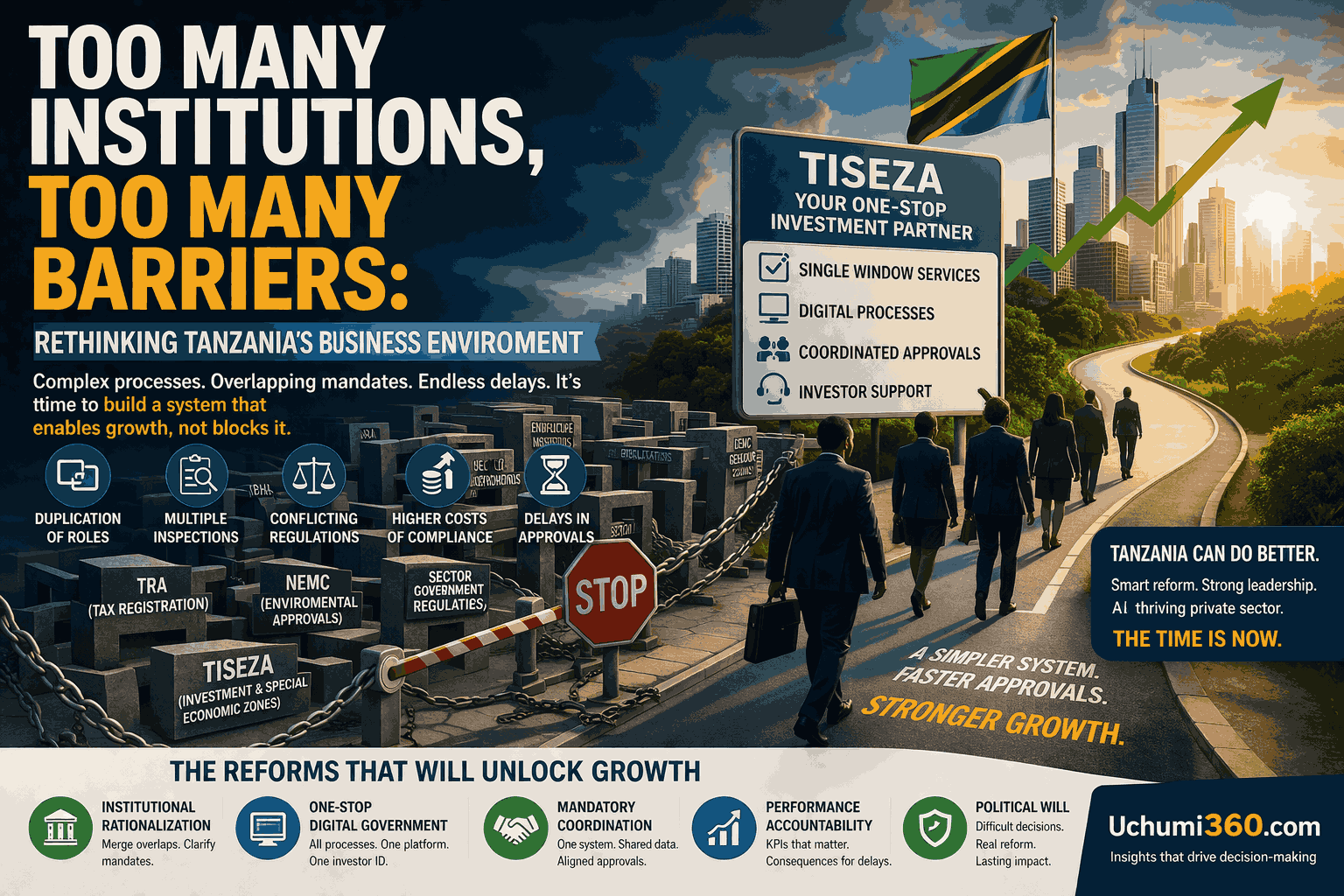
Recently, remarks by Profesa Kitila Mkumbo brought renewed attention to a long-standing structural problem: the country’s regulatory environment is dense, fragmented, and often uncoordinated. Investors are not only evaluating Tanzania’s opportunities they are also calculating the cost of navigating its institutions. That cost is rising.
Tanzania is trying to attract investment. It is also making it unnecessarily difficult to operate.
Recently, remarks by Professer Kitila Mkumbo brought renewed attention to a long-standing structural problem: the country’s regulatory environment is dense, fragmented, and often uncoordinated. Investors are not only evaluating Tanzania’s opportunities they are also calculating the cost of navigating its institutions. That cost is rising.
Across sectors, businesses face a system where multiple authorities exercise overlapping mandates. Licensing, taxation, compliance, environmental approvals, and operational regulation are handled by separate entities that rarely function as a unified system. The result is not regulation in the strategic sense it is accumulation. And accumulation creates friction.
A System Built in Layers, Not Designed as One
Tanzania’s institutional architecture did not emerge from a single coordinated design. It evolved over time, through laws, reforms, sector priorities, and administrative expansion. Each institution was created to solve a specific problem. Few were designed to work seamlessly with others. Today, that history is visible in how business is regulated.
An investor entering Tanzania may begin with Tanzania Investment and Special Economic Zones Authority (TISEZA), but the process does not end there. Tax registration, labour compliance, environmental approvals, sector licenses, and local government requirements all sit in different institutional silos. Each has its own procedures, timelines, and enforcement mechanisms. There is no single operational pathway. Only multiple entry points.
This fragmentation produces predictable outcomes: duplication of processes, repeated inspections, inconsistent requirements, and delays that extend beyond planning horizons. What should function as a system behaves instead as a sequence of independent checkpoints.
Regulation Without Coordination Becomes a Cost
Regulation is necessary. It protects standards, ensures safety, and structures markets. But when regulatory institutions operate without coordination, regulation shifts from enabling growth to constraining it. In Tanzania, the issue is not the presence of regulation. It is the absence of integration.
Businesses do not experience institutions individually. They experience the system as a whole. When that system requires the same information to be submitted multiple times, when approvals depend on parallel processes that do not communicate, and when compliance is enforced by multiple agencies independently, the cumulative effect is cost. Not just financial cost but time, uncertainty, and operational risk. In competitive investment destinations, these costs are minimized through system design. In fragmented systems, they compound.
Where Responsibility Sits
This is not an administrative glitch. It is a policy coordination problem. Responsibility is distributed across multiple levels of government but not equally.
At the top, the Executive defines direction.
Structural reform of institutions requires decisions that go beyond individual ministries. Aligning mandates, merging functions, and enforcing coordination are political decisions before they are technical ones.
Parliament holds another layer of responsibility.
Many institutional overlaps are rooted in legislation. Laws passed at different times, under different priorities, have created mandates that now intersect. Without legal harmonization, administrative coordination has limits.
Within government, the Ministry of Investment and Planning under Professer Kitila Mkumbo sits at the center of this issue.
Its role is not only to promote investment, but to ensure that the environment investors enter is coherent. That requires coordination authority, not just policy articulation.
The Prime Minister’s Office and reform units add another layer.
Frameworks such as the BluePrint for Regulatory Reforms already diagnose the problem. The constraint is no longer identification. It is execution.
What Others Did Differently
The contrast with countries that have successfully improved their business environments is not theoretical. It is structural.
Rwanda reduced friction by redesigning the system itself. Its one-stop investment framework is not a label it is operational. Processes are integrated, services are digital, and accountability is enforced. Delays are treated as system failures, not routine outcomes.
China followed a different path, but with the same principle: coordination. Special Economic Zones operate under simplified, aligned regulatory frameworks. Institutions do not compete for control. They function within a defined economic strategy.
In both cases, the objective was not to increase institutional presence, but to increase institutional efficiency.
Policy Is Not the Constraint
Tanzania has already acknowledged the problem in its own frameworks. The investment facilitation structure, anchored in Tanzania Investment and Special Economic Zones Authority (TISEZA), is intended to function as a one-stop center. The BluePrint for Regulatory Reforms outlines the need to reduce duplication and improve coordination. The Five-Year Development Plan emphasizes private sector-led growth.
These are not weak policies. The gap lies between policy design and system behavior. As seen across sectors in East Africa, policy ambition often exceeds execution capacity, creating a disconnect between stated goals and real economic outcomes.
From Fragmentation to System Design
Fixing this problem does not require new institutions. It requires rethinking how existing ones operate together.
Institutional rationalization becomes necessary where mandates overlap. Not every function needs a separate agency.
Digital integration is no longer optional. A true one-stop system is not a physical office it is a shared platform where institutions operate through a single interface.
Coordination must be enforced, not assumed. Institutions acting independently within a shared process create inefficiency by design.
Accountability must shift from internal performance to system outcomes. The relevant question is not whether an institution completed its process, but whether the overall system delivered efficiently.
The Strategic Shift Tanzania Must Make
Tanzania’s economic trajectory depends on its ability to convert potential into execution. Investment flows toward environments that are not only promising, but predictable.
The current structure sends mixed signals: opportunity on one side, complexity on the other. The shift required is not incremental. It is structural. From multiple institutions to one coordinated system. From parallel processes to integrated workflows. From administrative control to economic efficiency.
The question is no longer whether reform is needed. It is whether coordination can be enforced at the level required to make the system function as one.
 Uchumi360
Business Intelligence
Uchumi360
Business Intelligence
Uchumi360 covers business, investment, and economic policy across East, Central, and Southern Africa.
