
EAC Budget Aid Gap: Somalia Gets Half From Donors, Tanzania and Kenya Less Than 1%
Ready
Donor dependence varies sharply across East African government budgets. Donor projects finance about half of Somalia’s planned federal expenditure and grants account for roughly a quarter of Burundi’s budget, while Tanzania and Kenya receive grants equivalent to less than 1 percent of national spending. South Sudan records almost no grants in its formal budget despite extensive off budget donor financing of public services.
East African governments differ enormously in how much of their national budgets depend directly on grants and donor financed programmes. In Somalia, donor funded projects account for roughly half of planned federal expenditure. In Burundi, grants are equivalent to about a quarter of the national budget. The Democratic Republic of Congo and Rwanda sit further down the scale at roughly 8 percent and 7 percent respectively, while Uganda receives the equivalent of about 3.4 percent of its headline budget through grants. At the other end of the region, Tanzania and Kenya now finance almost their entire national budgets without grant dependence, with external grants accounting for less than 1 percent of planned expenditure in both countries. South Sudan appears even less donor dependent in its formal budget because it records virtually no grant revenue, although that number is deeply misleading because donors finance substantial health, humanitarian and development services outside the government budget.
The comparison matters because the phrase “foreign aid dependence” is often used loosely across East Africa. A country can receive billions of dollars from the World Bank, African Development Bank, European Union, United States, United Nations agencies and bilateral development partners while very little of that money actually enters the national treasury as grant revenue. Some financing is provided as concessional loans, which must eventually be repaid. Some is paid directly to contractors implementing infrastructure projects. Some is managed through NGOs, UN agencies or special project accounts. In fragile states, substantial public services can effectively be donor financed without appearing anywhere in the government’s central budget. The useful question is therefore not simply how much aid a country receives, but how much of the expenditure authorised by its national budget would disappear if grant financing stopped.
For this comparison, Uchumi360 examined the latest 2026 or 2026/27 budget documents available for all eight East African Community members and separated grants and donor-funded project expenditure from external loans. The resulting percentages measure planned on-budget donor support against the headline national budget or expenditure envelope. They should not be confused with total official development assistance received by each country, and they also describe budget plans rather than guaranteed disbursements.
| EAC Member | Latest Budget | On Budget Grants / Donor Funding | Approx. Share of Budget |
| Somalia | US$1.37bn expenditure framework | US$673.7m donor projects | 49.1% |
| Burundi | BIF7.02tn | BIF1.77tn grants | 25.3% |
| DRC | CDF54.34tn | CDF4.56tn grants | 8.4% |
| Rwanda | RWF7.80tn | RWF548.3bn grants | 7.0% |
| Uganda | UGX84.39tn | UGX2.83tn project grants | 3.4% |
| Tanzania | TSh62.33tn | TSh563.1bn grants | 0.9% |
| Kenya | KSh4.82tn | About KSh43.6bn grants | 0.9% |
| South Sudan | SSP11.34tn proposed | No grants recorded in fiscal framework | ~0% on budget |
The table does not rank which countries receive the most foreign assistance in absolute terms. It measures something narrower and more economically revealing: how visible donor grants are inside the machinery of government expenditure.
Somalia Is in a Different Fiscal Category From the Rest of the EAC
Somalia remains by far the most donor dependent EAC government when measured through the budget. Its 2026 budget policy framework projected total expenditure of about US$1.37 billion, of which US$673.7 million was expected to be spent through donor financed projects. That puts donor project spending at 49.1 percent of expenditure. The revenue side is even more dependent: the same framework projected US$470.6 million in domestic revenue and US$828.1 million in donor grants, including both budget and project support, meaning grants represented almost 64 percent of projected revenue and grants.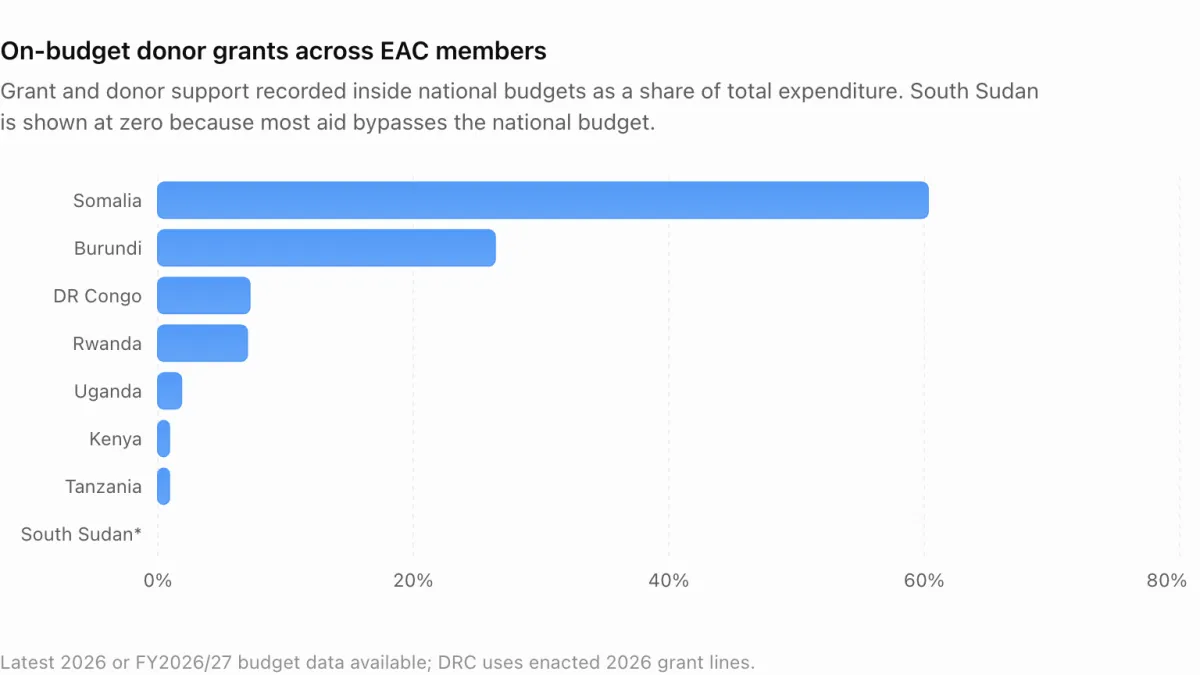 Somalia’s numbers reflect the unusual structure of a state still rebuilding its tax base and public institutions after decades of conflict. Domestic revenue collection has improved, and debt relief under the Heavily Indebted Poor Countries initiative has changed the country’s financing position, but the federal government still lacks the fiscal capacity to fund the development functions expected of a national government from taxation alone. Donor resources finance infrastructure, institutional reform, social services and development projects at a scale comparable to the government’s own operating expenditure.
The direction of policy is nevertheless towards reducing this dependence. Somalia’s Ministry of Finance explicitly says it wants domestic revenue to constitute a larger share of government resources over time, while donor grants decline relative to the economy. That transition will take years because the starting position is unusually weak. Even a substantial increase in tax collection can be overwhelmed by the development financing required for infrastructure, security, education, health and reconstruction.
Burundi’s Budget Depends on Grants for About One Shilling in Four
Burundi has the second highest direct grant dependence in the EAC. Its 2026/27 budget was set at approximately BIF7.02 trillion, while external grants were projected at BIF1.77 trillion. That places grants at about 25.3 percent of the headline budget. External loans were comparatively small at about BIF65.4 billion, making Burundi’s external financing unusual because grants rather than borrowing account for the overwhelming majority of the foreign contribution included in the budget.
The scale of grant financing is also visible in Burundi’s fiscal accounts. IMF projections for 2026/27 place project grants at BIF788.9 billion under a narrower central government accounting framework, equivalent to about 3 percent of GDP. The difference from the national budget figure partly reflects differences between the government’s budget presentation and IMF fiscal reporting, but both sources show that grants remain an important component of public investment.
Burundi’s dependence is particularly concentrated in development spending rather than routine government operations. External partners finance infrastructure, energy, agriculture and social programmes that the country’s tax base would struggle to support at the same scale. This also means that the economic consequences of aid reductions would probably appear first through slower public investment rather than an immediate inability to pay the entire civil service.
DRC Budgets Billions in Grants but Does Not Always Receive Them on Time
The Democratic Republic of Congo’s 2026 budget provides one of the clearest examples of why budgeted donor support and actual donor disbursement need to be separated. The country approved a national budget of CDF54.34 trillion, approximately US$22 billion at the exchange rate used when Parliament adopted it. Within the financing framework, project grants were budgeted at about CDF4.50 trillion and budget grants at roughly CDF67 billion, putting total planned grants around CDF4.56 trillion, or approximately 8.4 percent of the overall national budget.
The wider external financing position is much larger because the DRC also expects foreign loans. Total external receipts were projected above CDF17 trillion, including programme loans and project borrowing, but loans are liabilities and should not be counted as aid in the same way as grants. The grant share therefore gives a better measure of how much spending is directly subsidised by external partners without creating an equivalent repayment obligation.
Actual execution has been much weaker than the budget suggests. By the end of August 2026, the Ministry of Budget reported only CDF705.7 billion in expenditure financed from external resources against a linear expectation of CDF2.72 trillion for that point in the year. The annual programme anticipated more than CDF5.15 trillion in resources from external partners under the expenditure classification being monitored, but only 13.7 percent of that annual amount had been disbursed during the first eight months. Domestic resources were therefore carrying almost all expenditure actually paid during the period.
This creates an important distinction between donor dependence on paper and donor dependence in cash. The DRC can approve a budget containing substantial external financing, but delayed disbursement forces the Treasury either to postpone projects or finance expenditure from its own resources. A budget can therefore look more aid-dependent than actual execution if donors release money slowly.
Rwanda Still Uses Grants, but Loans Now Matter Much More
Rwanda’s 2026/27 budget totals RWF7.796 trillion, of which RWF548.3 billion is expected from external grants. Grants therefore finance about 7 percent of the national budget. The larger external contribution comes from loans, which are projected at RWF1.974 trillion, equivalent to about a quarter of the entire budget. Combined, grants and external borrowing provide roughly one third of Rwanda’s resource envelope, but only the RWF548.3 billion grant component represents donor financing that does not directly add to public debt.
This is an important change in how Rwanda’s public finances should be understood. The country remains a major recipient of development finance, but its fiscal relationship with external partners increasingly involves debt-financed investment alongside grants. Domestic revenues of RWF5.27 trillion now finance the majority of the budget, while borrowed external resources are used heavily for major infrastructure and strategic investments.
The composition matters because grants and concessional loans create different long-term obligations. A grant can finance a hospital, road or social programme without requiring future taxpayers to repay the donor. A loan can provide the same infrastructure today but creates debt service in future budgets. Rwanda’s external dependence is therefore more significant than its 7 percent grant figure suggests if the question is foreign financing generally, but considerably lower if the question is how much of the budget is being subsidised outright by aid.
Uganda Gets More External Money Through Loans Than Grants
Uganda’s approved 2026/27 budget totals UGX84.39 trillion. Project grants amount to approximately UGX2.83 trillion, equivalent to about 3.4 percent of the headline budget. There is no general budget support grant in the fiscal framework, meaning the grant component is tied almost entirely to specific externally financed projects.
Uganda’s external financing is much larger when loans are included. The government expects approximately UGX12.49 trillion in external resources before debt refinancing adjustments, including UGX1.22 trillion in external borrowing for general budget financing and more than UGX8.4 trillion in project loans alongside the UGX2.83 trillion of grants. External resources represent 17.7 percent of the government’s resource inflows before refinancing, but the majority is borrowed rather than donated.
This places Uganda in a middle position within the EAC. It is no longer dependent on donors to fund the basic operation of government, but development partners still finance a meaningful share of capital expenditure. Uganda’s fiscal vulnerability is increasingly associated with the cost, absorption and repayment of externally financed projects rather than dependence on traditional budget support grants.
The distinction is visible in government policy itself. Uganda has accumulated billions of dollars in approved but undisbursed concessional loans, and the Ministry of Finance has increasingly focused on improving project preparation and absorption rather than simply finding more external financing. The problem is therefore not necessarily lack of foreign capital but whether existing borrowed resources are converted into productive assets quickly enough to justify the debt.
Tanzania Now Finances More Than 99 Percent of Its Budget Without Grants
Tanzania provides one of the strongest contrasts with Somalia and Burundi. The government’s 2026/27 budget totals TSh62.33 trillion, while grants from development partners are expected to contribute only TSh563.1 billion. That is approximately 0.9 percent of the national budget. The government itself emphasised that domestic revenue is expected to finance about 74.2 percent of the budget before borrowing, reflecting a long running policy objective of reducing dependence on external budget support.
This does not mean Tanzania receives little development finance. The World Bank, African Development Bank, European Union and bilateral partners continue financing substantial infrastructure, health, agriculture and institutional programmes, while external loans remain part of the government financing mix. What has changed is the role of grants within the core national budget. Development partner money that does not have to be repaid has become marginal relative to tax revenue, non tax revenue and borrowing.
The difference has practical political consequences. A government whose budget depends on grants for less than 1 percent of expenditure is considerably less exposed to a donor decision to suspend direct financial support than a government relying on grants for a quarter or half of its spending. Individual sectors and programmes can still be heavily affected, particularly health, climate and development projects, but the national Treasury itself is no longer structurally dependent on grant disbursements to the same extent.
Kenya’s Grant Dependence Is Also Below 1 Percent
Kenya is in a similar position. Parliament authorised approximately KSh4.82 trillion of expenditure for 2026/27. Treasury development estimates identify about KSh43.6 billion in grant commitments across externally financed projects, putting direct grant financing at roughly 0.9 percent of the national budget.
Kenya still borrows externally and receives substantial financing from institutions such as the World Bank and African Development Bank, but most of that financing enters the fiscal framework as debt rather than grants. The country’s fiscal challenge is therefore dominated by domestic taxation, public debt and interest payments rather than conventional donor dependence. Consolidated Fund Services, which include debt service and other statutory obligations, now consume a much larger share of the budget than foreign grants contribute.
This helps explain why changes in international lending conditions, sovereign bond yields or multilateral financing terms can matter considerably more to Kenya than the withdrawal of traditional aid. Kenya remains linked deeply to international finance, but that relationship increasingly resembles sovereign borrowing and project finance rather than donor funded government.
South Sudan Shows Why the Budget Alone Can Give the Wrong Answer
South Sudan is the most important methodological exception in the comparison. Its proposed 2026/27 national budget is approximately SSP11.34 trillion and is financed almost entirely from oil and non oil domestic revenue. Oil is expected to provide around SSP9.01 trillion and non oil revenue another SSP2.32 trillion. IMF fiscal tables likewise record zero grants in the central government budget. On a purely budgetary calculation, South Sudan would therefore appear to be the least aid dependent government in the EAC.
That conclusion would be wrong. South Sudan receives extensive humanitarian and development assistance that bypasses the Treasury and is implemented directly through UN agencies, NGOs, development partners and externally managed projects. The Ministry of Health has said more than 80 percent of health services remain dependent on external financing, while World Bank, Global Fund and bilateral programmes finance major parts of healthcare, agriculture, food security and institutional development.
South Sudan therefore represents the opposite accounting model from Somalia. Somalia has incorporated large amounts of donor project financing into its formal federal budget, which makes dependence highly visible in government accounts. South Sudan receives substantial assistance outside the budget, so its national fiscal statements can show almost no grants even while essential public services remain donor dependent.
This difference is crucial when comparing fragile states. A zero in the grants column does not necessarily mean the state finances itself. It can mean donors do not trust, or are not institutionally structured, to channel their money through the state budget.
Grant Dependence and Foreign Financing Are Not the Same Thing
The comparison also reveals why external loans should not be combined casually with grants. Rwanda receives grants equivalent to about 7 percent of its budget, but its external loans are more than three times larger. Uganda receives grants equivalent to only 3.4 percent of its headline budget but considerably more through external borrowing. The DRC similarly expects billions of dollars in programme and project loans alongside its grant financing.
If grants and loans were added together, several EAC countries would appear far more externally dependent. That may be appropriate when analysing exposure to foreign capital, foreign currency debt or international financial institutions, but it answers a different question. Borrowed money has to be serviced from future revenues. Grants do not.
The distinction also matters politically. Traditional donor dependence gives development partners financial influence because they can suspend resources without creating a contractual debt dispute. Loan dependence gives creditors a different form of influence because governments have repayment commitments and may need continued refinancing. East Africa has generally been moving away from the first form of dependence faster than the second.
Tanzania and Kenya demonstrate this most clearly. Both have grant shares below 1 percent, but neither can be described as financially isolated from international institutions. External borrowing, foreign investors, multilateral lenders and international capital markets continue to influence their fiscal space substantially.
The Regional Divide Is Wider Than It First Appears
The eight EAC economies can broadly be placed into four fiscal groups. Somalia remains structurally dependent on donor grants and externally financed projects for a very large share of the federal budget. Burundi also relies heavily on grants, particularly to support development expenditure. Rwanda and the DRC retain meaningful grant components but finance most government spending from domestic revenue and borrowing. Uganda sits below them, with grants playing a relatively small role even though externally financed projects remain important.
Kenya and Tanzania have largely moved beyond direct grant dependence at the national budget level. Their vulnerability to the outside world now comes more through borrowing costs, debt refinancing, commodity prices, exchange rates and investment flows than through traditional donor budget support.
South Sudan belongs in a separate category because the government budget and the financing of public services are partially disconnected. The Treasury itself depends on oil, but parts of the state’s social and humanitarian functions depend heavily on donors operating outside the Treasury.
These differences also help explain why the same aid decision can have dramatically different consequences across the region. A donor suspension affecting Tanzania or Kenya may close individual programmes without threatening the functioning of the national budget. A comparable reduction in Burundi can materially reduce public investment. In Somalia, a large and sustained withdrawal of grants would require either a significant reduction in government development activity or an extraordinary increase in domestic revenue. In South Sudan, cuts can damage health and humanitarian services even when the formal budget barely changes.
The Numbers Reveal Two Different Kinds of Fiscal Independence
East Africa has made substantial progress in domestic revenue mobilisation, but the regional picture does not support a single story of countries becoming either “aid dependent” or “self reliant.” What has happened instead is a restructuring of external dependence. Kenya and Tanzania have reduced grants to almost negligible shares of their national budgets, yet remain significant borrowers. Rwanda has developed a much stronger domestic revenue base while continuing to use large volumes of concessional external finance. Uganda relies far less on grants than it once did but still funds major projects with external resources. Burundi remains heavily dependent on development grants, while Somalia’s federal budget would be fundamentally different without donor money.
South Sudan demonstrates why fiscal sovereignty cannot be measured only through treasury accounts. Its government can finance the formal budget mainly from oil while donors simultaneously finance much of the health and humanitarian system. A state can therefore be fiscally independent on paper while remaining operationally dependent on outside financing for services its citizens rely on.
For the EAC, this distinction will become increasingly important as the bloc discusses deeper fiscal coordination and monetary integration. Governments entering a more integrated economic system do not start from comparable fiscal structures. Some can fund almost all national expenditure from domestic revenue and borrowing, while others still require large grant flows simply to maintain existing levels of development spending. The ability of EAC members to meet regional obligations, finance infrastructure and absorb economic shocks will therefore differ substantially even when they have agreed to the same integration timetable.
The simplest number in this comparison may also be the most revealing. In Tanzania and Kenya, grants finance less than one shilling in every hundred budgeted by government. In Burundi, it is roughly one in four. In Somalia, donor projects finance almost one dollar in every two that the federal government plans to spend. Those countries are members of the same regional community, but the fiscal foundations on which their governments operate remain very different.
FAQ
Which EAC country is most dependent on donor funding in its national budget?Somalia has the highest visible dependence. Its 2026 budget framework puts donor financed project expenditure at about 49 percent of total planned federal expenditure.
How much of Burundi’s budget comes from grants? Burundi budgeted approximately BIF1.77 trillion in grants against a national budget of about BIF7.02 trillion for 2026/27, equivalent to roughly 25 percent.
How much of Rwanda’s budget is financed by grants? External grants of RWF548.3 billion represent about 7 percent of Rwanda’s RWF7.80 trillion 2026/27 budget. External loans are much larger but should be treated separately because they add to public debt.
How much of Uganda’s budget comes from donor grants? Uganda expects approximately UGX2.83 trillion in project grants in 2026/27, equivalent to about 3.4 percent of its UGX84.39 trillion headline budget.
How much of Tanzania’s budget is donor funded? Tanzania expects about TSh563 billion in grants against a TSh62.33 trillion budget, putting direct grant financing at roughly 0.9 percent.
How much of Kenya’s national budget is financed by grants? Kenya’s 2026/27 development estimates contain approximately KSh43.6 billion in external grants against a national budget of about KSh4.82 trillion, also equivalent to roughly 0.9 percent.
How much of the DRC budget comes from grants? The DRC budgeted about CDF4.56 trillion in project and budget grants in 2026 against an overall national budget of CDF54.34 trillion, equivalent to roughly 8.4 percent.
Why does South Sudan show almost no donor grants in its budget? Much of South Sudan’s foreign assistance is managed outside the central government budget through development partners, UN agencies and NGOs. The formal fiscal framework therefore records virtually no grants even though donors finance substantial parts of healthcare, humanitarian relief and development programmes.
Are World Bank and African Development Bank loans counted as donor aid in this comparison? No. The comparison separates grants from loans because loans have to be repaid. External borrowing is economically important, but combining it with grants would overstate the amount of national spending that is genuinely subsidised by donors.
Does a low grant percentage mean a country is financially independent from foreign institutions? No. Kenya and Tanzania have very low grant dependence but continue to borrow externally and are affected by global interest rates, multilateral lenders and international capital markets. Low grant dependence measures one form of fiscal independence, not complete financial autonomy.
 Uchumi360
Business Intelligence
Uchumi360 covers business, investment, and economic policy across East, Central, and Southern Africa.
For the serious reader
You read to the end. That places you in a small group.
Uchumi360 is built for readers who demand precision over speed, structure over sentiment, and analysis that holds uncomfortable conclusions rather than softening them. If this work sharpens how you think about Africa's economy, help us keep building the infrastructure behind it.
Institutional Partners
Commission intelligence. Shape the conversation.
Uchumi360 works with development finance institutions, investment firms, sovereign bodies, and strategic organisations across the coverage region. Institutional partnership unlocks:
- Commissioned sector and country intelligence reports
- Branded research series under your institution's authority
- Exclusive data briefings for internal strategy teams
- Speaking and editorial presence at Uchumi360 events
- Co-published investment outlooks for your markets
Support Our Work
Independent analysis has a cost. Help us bear it.
Uchumi360 does not carry advertising. It does not take editorial direction from sponsors. Every article is produced without commercial compromise. Your contribution funds the reporting, research, and editorial infrastructure that keeps this analysis free from influence.
Secure checkout: One-time and monthly support are processed securely. Add payment credentials to enable checkout here.
Stay Connected
Keep up with every new insight.
Follow our latest analysis, policy coverage, and market intelligence as soon as it is published. If you need something specific, reach out directly and we will point you to the right research.
