
IFAD and Equity Group Launch $200 Million Climate Adaptation Finance Mechanism for East Africa
Ready
The International Fund for Agricultural Development and Equity Group formally launched the Africa Rural Climate Adaptation Finance Mechanism, or ARCAFIM, on 4 September 2026 at the Africa Food Systems Forum in Kigali, a $200 million, twelve-year blended finance vehicle targeting 260,000 smallholder farmers and 500 rural businesses across Kenya, Uganda, Tanzania and Rwanda. The mechanism was first announced at COP28 in December 2023 and has spent nearly three years in structuring and design before this operational launch, with Equity Group matching $90 million in concessional public capital dollar-for-dollar from its own balance sheet, a structural choice meant to prove that lending to climate-vulnerable smallholders can function as an ordinary, profitable line of business rather than a subsidised one-off programme.
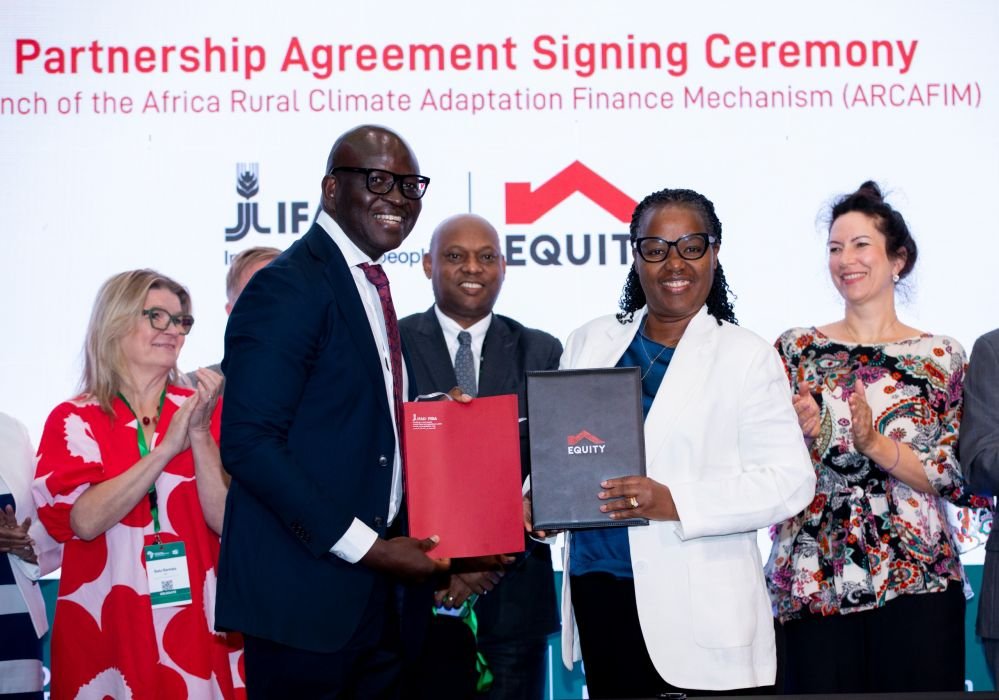
KIGALI — Nearly three years after it was first announced at a UN climate summit, a $200 million climate adaptation financing mechanism for East African smallholder farmers became operational on 4 September 2026, when the International Fund for Agricultural Development and Equity Group formally launched the Africa Rural Climate Adaptation Finance Mechanism at the Africa Food Systems Forum in Kigali.
The gap between the initial announcement and this operational launch is itself informative. IFAD first disclosed ARCAFIM's roughly $200 million funding base at COP28 in Dubai in December 2023, and the Nordic Development Fund provided an early booster grant of EUR 500,000 specifically to help design and structure the mechanism before it could actually begin lending. Blended finance vehicles combining public, concessional and commercial capital across multiple governments, a UN agency and a private bank typically require this kind of multi-year structuring period precisely because the risk-sharing arrangements, taxonomies and institutional agreements involved are genuinely complex to negotiate, a detail worth keeping in mind for anyone assessing how quickly the mechanism can now scale.
How the Money Is Structured
| Component | Amount | Source |
| Lending capital | $180 million | Split evenly between Equity Group and IFAD's co-financiers |
| — Equity Group's share | $90 million | Equity Bank Kenya, Rwanda, Tanzania and Uganda affiliates (own balance sheet) |
| — IFAD's share | $90 million | Green Climate Fund ($55 million), Finland, Nordic Development Fund |
| Technical assistance | ~$20 million | Denmark, Green Climate Fund, other partners |
| Total mechanism size | ~$200 million | |
| Expected loans generated (via ~4 revolving cycles) | ~$266 million | Lent to smallholder farmers and MSMEs over 12 years |
Sources: IFAD; Nordic Development Fund; KT Press; Xinhua.
What distinguishes this structure from a typical donor-funded agricultural lending programme is that Equity Group's $90 million isn't a service fee for administering someone else's money, it's the bank's own capital, placed directly at risk alongside the concessional funding. Credit protection is tranched: international financing partners absorb losses first, a mezzanine layer of risk is shared between the international partners and Equity, and Equity itself carries the senior risk on top of that, the layer most exposed if the portfolio performs well, and the layer that would be hit hardest, after the cushioning tranches are exhausted, if it doesn't.
Why the Tranching Structure Is the Actual Innovation
Development finance mechanisms aimed at smallholder farmers are not new, and blended finance itself, mixing concessional and commercial capital to de-risk lending into markets private capital would otherwise avoid, has been used across African agriculture for years with mixed results. What ARCAFIM's designers are explicitly betting on is that structuring the risk this way, with a commercial bank carrying real exposure rather than acting purely as an administrator, changes the bank's own incentives enough to make the lending genuinely commercially sustainable once the concessional capital runs out.
IFAD Vice President Gérardine Mukeshimana framed that ambition directly: "ARCAFIM's ambition is to make rural climate adaptation a recognizable, viable and sustainable business line for African financial institutions. It will support tailored financial products and a climate adaptation financing taxonomy, so that participating institutions gain the experience, systems and confidence to continue expanding adaptation finance." Equity Group's Group Managing Director, Dr James Mwangi, made the same point in blunter commercial language: "By committing our own balance sheet alongside concessional capital, we are not funding a project, we are building a market, one in which lending climate resilience becomes an ordinary banking business rather than an act of charity."
That's a meaningfully different objective than simply disbursing $200 million in loans over twelve years. The programme's own stated measure of success is "commercial permanence," whether the lending survives as an ordinary business line for African financial institutions long after the concessional capital has been spent, not simply whether the money reaches its 260,000 target beneficiaries during the mechanism's active period.
What the Money Is Actually Meant to Finance
The technical assistance component, roughly $20 million funded by Denmark, the Green Climate Fund and other partners, is built into the mechanism's core design rather than layered on as a separate capacity-building add-on. It's meant to do two things simultaneously: build the capacity of participating microfinance institutions and SACCOs to actually originate adaptation-focused loans, and give farmers and rural enterprises themselves the technical knowledge to identify which investments will genuinely protect them, specifically named categories including irrigation and water harvesting, dairy and livestock resilience, post-harvest storage, renewable energy and climate-resilient agro-processing.
That specificity matters because "climate adaptation finance" as a category can otherwise become vague enough to justify almost any rural lending. Equity Bank Kenya Managing Director Moses Nyabanda described the practical mechanics: "Through ARCAFIM, we will finance smallholder farmers and agricultural producers directly and through microfinance institutions, SACCOs and value chain companies, while extending financing to rural MSMEs." The programme's stated targets, 50% women and 30% youth among beneficiaries, and a food security impact projected to reach 1.2 million people, give the mechanism a set of specific outcomes to be measured against rather than only a total dollar figure disbursed.
Where the Money Will Actually Go
ARCAFIM operates across Kenya, Uganda, Tanzania and Rwanda, chosen specifically as markets already experiencing significant climate stress and where Equity Group has an existing banking and lending infrastructure to build on through its Rwanda, Tanzania and Uganda affiliates. That existing infrastructure is itself part of the mechanism's design logic: rather than building new lending channels from scratch, ARCAFIM is attempting to redirect and expand an already-operating commercial bank's lending capacity toward a specific, underserved category of borrower and use case.
The mechanism's backers were explicit that East Africa is a pilot for a larger continental ambition. Mukeshimana said the model "is starting in East Africa, but it is designed to be adapted and replicated across Africa," and IFAD and Equity Group have already identified Southern and West Africa as the next candidate regions if the East African rollout demonstrates that the commercial-permanence thesis actually holds.
What Would Actually Prove This Worked
The honest measure of ARCAFIM's success won't be visible for years, and it isn't simply whether $266 million in loans eventually gets disbursed. The real test is narrower and harder to fake: whether Equity Group and the microfinance institutions and SACCOs it works with keep originating climate adaptation loans at meaningful volume after the concessional first-loss and mezzanine protections have been drawn down or expired, using their own commercial judgment rather than continued external risk-sharing support. If that happens, ARCAFIM will have demonstrated something genuinely valuable for African agricultural finance: that lending to climate-vulnerable smallholders, properly structured and paired with the right technical assistance, can be a viable line of business rather than a permanent subsidy. If commercial lending volume drops off once the concessional capital and risk protection are gone, the twelve-year mechanism will have proven only that donor-backed lending can reach smallholder farmers while the donor money lasts, a considerably less transformative outcome, and one African agricultural finance has already seen plenty of examples of.
FAQ
What is ARCAFIM? The Africa Rural Climate Adaptation Finance Mechanism, a $200 million, twelve-year blended finance vehicle launched by IFAD and Equity Group on 4 September 2026, designed to expand climate adaptation lending to smallholder farmers and rural businesses across Kenya, Uganda, Tanzania and Rwanda.
Why did it take almost three years to launch after being first announced? ARCAFIM's roughly $200 million funding base was first disclosed at COP28 in December 2023, with the Nordic Development Fund providing early support to design and structure the mechanism, a process that typically takes years for blended finance vehicles combining multiple public, concessional and commercial funding sources with tranched risk-sharing arrangements.
How is the money actually structured? $180 million in lending capital, split evenly between Equity Group's own balance sheet ($90 million) and a matching $90 million channelled by IFAD from the Green Climate Fund, Finland and the Nordic Development Fund, plus roughly $20 million in technical assistance funded by Denmark, the Green Climate Fund and other partners.
What makes this different from typical donor-funded agricultural lending? Equity Group is placing its own capital directly at risk, carrying the senior risk layer in a tranched structure where international partners absorb losses first, rather than simply administering donor funds as an intermediary, a structure explicitly designed to test whether climate adaptation lending can become a genuinely commercial, self-sustaining business line.
Who is this actually meant to reach? The mechanism targets 260,000 smallholder producers and 500 rural micro, small and medium-sized enterprises, with at least 50% of beneficiaries expected to be women and 30% youth, aiming to strengthen food security for approximately 1.2 million people.
Will this expand beyond East Africa? IFAD and Equity Group have identified Southern and West Africa as the next candidate regions for replicating the model, contingent on ARCAFIM demonstrating in East Africa that climate adaptation lending can remain commercially viable once the concessional capital supporting it is spent.
 Uchumi360
Business Intelligence
Uchumi360
Business Intelligence
Uchumi360 covers business, investment, and economic policy across East, Central, and Southern Africa.
For the serious reader
You read to the end. That places you in a small group.
Uchumi360 is built for readers who demand precision over speed, structure over sentiment, and analysis that holds uncomfortable conclusions rather than softening them. If this work sharpens how you think about Africa's economy, help us keep building the infrastructure behind it.
Institutional Partners
Commission intelligence. Shape the conversation.
Uchumi360 works with development finance institutions, investment firms, sovereign bodies, and strategic organisations across the coverage region. Institutional partnership unlocks:
- Commissioned sector and country intelligence reports
- Branded research series under your institution's authority
- Exclusive data briefings for internal strategy teams
- Speaking and editorial presence at Uchumi360 events
- Co-published investment outlooks for your markets
Support Our Work
Independent analysis has a cost. Help us bear it.
Uchumi360 does not carry advertising. It does not take editorial direction from sponsors. Every article is produced without commercial compromise. Your contribution funds the reporting, research, and editorial infrastructure that keeps this analysis free from influence.
Secure checkout: One-time and monthly support are processed securely. Add payment credentials to enable checkout here.
Stay Connected
Keep up with every new insight.
Follow our latest analysis, policy coverage, and market intelligence as soon as it is published. If you need something specific, reach out directly and we will point you to the right research.
