
Tanzania Falls Behind Kenya, Uganda and Rwanda in Africa's Electric Vehicle Race
Ready
Tanzania is surrounded by countries that are rapidly changing how vehicles are imported, financed, manufactured and powered. Kenya has registered more than 50,000 electric vehicles, Uganda sold over 30,000 electric motorcycles in 2025, Rwanda has stopped registering new petrol motorcycle taxis in Kigali, and even Burundi has approved restrictions on petrol car imports from 2027. Tanzania, despite its large transport market and expanding electricity generation capacity, has struggled to develop comparable commercial scale. Research points to inconsistent regulation, limited financing, import costs and a competing national emphasis on natural gas, although Zanzibar's electric bus programme demonstrates that the country is capable of moving differently.
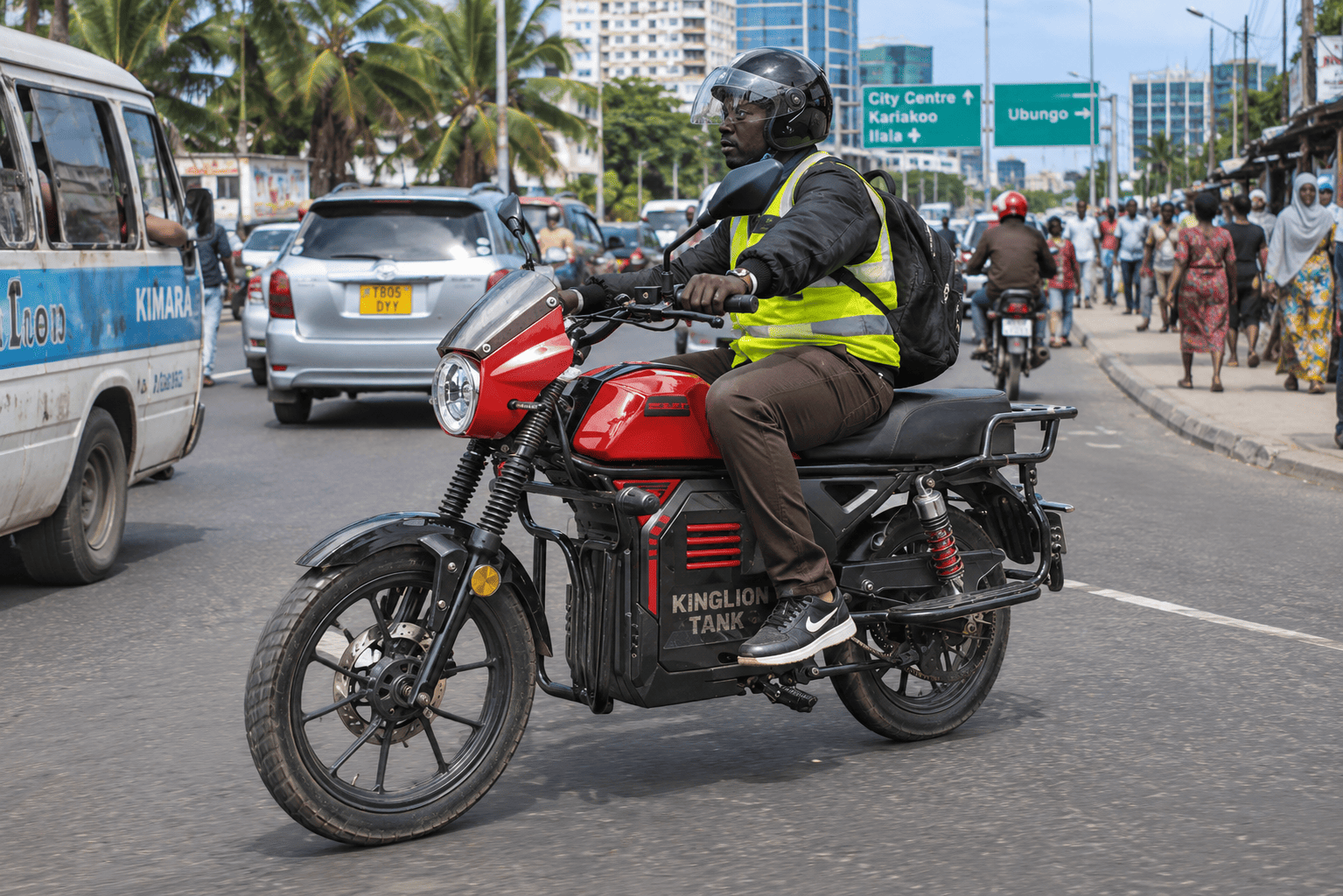
Tanzania is becoming an exception in a regional electric mobility market that is expanding rapidly, as neighbouring Kenya, Uganda and Rwanda introduce policies, financing arrangements and infrastructure that are moving electric motorcycles and buses from demonstration projects into commercial transport. The International Energy Agency's 2026 Global EV Outlook reports that Uganda sold more than 30,000 electric two-wheelers in 2025, while Kenya recorded more than 25,000 sales, accounting for approximately 15% of new motorcycle registrations. Rwanda has gone further in regulatory terms by prohibiting the registration of new petrol-powered motorcycle taxis in Kigali since January 2025. Tanzania, meanwhile, has an emerging electric motorcycle and three-wheeler market but continues to face regulatory uncertainty, limited investment and difficulties establishing the commercial infrastructure necessary to expand adoption.
The differences are especially consequential because Tanzania has many of the conditions that should make electric mobility commercially attractive. It has one of East Africa's largest markets for motorcycles, three-wheelers and other commercial passenger vehicles; a growing electricity system; substantial demand for affordable urban transportation; and an extensive network of small transport operators whose daily earnings are influenced by petrol prices and maintenance costs. Dar es Salaam alone provides a substantial potential market for electric boda bodas, bajajis, delivery motorcycles and buses, while growing cities such as Dodoma, Mwanza, Arusha and Mbeya present additional opportunities. Yet the scale of the market has not translated into investment and adoption comparable with the more developed commercial electric motorcycle markets in Kenya and Uganda.
The explanation is more complicated than the absence of electric vehicles on Tanzanian roads. The Africa E Mobility Alliance estimated in its 2025 industry report that Tanzania had approximately 10,000 electric two and three-wheelers, more than Kenya's estimated 8,421 and Uganda's 3,200 at the time. However, it cautioned that most of Tanzania's estimated fleet consisted of lead acid battery scooters, a different market from the more commercially developed lithium ion electric motorcycle fleets increasingly used by professional riders in neighbouring countries. Those estimates also predate the extraordinary growth recorded in Kenya and Uganda during 2025 and 2026, making them unsuitable as a current ranking of national electric vehicle fleets.
Kenya's Ministry of Roads and Transport reported in November 2026 that the country had registered more than 50,000 electric vehicles by June 2026, predominantly motorcycles, following the formal launch of its National Electric Mobility Policy in February. Uganda has developed a substantial battery swapping network supporting electric commercial motorcycles, while Rwanda has established tax incentives, electricity pricing arrangements and regulatory restrictions intended to accelerate the transition. Burundi, despite possessing a much smaller economy and substantially weaker electricity infrastructure than Tanzania, has adopted legislation requiring certain passenger vehicles ordered for import from January 2027 to be electric or hybrid. The direction of policy across the region suggests that governments increasingly regard vehicle electrification as an issue involving transport costs, fuel import dependence, industrial development and energy policy rather than environmental protection alone. al gas reserves, increasing electricity generation and a large commercial transport sector, has not attracted a comparable level of electric vehicle investment. They also reveal an unusual competition between different national approaches to reducing transport fuel costs. While Kenya, Uganda and Rwanda have concentrated on electric motorcycles and buses, Tanzania has devoted substantial policy attention and investment to compressed natural gas as an alternative to petrol and diesel. Both approaches can reduce dependence on imported petroleum products, but they require different infrastructure, financing arrangements and long term industrial capabilities.
Kenya Has Turned Electric Motorcycles Into a Commercial Financing Market
Kenya's electric vehicle market has expanded through the combination of supportive regulation, dedicated electricity pricing, commercial financing and the rapid growth of companies supplying electric motorcycles to boda boda operators. According to the International Energy Agency, more than 25,000 electric motorcycles were sold in Kenya during 2025, compared with approximately 4,862 in 2024, taking their share of new motorcycle registrations to around 15%. The growth was driven principally by commercial motorcycle operators, whose relatively high daily mileage makes the cost of fuel and maintenance a major consideration when selecting vehicles.
A November 2026 study published by the Africa E Mobility Alliance, Popular Transport and Electrification: Kenya Baseline Study, reported that cumulative electric vehicle registrations increased from 1,378 in 2022 to 39,324 by the end of 2025. Electric two wheelers accounted for 94% of registered electric vehicles, while the country had also registered 168 electric buses and approximately 1,600 electric three wheelers by March 2026. The study estimated that Kenya's popular transport sector includes approximately 1.5 million boda bodas, 70,000 matatus and 55,000 tuk tuks, illustrating the size of the market available to companies capable of providing affordable electric alternatives.
Kenya's expansion has been supported by companies including Spiro, Roam and Ampersand, which have developed vehicle supply, battery swapping infrastructure and financing arrangements designed around the earnings of commercial motorcycle riders. Rather than requiring every rider to purchase a motorcycle and an expensive battery upfront, some companies offer arrangements under which the vehicle is financed separately from the battery, with riders paying for battery access or swaps as they operate. Others work with asset financing institutions to recover vehicle costs through daily or weekly payments, reducing the difficulty of obtaining a conventional bank loan.
These arrangements address an economic constraint affecting many East African transport operators. A motorcycle taxi rider may depend on daily fares to meet fuel, maintenance and loan repayment costs and may not possess the savings required to purchase a substantially more expensive electric motorcycle outright. A lower operating cost therefore provides limited benefit if the initial purchase price remains inaccessible. Financing that follows the operator's cash flow can allow the rider to obtain the vehicle while using savings on fuel and maintenance to support repayment. The International Energy Agency estimates that conventional motorcycle operators in Kenya can spend approximately 40% to 60% of daily earnings on petrol, while electricity costs for commercial electric motorcycles are typically below $2 a day, depending on vehicle use and commercial charging arrangements.
Government policy has reinforced the commercial case. Kenya Power operates a dedicated electric mobility tariff of approximately KSh 16 per kilowatt hour during peak periods and KSh 8 during off-peak periods, although eligibility rules and consumption thresholds apply. The National Electric Mobility Policy, officially launched on February 3, 2026, provides a framework for developing charging infrastructure, promoting investment and coordinating public institutions. The government has also maintained selected tax exemptions for domestically assembled electric vehicles, while the International Finance Corporation signed a cooperation agreement with the State Department for Transport in August 2026 to support implementation of the national policy.
The Kenyan experience demonstrates why electric vehicle adoption cannot be explained solely by the purchase price or availability of electric models. Private companies have developed businesses around vehicle ownership, battery management, maintenance and financing, while the public sector has provided a clearer regulatory framework and electricity pricing arrangements. The market remains exposed to challenges involving charging access, limited financing, import duties on certain vehicle categories and the cost of expanding electricity distribution infrastructure. Nevertheless, the combination has been sufficient to attract investment and expand the number of vehicles operating commercially.
Uganda Has Built a Battery Swapping Industry and Begun Manufacturing Electric Buses
Uganda's electric mobility market has developed even faster in some commercial segments. The International Energy Agency reports that sales of electric two-wheelers exceeded 30,000 during 2025, making Uganda one of Africa's fastest-growing markets for electric motorcycles. The expansion was supported by investment from companies including Spiro, Zembo and Gogo, which developed motorcycle financing arrangements and battery swapping facilities serving commercial riders. The figures relate to electric two-wheeler sales during 2025 and should not be confused with the total number of electric vehicles registered or currently operating in Uganda.
The scale of the supporting infrastructure is also increasing. A World Bank study published in September 2026 reported that Uganda's battery swapping network expanded from approximately 150 stations in mid-2024 to more than 350 by late 2025. The Bank estimated that an electric boda boda could save its operator approximately UGX 1 million, equivalent to about $255, annually compared with a petrol motorcycle, although actual savings depend on vehicle utilisation, energy pricing, maintenance and financing arrangements. The study also identified limitations involving the cost of purchasing vehicles, access to credit, grid connections and uncertainty over the treatment of imports and incentives.
Uganda's strategy is distinguished by its attempt to develop local automotive manufacturing alongside vehicle adoption. Kiira Motors Corporation, supported by the Ugandan government, has developed the Kayoola electric bus programme and established an automotive production facility in Jinja. During 2026, Uganda introduced locally manufactured electric buses into commercial transport services in Kampala and surrounding urban areas. The Uganda Media Centre reported that eight electric buses began operations in May, followed by the launch of another 15 buses serving routes around Kira Municipality later in the year. These deployments remain modest relative to the country's total public transport fleet, but they represent an operational market for vehicles assembled through a domestic manufacturing programme.
The country's industrial ambitions extend beyond the manufacture of complete vehicles. Uganda has pursued battery assembly, charging equipment, training and the development of local suppliers, aiming to capture a greater share of the value associated with vehicle electrification. The government's 2026/27 budget speech reported that Kiira Motors had recorded bus sales worth UGX 21.6 billion and orders for 450 buses from Uganda and regional customers. Orders and production targets should be distinguished from vehicles already delivered, but they indicate the scale of the commercial and industrial ambitions attached to the programme.
The World Bank's analysis also shows that vehicle adoption creates new responsibilities for the electricity sector. Under a moderate expansion scenario, electric vehicles could increase peak electricity demand in Greater Kampala by approximately 99 megawatts without substantial charging coordination, compared with 60 megawatts under better managed charging conditions. The Bank estimated that coordinated charging could reduce the additional annual cost of electricity distribution losses in its model from about $21 million to $10 million. These figures are scenario estimates rather than observed costs, but they demonstrate why large electric vehicle fleets require planning involving utilities, transport authorities, charging operators and electricity regulators.
Uganda's progress is therefore commercially and institutionally relevant to Tanzania. Both countries possess substantial commercial motorcycle markets, growing urban populations and expanding electricity infrastructure, but Uganda has begun connecting vehicle sales, battery services, financing and domestic manufacturing through a more identifiable national programme. Tanzania also shares an electricity interconnection development agenda with Uganda, supported by the World Bank's June 2026 regional power trade initiative, which creates opportunities for cooperation in electricity supply even as the countries pursue different approaches to transport electrification.
Rwanda Has Used Regulation and Electricity Pricing to Accelerate Adoption
Rwanda has pursued a more interventionist approach by introducing regulations intended to direct specific parts of the transport market towards electric vehicles. Since January 2025, Kigali has prohibited the registration of new petrol powered motorcycle taxis, requiring new entrants into that commercial category to use electric models. The restriction does not mean every motorcycle operating in Kigali is already electric, nor does it constitute a nationwide ban on all petrol motorcycles. It is a targeted measure affecting new registrations within a commercially important transport category.
The policy has been supported by other measures intended to reduce the cost of adoption. Rwanda has introduced exemptions and favourable tax treatment for qualifying electric vehicles, arrangements for charging facilities and an electricity tariff cap of RWF 110 per kilowatt hour for electric mobility charging. The Africa E Mobility Alliance's 2026 implementation assessment also identifies government support for land access, charging infrastructure and battery safety rules as part of Rwanda's relatively developed regulatory framework. These measures are intended to make the financial conditions for electric transport more predictable while creating demand for vehicle suppliers and battery service operators.
Companies such as Ampersand have developed battery swapping services for motorcycle taxi operators in Rwanda, allowing riders to exchange depleted batteries rather than waiting for vehicles to recharge. Financing initiatives supported by international development partners have also targeted the additional upfront cost of electric motorcycles, including subsidies and credit guarantees. Rwanda's comparatively small domestic market means that the scale of adoption differs from Kenya and Uganda, but the policy approach demonstrates how government decisions can create a defined market for private investment.
The distinction matters because an investor considering a vehicle assembly facility, charging network or battery service operation needs some confidence that demand will develop over several years. Rwanda's registration restriction provides a direct indication of future demand within Kigali's motorcycle taxi market, while tax incentives and regulated electricity pricing help companies estimate operating costs. The approach also involves economic risks, particularly where riders cannot afford qualifying vehicles or charging and battery services fail to expand sufficiently. Nevertheless, Rwanda has established a clearer direction for commercial electrification than Tanzania's more fragmented arrangements.
Burundi, Malawi and Mozambique Are Changing Tax Rules Even Without Large EV Fleets
The regional comparison becomes more revealing when countries with smaller markets and weaker infrastructure are considered. Burundi's 2026/27 Finance Law introduces exemptions for electric vehicles and related equipment and, under Article 221, requires certain passenger cars and jeep type vehicles ordered for import from January 1, 2027 to be electric or hybrid. The requirement does not apply to every vehicle category, and the law provides exceptions for specified institutions. According to a November 2026 policy brief by the Africa E Mobility Alliance, qualifying electric vehicles receive exemptions from import duty, value added tax and excise duty, while hybrid vehicles remain subject to a customs duty of 25%.
Burundi's decision is economically unusual because the country faces substantial electricity access constraints and recurring shortages of petroleum products. Its policy is motivated partly by the desire to reduce the cost of importing fuel, which exposes the economy to foreign exchange shortages and international price fluctuations. The Africa E-Mobility Alliance estimates that Burundi imported approximately $255.8 million in mineral fuels in 2023, equivalent to 22% of its total imports and approximately 68% of exports of goods and services. These figures provide context for the government's willingness to adopt an unusually restrictive vehicle import policy despite the country's relatively limited charging infrastructure.
However, Burundi's legislation should not be confused with evidence that it has achieved higher electric vehicle adoption than Tanzania. Available reporting indicated that the country had only a few hundred electric and hybrid vehicles by May 2026, and the policy brief itself identifies major uncertainties concerning charging infrastructure, battery standards, implementation and the affordability of qualifying vehicles. Burundi has established an aggressive future policy direction, but the commercial results remain to be demonstrated.
Malawi has taken a different approach through fiscal incentives. Its 2023/24 budget removed import duties and certain taxes on electric vehicles and charging equipment, while subsequent measures extended relief to electric motorcycles. These decisions indicate that the government has sought to reduce the cost of adopting electric vehicles, partly to address petroleum import dependence and related foreign exchange pressures. However, reliable national statistics demonstrating commercial adoption comparable with Kenya or Uganda are not readily available, and the existence of tax incentives alone is insufficient to establish that Malawi's electric vehicle market has expanded faster than Tanzania's.
Mozambique has also moved to change import taxation. Legislation approved in late 2025 and implemented from January 2026 removed the previous 20% customs duty on vehicles powered exclusively by electric motors, while additional tax reforms reduced the excise burden on selected electric vehicles. Finance Minister Carla Loveira presented the customs exemption as part of efforts to encourage cleaner transport and reduce barriers to adoption. Mozambique nevertheless remains an early stage electric vehicle market, and available national vehicle statistics do not provide sufficient evidence to conclude that it has achieved a higher adoption rate than Tanzania.
Zambia has similarly introduced incentives for qualifying electric vehicles and components, while pursuing discussions on electric bus deployment. In December 2025, the Zambian government announced plans to work with Uganda on the introduction of electric buses after officials inspected and tested a Kiira Motors vehicle. This suggests increasing policy interest and potential regional industrial cooperation, but it does not establish that a large electric bus fleet has been deployed or that Zambia currently leads Tanzania in adoption.
The Democratic Republic of Congo presents another distinct case. Its principal attraction to electric mobility investors includes its large motorcycle transport market, extensive population and position within the global supply chain for battery minerals. Spiro identified the DRC among the markets it intended to enter following a $215 million financing announcement in June 2026, while local companies have introduced electric motorcycles and vehicle assembly initiatives in Kinshasa and other cities. The DRC remains at an early stage of commercial deployment, however, and investment announcements should be distinguished from motorcycles actually sold, charging facilities constructed and vehicles operating on public roads.
These differences demonstrate why Tanzania's position cannot be accurately described as falling behind every neighbouring country in actual electric vehicle adoption. Kenya and Uganda have clear evidence of rapidly expanding commercial sales, Rwanda has introduced a more directive regulatory framework, and Burundi has adopted an ambitious import policy that has yet to take effect. Malawi, Mozambique, Zambia and the DRC have taken various policy or investment steps, but the available evidence is insufficient to establish that all four have larger or faster growing operational electric vehicle markets than Tanzania.
Tanzania's Problem Is Increasingly About Regulation, Financing and Commercial Scale
Research conducted by the Africa E Mobility Alliance, with support from UN Habitat and the Urban Electric Mobility Initiative, identifies several obstacles affecting Tanzania's electric mobility industry. Its report, Barriers to E Mobility in Tanzania, documents inconsistent treatment of electric vehicles by customs and registration authorities, uncertainty concerning applicable standards, high import costs, limited access to investment capital and inadequate coordination among institutions responsible for transport, taxation, standards and electricity. The research drew on consultations with Tanzanian companies and public institutions, including the Tanzania Revenue Authority, Tanzania Bureau of Standards, TANESCO and Dar es Salaam Rapid Transit.
The report records cases in which companies experienced difficulty registering electric vehicles or obtaining licence plates and insurance, while others faced import charges exceeding 50% of the value of their products. It also documented uncertainty concerning customs classifications for batteries, electric motorcycles and imported vehicle components. These findings are important because an electric vehicle supplier must be able to establish the total landed cost of its products before committing capital, setting prices or offering financing to customers. Where the tax treatment changes according to the classification applied or the interpretation of individual officials, companies face additional uncertainty that can undermine their willingness to invest in assembly, distribution and charging infrastructure.
The regulatory situation has evolved since the original research. Tanzania's 2023 amendments to the Motor Vehicle Registration and Transfer Tax legislation recognised electric vehicle categories, while subsequent regulations gazetted in June 2025 established registration fees for different classes of electric vehicles. The Energy and Water Utilities Regulatory Authority also published guidelines for electric mobility charging stations and battery swapping in April 2026. These developments mean it would be inaccurate to describe Tanzania as having no laws or rules addressing electric vehicles. The more specific difficulty concerns the absence of a sufficiently coordinated national market development strategy and continued problems implementing existing rules.
Reporting by The Citizen in February 2026 documented concerns that some electric motorcycles and three wheelers operating in Dar es Salaam and Arusha remained unregistered despite the existence of legal provisions governing their registration. The report identified uncertainty among operators and distributors, as well as difficulties concerning licensing, safety and enforcement. Some electric vehicle businesses reported completing registration successfully, while others continued encountering delays. The difference indicates that Tanzania's problem cannot be reduced to the legal recognition of electric vehicles; it also involves consistent administrative procedures and clear responsibilities for the institutions required to apply them.
Financing presents another substantial constraint. The Africa E Mobility Alliance's Tanzania study found that companies operating in the sector had secured only slightly more than $1 million in funding at the time of its assessment, compared with more than $5 million in Uganda and $50 million in Kenya. These figures describe historical funding conditions rather than current national investment totals and should not be used as a definitive ranking for November 2026. They nevertheless illustrate the financing gap that confronted Tanzanian firms during the market's early development. The report also identified shortages of trained technicians, limited access to suitable vehicles and weak customer awareness as obstacles restricting the expansion of electric transport businesses.
The investment consequences have become visible in decisions made by regional companies. In June 2026, The EastAfrican reported that Spiro had prioritised expansion into Ethiopia and the Democratic Republic of Congo over the full commercial rollout previously announced for Tanzania. Raymond Kitunga, the company's deputy country head for Kenya, attributed the decision partly to the absence of a sufficiently developed national electric mobility policy and weaker market readiness in Tanzania. The company had previously announced plans involving battery swapping stations, local assembly and collaboration with youth organisations, but the full programme had not materialised at the time of the report.
The comments are commercially revealing because electric vehicle companies require several connected investments before customers can adopt their products at scale. A motorcycle supplier may need battery swapping facilities before riders are willing to purchase vehicles, while swapping stations require sufficient motorcycle demand to operate profitably. Lenders need confidence that vehicles can be registered, insured, maintained and resold if borrowers default. Electricity companies must understand where charging demand will arise and what infrastructure is required to serve it. Without coordination, each participant may delay investment while waiting for the others to establish the conditions necessary for the market to function.
Tanzania's relatively large transport market does not automatically resolve this problem. It creates demand potential, but the conversion of that potential into a commercially attractive investment proposition depends on predictable regulation, financing arrangements and an effective network of suppliers and service providers.
Natural Gas Has Become Tanzania's More Visible Transport Energy Strategy
Tanzania's slower electric vehicle expansion also needs to be examined alongside its considerable investment in compressed natural gas. Unlike Kenya and Rwanda, Tanzania possesses commercially developed domestic natural gas resources, including production from Songo Songo and Mnazi Bay. The government has promoted the use of natural gas in vehicles as a means of reducing the cost of transport, creating additional domestic demand for Tanzanian energy resources and lowering dependence on imported petrol and diesel.
The strategy has produced measurable results. The Bank of Tanzania's October 2026 Consolidated Zonal Economic Performance Report recorded an increase in the number of vehicles using compressed natural gas from approximately 7,000 in 2024/25 to 16,354 in 2025/26. Other official statements during 2026 referred to more than 20,000 vehicles using natural gas, although differences in reporting periods, vehicle categories and definitions mean those figures should not be treated as directly interchangeable. The government and private investors have also expanded refuelling stations and vehicle conversion facilities, particularly in Dar es Salaam, with additional projects planned or under development in Morogoro, Dodoma and other locations.
The economic logic of compressed natural gas differs from that of electric mobility. Tanzania produces natural gas domestically and can use it directly as a transport fuel after appropriate processing and distribution, while electric vehicles rely on electricity generated through a mixture of natural gas, hydropower and other sources. Both approaches can reduce the amount of imported petrol or diesel consumed by transport operators, although their relative costs, emissions and infrastructure requirements differ. Natural gas remains a fossil fuel, while electric vehicles produce no tailpipe emissions and their wider environmental benefits depend partly on how electricity is generated and how batteries are manufactured and managed.
The availability of domestic natural gas creates a commercial reason for Tanzania to support compressed natural gas vehicles, particularly where conversions allow existing petrol vehicles to continue operating with lower fuel costs. Converting a vehicle may also be financially easier than replacing it with a new electric model, depending on the vehicle, installation cost and availability of refuelling facilities. For taxi operators and owners of existing vehicles, this can make natural gas an attractive immediate option.
However, the development of compressed natural gas does not inherently prevent investment in electric motorcycles or buses. The two technologies can serve different transport categories, and a diversified transport energy strategy could support both. Electric motorcycles may be particularly competitive for riders travelling predictable daily distances with access to battery swapping, while compressed natural gas can offer a lower cost fuel alternative for owners of existing petrol vehicles. Electric buses may be suitable for organised urban routes where fleet operators can finance vehicles and operate centralised charging depots, while the economics of gas powered vehicles may differ according to their size, routes and fuel consumption.
The policy question for Tanzania is whether support for natural gas has become the practical default for reducing transport fuel dependence while electric mobility remains without a comparably coordinated commercial development programme. The existence of a successful natural gas conversion industry does not demonstrate that the government has deliberately excluded electric vehicles. It does suggest that investors in the two sectors are operating within different levels of policy attention, financing coordination and supporting infrastructure.
Zanzibar Is Already Demonstrating a Different Tanzanian Approach
The most important domestic qualification to Tanzania's slower electric mobility development is Zanzibar, which began operating its first electric public bus service in 2026. President Hussein Ali Mwinyi officially launched the ZanBus programme on July 23, with an initial fleet of 15 electric buses serving two corridors between Stone Town, the international airport, Chukwani and Buyu. The project is financed through an arrangement involving the Zanzibar Social Security Fund and private sector partners, with the buses supplied by India's EKA Mobility. The programme includes charging infrastructure, terminal development and a digital fare payment system.
The Zanzibar government has outlined ambitions to expand the service substantially, ultimately targeting a fleet of 500 electric buses. Those figures are policy targets rather than vehicles already in operation, and the programme's financial performance will depend on passenger demand, fleet utilisation, fares, maintenance and the cost of electricity and financing. The initial rollout also encountered operational challenges, including shortages of passenger cards, long waiting times and limited bus availability, illustrating the difficulties of introducing a new transport system even when vehicles and charging infrastructure have been secured.
Nevertheless, the project is relevant because it demonstrates that Tanzanian institutions can organise electric public transport through coordinated financing, fleet procurement and infrastructure planning. Zanzibar's relatively compact geography, high concentration of passenger movement and dependence on imported liquid fuels make it a distinct market from mainland Tanzania, but its experience provides a practical example of how a public institution can establish an initial fleet and supporting operating arrangements.
Dar es Salaam presents a substantially larger opportunity because of its population, extensive network of daladalas, boda bodas and bajajis, and the existence of an organised bus rapid transit system. However, the commercial structure is more complicated. Large numbers of vehicles are owned by individuals or small operators, while routes, financing and operational arrangements differ across the sector. Electrification would therefore require financing arrangements suited to different categories of owners, charging or swapping locations close to operating routes and coordination with existing transport regulations.
The Zanzibar experience also highlights the difference between purchasing electric vehicles and establishing an operational transport service. A fleet requires maintenance, spare parts, trained technicians, predictable electricity supply, ticketing arrangements and sufficient passenger revenue to support operating costs. The success of electrification should therefore be assessed through actual vehicle availability, passenger numbers, costs and financial performance rather than announced fleet targets alone.
Tanzania Could Lose More Than Vehicle Sales as Regional Manufacturing Expands
The economic consequences of slower electric vehicle adoption extend beyond the number of vehicles operating on Tanzanian roads. Kenya and Uganda are attracting investment in vehicle assembly, charging equipment, batteries, maintenance services, software systems and financing products, creating opportunities for domestic suppliers and technical employment. As these industries grow, companies are likely to make investment decisions based on existing production facilities, the availability of skilled workers, market size, supplier relationships and the stability of government policy.
Tanzania has the potential to participate in these activities because of its domestic transport market, industrial infrastructure, access to ports and regional trading position. Dar es Salaam could support the importation and assembly of electric motorcycles and components for domestic use and neighbouring markets, while industrial areas in Pwani, Morogoro and other regions could accommodate supporting manufacturing and maintenance activities. However, the commercial viability of such investments will depend on costs, demand, finance and predictable regulation rather than the availability of industrial land or policy announcements alone.
The country's wider mineral and energy resources provide additional opportunities, but they should be treated separately from vehicle assembly. Tanzania possesses deposits of graphite and other minerals relevant to battery supply chains, while domestic electricity generation can support charging and industrial processing. Developing a battery manufacturing industry, however, requires substantial capital, technology, specialised skills, reliable electricity and access to international markets. The presence of minerals does not automatically establish that battery cell manufacturing would be commercially competitive in Tanzania.
An electric motorcycle assembly programme may therefore be a more immediate industrial opportunity than attempting to establish a complete battery manufacturing industry. Firms could initially concentrate on importing components, assembling vehicles, adapting products to local operating conditions and developing maintenance capabilities, while expanding local production where scale and costs justify it. The same principle applies to battery swapping services, where commercially viable operations require a large enough fleet to recover investment in batteries, charging equipment and station infrastructure.
The regional experience indicates that financing is likely to determine whether these opportunities materialise. Vehicle manufacturers and battery service companies need working capital and long term investment, while riders and small transport operators require affordable means of acquiring vehicles. Partnerships involving banks, specialised asset financiers, development finance institutions and established transport operators could reduce some of these constraints, although lenders will need reliable vehicle registration, insurance, service support and mechanisms for managing credit risk.
A National Electric Mobility Strategy Would Need to Begin With Commercial Transport
The evidence from Kenya, Uganda and Rwanda suggests that the earliest large scale opportunities in Tanzania are more likely to emerge in commercial motorcycles, three wheelers and organised bus fleets than in the immediate replacement of privately owned passenger cars. Commercial vehicles generally operate more frequently than privately owned cars, allowing the financial benefits of lower energy and maintenance costs to accumulate more quickly. Their routes and operating patterns can also make it easier to locate battery swapping stations and charging depots where demand is concentrated.
For electric boda bodas, the central issue is whether the cost of purchasing or financing a vehicle, together with battery access charges, is lower than the cost of acquiring and operating a comparable petrol motorcycle over the repayment period. A commercially viable model must include vehicle purchase costs, financing charges, batteries, maintenance, insurance, registration, downtime and eventual replacement. Fuel savings are relevant, but they cannot be evaluated independently of the overall ownership arrangement.
For electric bajajis, Tanzania already has an emerging market that could support greater expansion. Three wheelers are widely used for urban passenger transport, cargo delivery and short distance trips, while some operators travel predictable routes over substantial distances each day. Dedicated charging facilities and financing arrangements could improve the commercial case, particularly where vehicles are operated intensively and electricity is priced competitively. However, the durability of batteries, the availability of spare parts and the ability to repair vehicles locally will influence whether owners are willing to replace familiar petrol models.
Bus electrification involves different considerations. An organised operator can potentially charge vehicles at a central depot, negotiate electricity supply arrangements and plan routes according to battery range and charging requirements. However, electric buses generally require greater upfront investment than conventional alternatives, making financing, fleet utilisation and operating revenue crucial. Zanzibar's programme demonstrates one approach involving institutional investment, while Kenya's BasiGo model and Uganda's Kiira Motors programme provide different examples of private fleet financing and domestic manufacturing.
A practical Tanzanian strategy would therefore need to establish clear institutional responsibilities, predictable customs treatment, safety and battery standards, functioning registration and insurance procedures, and a coordinated approach to charging infrastructure and electricity pricing. It would also need to address the economic incentives facing transport operators rather than assuming that the environmental benefits of electric vehicles are sufficient to create demand.
The existing work by EWURA on charging and battery swapping guidelines provides a starting point, while the legal recognition of electric vehicles in registration regulations creates an administrative foundation. The next challenge involves ensuring that the different institutions responsible for transport, energy, taxation, standards, investment and licensing apply compatible rules and provide investors with sufficient clarity to commit capital.
Tanzania's Delay Is Becoming an Industrial and Economic Policy Question
The evidence from neighbouring countries indicates that electric mobility is increasingly being treated as a commercial transport industry rather than an isolated technology initiative. Kenya has demonstrated how financing, battery swapping and electricity pricing can support rapid motorcycle adoption. Uganda has expanded commercial electric motorcycles while investing in domestic bus manufacturing and the supporting electricity infrastructure. Rwanda has created a regulatory direction for motorcycle taxis, while Burundi is preparing a major intervention in its passenger vehicle import market. Malawi, Mozambique, Zambia and the DRC are developing incentives or investment programmes at different stages of maturity, although they have not all achieved comparable commercial adoption.
Tanzania is operating within the same regional market, with substantial demand for affordable transport and an expanding electricity system. Its slower development of commercially financed electric motorcycles and larger electric vehicle fleets cannot be explained simply by a lack of suitable geography or technology. Research identifies specific constraints involving policy coordination, customs treatment, registration, standards, financing, customer awareness and technical capacity. Those constraints affect whether companies can establish supply networks, whether lenders can finance vehicles and whether operators can achieve sufficient savings to justify adoption.
The country's investment in compressed natural gas provides a rational response to the availability of domestic energy resources and the cost of imported petroleum products. However, natural gas and electricity offer different opportunities within the transport sector, and the growth of one does not eliminate the potential economic value of the other. Tanzania's infrastructure and energy advantages could support a broader strategy covering both technologies, with commercial choices determined by operating costs, vehicle categories and the availability of suitable services.
Zanzibar's electric bus programme demonstrates that domestic institutions are already capable of pursuing electrification when financing, procurement and operational responsibilities are coordinated. The wider challenge is whether mainland Tanzania can establish comparable conditions for private businesses and commercial transport operators across a much larger and more varied market.
As Kenya and Uganda continue expanding electric motorcycle fleets and attracting assembly and battery investment, the cost of delayed policy coordination for Tanzania may increasingly be measured through investment decisions made elsewhere in the region. The country has the transport demand, electricity resources and commercial scale to participate in the transition. Whether it captures the associated investment, manufacturing and operating opportunities will depend on how quickly its institutions establish the conditions that allow businesses and transport operators to adopt the technology competitively.
 Uchumi360
Business Intelligence
Uchumi360 covers business, investment, and economic policy across East, Central, and Southern Africa.
For the serious reader
You read to the end. That places you in a small group.
Uchumi360 is built for readers who demand precision over speed, structure over sentiment, and analysis that holds uncomfortable conclusions rather than softening them. If this work sharpens how you think about Africa's economy, help us keep building the infrastructure behind it.
Institutional Partners
Commission intelligence. Shape the conversation.
Uchumi360 works with development finance institutions, investment firms, sovereign bodies, and strategic organisations across the coverage region. Institutional partnership unlocks:
- Commissioned sector and country intelligence reports
- Branded research series under your institution's authority
- Exclusive data briefings for internal strategy teams
- Speaking and editorial presence at Uchumi360 events
- Co-published investment outlooks for your markets
Support Our Work
Independent analysis has a cost. Help us bear it.
Uchumi360 does not carry advertising. It does not take editorial direction from sponsors. Every article is produced without commercial compromise. Your contribution funds the reporting, research, and editorial infrastructure that keeps this analysis free from influence.
Secure checkout: One-time and monthly support are processed securely. Add payment credentials to enable checkout here.
Stay Connected
Keep up with every new insight.
Follow our latest analysis, policy coverage, and market intelligence as soon as it is published. If you need something specific, reach out directly and we will point you to the right research.
