
Kenyans Need Nearly Double the Money Ethiopians Do to Feel Satisfied

Ready
Remitly's 2026 income satiation analysis, built on Purdue University research and adjusted for local purchasing power, puts Ethiopia's "peak happiness" threshold at $10,176 a year, the lowest of 123 countries studied worldwide, while Kenya sits at $18,929, nearly double. Tanzania falls in between at $16,622, close to Madagascar ($16,642) and just below Uganda ($17,662). The figure measures income satiation, the point where more money stops producing meaningful gains in reported life satisfaction, not a poverty line, an average salary, or a happiness ranking; a low number doesn't mean people there live better. The most counterintuitive finding is regional: Djibouti ($25,811) and Comoros ($25,772), small economies with little industrial base, need more income to hit that ceiling than South Africa ($22,172), the continent's most diversified major economy, evidence that the number tracks local cost of living as much as it tracks anything about income itself.
NAIROBI — An Ethiopian earning $10,176 a year has, statistically, reached the point where more money stops meaningfully improving how satisfied they say they are with life. A Kenyan needs $18,929 to reach the same point, nearly double. That's the core finding in a 2026 analysis by remittance company Remitly, built on Purdue University's global income satiation research and adjusted for local purchasing power and inflation, comparing 123 countries worldwide.
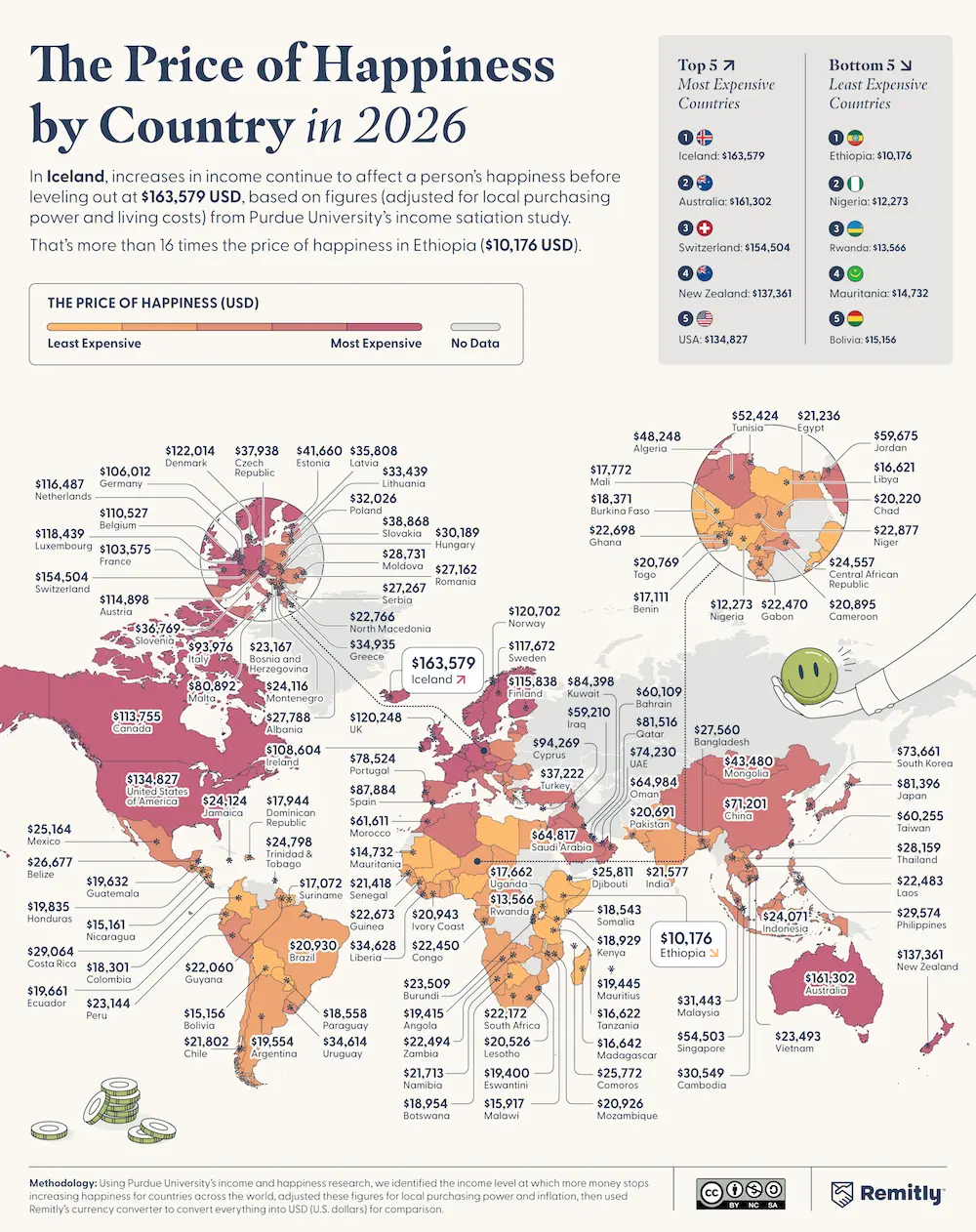 Global chart showing the price of happiness worldwide.
Before going further: this is not a happiness ranking, and it does not mean Ethiopians are better off than Kenyans. It measures income satiation, the income level at which additional earnings start producing sharply diminishing returns on reported life satisfaction. It is not a poverty line, a living wage, or an average salary. A country can post a low number here and still have most of its population living on far less than that threshold. Keep that in mind, and the regional comparison gets genuinely interesting.
East Africa's Full Ranking
| Country | Annual Threshold (USD) |
| Ethiopia | $10,176 |
| Rwanda | $13,566 |
| Malawi | $15,917 |
| Tanzania | $16,622 |
| Madagascar | $16,642 |
| Uganda | $17,662 |
| Somalia | $18,543 |
| Kenya | $18,929 |
| Mauritius | $19,445 |
| Mozambique | $20,926 |
| South Africa | $22,172 |
| Zambia | $22,494 |
| Burundi | $23,509 |
| Comoros | $25,772 |
| Djibouti | $25,811 |
Source: Remitly, "The Price of Happiness by Country in 2026," based on Purdue University income satiation research.
Ethiopia's $10,176 isn't just the region's lowest. It's the lowest of all 123 countries Remitly's analysis covers worldwide, more than 16 times lower than Iceland's $163,579, the global maximum. That gap says more about purchasing power and price levels than about anything resembling wellbeing: $10,176 in Addis Ababa buys a fundamentally different basket of goods than $10,176 in Reykjavik, which is the entire point of adjusting for local cost of living in the first place.
The Number That Should Actually Surprise You
Kenya's position near the top of the East African range makes intuitive sense; Nairobi is one of the region's most expensive cities, and housing, transport and school fees eat a large share of household income there. What doesn't fit the obvious story is Djibouti and Comoros.
Both sit above South Africa, $25,811 and $25,772 respectively against South Africa's $22,172, despite South Africa having by far the largest, most industrially diversified economy in the comparison, a $480 billion economy with deep financial markets, manufacturing and mining sectors that neither Djibouti nor Comoros comes close to matching. That's not a contradiction in the data. It's the data doing exactly what it's designed to do: tracking what things actually cost locally, not how large or sophisticated the surrounding economy is. Small, import-dependent economies with limited domestic production, like Djibouti and Comoros, often carry higher relative price levels for the goods people actually buy, even when average incomes are far lower than South Africa's.
Where Tanzania Sits, and Why the Middle Is the More Useful Story
Tanzania's $16,622 sits almost exactly between Ethiopia's floor and Kenya's regional high point, roughly 63% above Ethiopia, 12% below Kenya, and nearly identical to Madagascar's $16,642. That middle position is more analytically useful than either extreme, because it shows the number moving with cost structure rather than with any single national story about growth or poverty. Uganda, at $17,662, sits close enough to Tanzania that the two economies' cost environments look more alike than either country's GDP growth headlines would suggest.
The Real Question This Data Raises
The more useful question this dataset raises for East African policymakers isn't how to raise incomes. Every government in the region is already trying to do that. It's whether growth in income is being matched, or outpaced, by growth in the cost of the things households can't avoid buying: housing, transport, electricity, food, healthcare, education. A country can grow its GDP steadily while its income satiation threshold rises just as fast, leaving households no better off in terms of what their earnings actually buy.
That's the uncomfortable implication sitting underneath a dataset that looks, on its surface, like a curiosity. The price of happiness isn't really about income. It's about what income can purchase, and in East Africa, that number moves a lot faster between neighbouring economies than most people assume.
FAQ
Does this mean Ethiopians are happier than Kenyans? No. The figure measures income satiation, the income level where more money stops producing meaningful gains in reported life satisfaction, not actual happiness levels, living standards, or wellbeing rankings between countries.
Why is Ethiopia's threshold the lowest in the world? Because the analysis adjusts for local purchasing power and cost of living, and prices for goods and services in Ethiopia are considerably lower than in high-income countries, meaning a smaller dollar figure goes further locally.
Why do Djibouti and Comoros have higher thresholds than South Africa? Because the measure tracks local cost of living rather than the overall size or sophistication of an economy. Small, import-dependent economies like Djibouti and Comoros often carry higher relative prices for everyday goods, even though their overall economies are far smaller than South Africa's.
Where does Tanzania rank regionally? Almost exactly in the middle: $16,622, above Ethiopia, Rwanda and Malawi, but below Uganda, Kenya, Somalia and Mauritius, and nearly identical to Madagascar.
Is this the same as a poverty line or average salary? No. It's a statistical estimate of where additional income stops meaningfully improving reported life satisfaction. Most people in every country studied, including wealthy ones, earn well below their country's threshold.
What's the actual takeaway for East African economic policy? That raising incomes alone doesn't guarantee better living standards if the cost of essential goods, housing, transport, food, healthcare, rises just as fast. The more useful policy question is whether growth in earnings is outpacing or merely matching growth in the cost of living.
 Uchumi360
Business Intelligence
Uchumi360
Business Intelligence
- Remitly, "The Price of Happiness by Country in 2026," 2026, based on Purdue University income satiation research (Jebb, Tay, Diener & Oishi), adjusted for local purchasing power and inflation using Remitly's currency conversion methodology
- Primary source for all country-level thresholds cited in this piece
Uchumi360 covers business, investment, and economic policy across East, Central, and Southern Africa.
For the serious reader
You read to the end. That places you in a small group.
Uchumi360 is built for readers who demand precision over speed, structure over sentiment, and analysis that holds uncomfortable conclusions rather than softening them. If this work sharpens how you think about Africa's economy, help us keep building the infrastructure behind it.
Institutional Partners
Commission intelligence. Shape the conversation.
Uchumi360 works with development finance institutions, investment firms, sovereign bodies, and strategic organisations across the coverage region. Institutional partnership unlocks:
- Commissioned sector and country intelligence reports
- Branded research series under your institution's authority
- Exclusive data briefings for internal strategy teams
- Speaking and editorial presence at Uchumi360 events
- Co-published investment outlooks for your markets
Support Our Work
Independent analysis has a cost. Help us bear it.
Uchumi360 does not carry advertising. It does not take editorial direction from sponsors. Every article is produced without commercial compromise. Your contribution funds the reporting, research, and editorial infrastructure that keeps this analysis free from influence.
Secure checkout: One-time and monthly support are processed securely. Add payment credentials to enable checkout here.
Stay Connected
Keep up with every new insight.
Follow our latest analysis, policy coverage, and market intelligence as soon as it is published. If you need something specific, reach out directly and we will point you to the right research.
